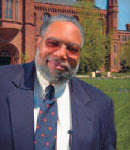
Lonnie G. Bunch III, Founding Director of the NMAAHC ~ American History


Celebrating Our American Story

Portrait of Dr. Carter G. Woodson

Dr. Carter G. Woodson, 1940s. Scurlock Studio Records, Archives Center, National Museum of American History, Smithsonian Institution.

It’s Black History Month; 28 days to recognize and celebrate some of the African Americans who have influenced, improved, and shaped our country.

In support of this tradition, I’d like to tell you about Carter G. Woodson, the visionary who first created Negro History Week in February 1926.

Woodson was an impressive scholar, the second African American to receive a Ph.D. in history from Harvard (W.E.B. Du Bois was the first). He was passionate about African American history and, by 1916, he had established the Association for the Study of Negro Life and Culture, an organization whose goal was to make black history accessible to a wider audience.

Ten years later, Woodson created Negro History Week to ensure that schoolchildren be exposed to black history. He believed Negro History Week—which became Black History Month in 1976—would be a vehicle for empowerment.

Today, Carter G. Woodson’s vision for black history as a means of pride and empowerment is as relevant as ever. While Black History Month has evolved from its roots, it is still a catalyst for change … and it is still needed to highlight the contributions, achievements, and continued progress of African Americans in our country.

The National Museum of African American History and Culture tells stories like Carter G. Woodson’s all year long. And during this special month of celebration and recognition, you’re invited to learn more about Carter G. Woodson and other African American individuals, groups, and moments that helped build our nation:

Tuskegee Airmen Tuskegee Airmen

From the early days of World War I, African Americans wanted to serve as pilots in the Army Air Force, but were repeatedly denied because of their race—until these patriotic Americans served with heroic success.Learn more about the Tuskegee Airmen.

America Sees the Truth America Sees the Truth

The 16th Street Baptist Church bombing, in which four young girls were killed, has been called a turning point of the civil rights movement. Learn more about how the 16th Street Baptist Church bombing awakened a complacent nation.

The Harlem Renaissance The Harlem Renaissance

The Great Migration drew to Harlem some of the greatest minds and brightest talents of the day. Between the end of World War I and the mid-1930s, they produced one of the most significant eras of cultural expression in the nation’s history. Learn more about the new spirit of self-determination, pride, and activism that came from the Harlem Renaissance.

Mahalia Jackson Mahalia Jackson: Gospel Takes Flight

“A voice like hers comes along once in a millennium.” That’s what Dr. Martin Luther King Jr. once said of legendary gospel singer Mahalia Jackson. Learn more about this iconic singer’s life and how she changed the future of music in America.

Autherine Lucy An Indomitable Spirit: Autherine Lucy

Despite determination and courage, many African Americans’ journeys along the road to equality did not end in a clear victory, but their stories helped shape our country and must be told. Learn more about Autherine Lucy’s long battle to attend the University of Alabama.

Read our full collection of stories, available worldwide on our award-winning website.
All the best,
DD YE year end 1 signature
Lonnie G. Bunch III
Founding Director

P.S. Our nation has been shaped by many brave African American heroes, visionaries, and leaders—including those whose stories have not been told until now. These stories remind us that history never stands still, but keeps marching forward. Thank you for your support. I hope you will consider joining as a Member or making a donation today.

Join

Marian Anderson, 2014.150.10.1. Collection of the Smithsonian National Museum of African American History and Culture, © Estate of Lloyd W. Yearwood

Rosa Parks, 2016.116.5. Collection of the Smithsonian National Museum of African American History and Culture, Gift of Roderick Lyons, © Roderick Lyons

Former President Barack Obama by Tony Powell/NMAAHC

Martin Luther King Jr., 2015.245.4. Collection of the Smithsonian National Museum of African American History and Culture

Building by Alan Karchmer/NMAAHC

The body of the PT-13D Stearman Kaydet aircraft in NMAAHC. Photo by Alan Karchmer/NMAAHC.

Stained glass rosette shared from the 16th Street Baptist Church in Birmingham, Alabama. Collection of the Smithsonian National Museum of African American History and Culture, Gift of the Family of Rev. Norman C. “Jim” Jimerson and Melva Brooks Jimerson. 2013.138a-c.

Photograph of Louis Armstrong recording at the CBS Studio in New York. Collection of the Smithsonian National Museum of African American History and Culture. 2014.63.92ab.

Mahalia Jackson with Dr. Martin Luther King, Jr. Collection of the Smithsonian National Museum of African American History and Culture, Gift of Paul and Claire Blumenfeld. 2014.141.3

Rosa Parks, Eleanor Roosevelt, and Mrs. H.C. Foster (Autherine Lucy), prior to civil rights rally at Madison Square Garden, New York City. Library of Congress, LC-USZ62-111444.