

Mother (Nettie Hunt) and daughter (Nickie) sit on the steps of the Supreme Court building on May 18, 1954, the day following the Court’s historic decision in Brown v. Board of Education. Nettie is holding a newspaper with the headline, “High Court Bans Segregation in Public Schools.” Reproduction courtesy of Corbis Images
Monthly Archives: May 2022

1980 – Rioting erupted in Miami’s Liberty City neighborhood after an all-white jury in Tampa acquitted four former Miami police officers of fatally beating black insurance executive Arthur McDuffie. Eight people were killed in the rioting.
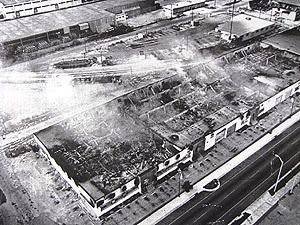
Burning Buildings, Liberty City Riot, 1980Fair use image
The 1980 race riots in Miami’s Liberty City and Overtown neighborhoods was sparked after the acquittal of four White Miami-Dade police officers who beat a Black motorcyclist to death then attempted to hide the crime. On May 17, 1980, the mostly-Black neighborhood erupted in violence after an all-white, all-male Tampa jury didn’t find sufficient evidence to convict the cops.
The incident that sparked the rioting occurred on December 17, 1979 when Arthur McDuffie, a U.S. Marine veteran and businessman, was riding his Kawasaki motorcycle through the neighborhood. The Miami-Dade officers gave chase claiming McDuffie was going 80-plus miles per hour. Officers said after McDuffie lost control of his bike he sped off on foot. According to the officers’ initial reports, McDuffie was involved in a scuffle with the cops with a reported six to eight officers present at the scene.
Later testimony by Officer Charles Veverka revealed that the cops struck McDuffie with nightclubs and their fists until he lay still. Veverka also said that one of the cops ran over McDuffie’s bike with their car to make it appear he had a bad wreck. Another officer, William Hanlon, claims he was the cop who choked McDuffie to the ground while officer Alex Marrero struck him with a heavy-duty flashlight.
The cops who testified in exchange for immunity were given lesser charges, save for Hanlon, who says he was the cop who ran over the motorbike. Mark Meier, another officer who testified against the defendants in the Tampa trial, said that McDuffie actually surrendered at one point. Two other officers, Herbert Evans, Jr. and Ubaldo Del Toro, were charged as accessories to the crime but both walked as well. On May 8, the judge in the case acquitted Del Toro and said that state prosecutors failed to make a case despite the testimonies.
On May 17, the jury acquitted the remaining cops, leading to the riots. Liberty City residents began rioting and burning cars, while reportedly attacking whites in the street. Gov. Bob Graham called in the National Guard. In three days of rioting, 17 were reported dead and over 1,000 arrested. The area was declared a disaster zone. Then President Jimmy Carter came to Miami and asked the community to quell the tension and take action before he would approve much needed federal assistance.
Like BlackAmericaWeb.com on Facebook. Follow us on Twitter.
Share this:

history… may 16

1770 – Marie Antoinette, at age 14, married the future King Louis XVI of France, who was 15.
1866 – The U.S. Congress authorized the first 5-cent piece to be minted.
1868 – U.S. President Andrew Johnson was acquitted during the Senate impeachment, by one vote.
1879 – The Treaty of Gandamak between Russia and England set up the Afghan state.
1881 – In Germany, the first electric tram for the public started service.
1888 – The first demonstration of recording on a flat disc was demonstrated by Emile Berliner.
1888 – The capitol of Texas was dedicated in Austin.
1910 – The U.S. Bureau of Mines was authorized by the U.S. Congress.
1914 – The American Horseshoe Pitchers Association (AHPA) was formed in Kansas City, Kansas.
1920 – Joan of Arc was canonized in Rome.
1929 – The first Academy Awards were held in Hollywood.
1939 – The Philadelphia Athletics and the Cleveland Indians met at Shibe Park in Philadelphia for the first baseball game to be played under the lights in the American League.
1946 – “Annie Get Your Gun” opened on Broadway.
1946 – Jack Mullin showed the world the first magnetic tape recorder.
1948 – The body of CBS News correspondent George Polk was found in Solonika Bay in Greece. It had been a week after he’d disappeared.
1960 – A Big Four summit in Paris collapsed due to the American U-2 spy plane incident.
1960 – Theodore Maiman, at Hughes Research Laboratory in California, demonstrated the first working laser.
1963 – After 22 Earth orbits Gordon Cooper returned to Earth, ending Project Mercury.
1965 – Spaghetti-O’s were sold for the first time.
1969 – Venus 5, a Russian spacecraft, landed on the planet Venus.
1971 – U.S. postage for a one-ounce first class stamp was increased from 6 to 8 cents.
1975 – Japanese climber Junko Tabei became the first woman to reach the summit of Mount Everest.
1977 – Five people were killed when a New York Airways helicopter, idling on top of the Pan Am Building in Manhattan, toppled over, sending a huge rotor blade flying.
1985 – Michael Jordan was named Rookie of the Year in the NBA.
1987 – The Bobro 400 set sail from New York Harbor with 3,200 tons of garbage. The barge travelled 6,000 miles in search of a place to dump its load. It returned to New York Harbor after 8 weeks with the same load.
1988 – A report released by Surgeon General C. Everett Koop declared that nicotine was addictive in similar was as heroin and cocaine.
1988 – The U.S. Supreme Court ruled that police do not have to have a search warrant to search discarded garbage.
1991 – Queen Elizabeth II became the first British monarch to address the U.S. Congress.
1992 – The Endeavour space shuttle landed safely after its maiden voyage.
1996 – Admiral Jeremy “Mike” Boorda, the nation’s top Navy officer, died from a self-inflicted gunshot wound after some of his military awards were called into question.
1997 – In Zaire, President Mobutu Sese Seko gave control of the country to rebel forces ending 32 years of autocratic rule.
2000 – U.S. First Lady Hillary Rodham Clinton was nominated to run for U.S. Senator in New York. She was the first U.S. first lady to run for public office.
2003 – Adam Rich was placed on three years probation after he pled no contest to misdemeanor charges of driving under the influence and being under the influence of a controlled substance. He was also ordered to take part ina 60-day treatment program and pay about $1,200 in fines.
2005 – Sony Corp. unveiled three styles of its new PlayStation 3 video game machine.
on-this-day.com
Share this:

history… may 15
1602 – Cape Cod was discovered by Bartholomew Gosnold.
1614 – An aristocratic uprising in France ended with the treaty of St.Menehould.
1618 – Johannes Kepler discovered his harmonics law.
1702 – The War of Spanish Succession began.
1768 – Under the Treaty of Versailles, France purchased Corsica from Genoa.
1795 – Napoleon entered the Lombardian capital of Milan.
1849 – Neapolitan troops entered Palermo, and were in possession of Sicily.
1856 – Lyman Frank Baum, author of “The Wonderful Wizard of Oz,” was born.
1862 – The U.S. Congress created the U.S. Department of Agriculture.
1911 – The U.S. Supreme Court ordered the dissolution of Standard Oil Company, ruling it was in violation of the Sherman Antitrust Act.
1916 – U.S. Marines landed in Santo Domingo to quell civil disorder.
1918 – Regular airmail service between New York City, Philadelphia and Washington, DC, began under the direction of the Post Office Department, which later became the U.S. Postal Service.
1926 – Roald Amundsen and Lincoln Ellsworth were forced down in Alaska after a four-day flight over an icecap. Ice had begun to form on the dirigible Norge.
1926 – The New York Rangers were officially granted a franchise in the NHL. The NHL also announced that Chicago and Detroit would be joining the league in November.
1930 – Ellen Church became the first female flight attendant.
1940 – Nylon stockings went on sale for the first time in the U.S.
1941 – Joe DiMaggio began his historic major league baseball hitting streak of 56 games.
1942 – Gasoline rationing began in the U.S. The limit was 3 gallons a week for nonessential vehicles.
1948 – Israel was attacked by Transjordan, Egypt, Syria, Iraq and Lebanon only hours after declaring its independence.
1951 – AT&T became the first corporation to have one million stockholders.
1957 – Britain dropped its first hydrogen bomb on Christmas Island in the Pacific Ocean.
1958 – Sputnik III, the first space laboratory, was launched in the Soviet Union.
1963 – The last Project Mercury space flight was launched.
1964 – The Smothers Brothers, Dick and Tom, gave their first concert in Carnegie Hall in New York City.
1970 – U.S. President Nixon appointed America’s first two female generals.
1970 – Phillip Lafayette Gibbs and James Earl Green, two black students at Jackson State University in Mississippi, were killed when police opened fire during student protests.
1972 – Alabama Gov. George C. Wallace was shot by Arthur Bremer in Laurel, MD while campaigning for the U.S. presidency. Wallace was paralyzed by the shot.
1975 – The merchant ship U.S. Mayaguez was recaptured from Cambodia’s Khmer Rouge.
1980 – The first transcontinental balloon crossing of the United States took place.
1983 – In Boston,MA, the Madison Hotel was destroyed by implosion.
1988 – The Soviet Union began their withdrawal of its 115,000 troops from Afghanistan. Soviet forces had been there for more than eight years.
1990 – Vincent Van Gogh’s “Portrait of Doctor Gachet” was sold for $82.5 million. The sale set a new world record.
1997 – The Space shuttle Atlantis blasted off on a mission to deliver urgently needed repair equipment and a fresh American astronaut to Russia’s orbiting Mir station.
1999 – The Russian parliament was unable a attain enough votes to impeach President Boris Yeltsin.
2014 – The National September 11 Memorial Museum was dedicated in New York City.
on-this-day.com
Share this:

1789 – The first U.S. congressional act on administering oaths became law.

The First Act of Congress: Administering Oaths for a New Kind of Government
Potter, Lee Ann
Social Education, v68 n7 p430 Nov-Dec 2004
In the spring of 1789, the first Congress faced a daunting task. Although the newly adopted Constitution provided a blueprint for the new government, Congress needed to enact legislation that would ensure a smooth transition from the Articles of Confederation and lay the groundwork for a strong national government, while simultaneously protecting individual liberties. Between March (actually April, when they reached a quorum) and late September, the first session of the first Congress met in New York City. The Congress proposed and debated numerous bills, and ultimately passed twenty-six acts. The very first act, signed into law by President George Washington on June 1, 1789, was “An Act to regulate the Time and Manner of administering certain Oaths.” The Constitution contained an oath of office only for the president. Article II, Section 1, directed the president to take the following oath before entering office: “I do solemnly swear (or affirm) that I will faithfully execute the Office of President of the United States, and will to the best of my Ability, preserve, protect and defend the Constitution of the United States.” This is the same oath that every president since George Washington has taken. In this issue’s “Teaching With Documents,” a regular feature of “Social Education,” teaching suggestions include providing students with a copy of the featured document and its transcription, asking a volunteer to read it aloud while the others follow along, and leading a class discussion with the following questions: (1) What type of document is this? (2) When was it created? (3) Who created it? and (4) What was the purpose of the document? Other suggestions include asking students what issues they think a brand new government might face.
Descriptors: Courts, United States History, Federal Legislation, Discussion (Teaching Technique), Teaching Methods, Presidents, Archives, Social Studies, Primary Sources
National Science Teachers Association, 1840 Wilson Boulevard, Arlington, VA 22201-3000. Web site: http://www.nsta.org.
ERIC.ed.gov

 Be a Seed for Change
You must be logged in to post a comment.