on this day … 4/4 1968 – Martin Luther King Jr. was assassinated at the age of 39


0896 – Formosus ended his reign as pope.

1541 – Ignatius of Loyola became the first superior-general of the Jesuits.

1581 – Francis Drake was knighted by Queen Elizabeth I. A few months earlier he became the first Englishman to circumnavigate the world.

1687 – King James II ordered that his declaration of indulgence be read in church.

1812 – The territory of Orleans became the 18th U.S. state and will become known as Louisiana.

1818 – A plan was passsed by the U.S. Congress that the U.S. flag would have 13 red and white stripes and 20 stars and that a new star would be added for the each new state.

1841 – U.S. President William Henry Harrison, at the age of 68, became the first president to die in office. He had been sworn in only a month before he died of pneumonia.

1848 – Thomas Douglas became the first San Francisco public teacher.

1850 – The city of Los Angeles was incorporated.

1862 – In the U.S., the Battle of Yorktown began as Union General George B. McClellan closed in on Richmond, VA.

1887 – Susanna M. Salter became mayor of Argonia, KS, making her the first woman mayor in the U.S.

1902 – British Financier Cecil Rhodes left $10 million in his will that would provide scholarships for Americans to Oxford University in England.

1905 – In Kangra, India, an earthquake killed 370,000 people.

1914 – The first known serialized moving picture opened in New York City, NY. It was “The Perils of Pauline”.

1917 – The U.S. Senate voted 90-6 to enter World War I on the Allied side.

1918 – The Battle of Somme, an offensive by the British against the German Army ended.

1932 – After five years of research, professor C.G. King, of the University of Pittsburgh, isolated vitamin C.

1945 – Hungary was liberated from Nazi occupation.

1945 – During World War II, U.S. forces liberated the Nazi death camp Ohrdruf in Germany.

1949 – Twelve nations signed a treaty to create The North Atlantic Treaty Organization (NATO).

1953 – Fifteen doctors were released by Soviet leaders. The doctors had been arrested before Stalin had died and were accused of plotting against him.

1967 – The U.S. lost its 500th plane over Vietnam.

1967 – Johnny Carson quit “The Tonight Show.” He returned three weeks later after getting a raise of $30,000 a week.

1968 – Martin Luther King Jr. was assassinated at the age of 39.

1969 – Dr. Denton Cooley implanted the first temporary artificial heart.

1971 – Veterans stadium in Philadelphia, PA, was dedicated this day.

1973 – In New York, the original World Trade Center twin towers opened. At the time they were the tallest building in the world.

1974 – Hank Aaron tied Babe Ruth’s major league baseball home-run record with 714.

1975 – More than 130 people, most of them children, were killed when a U.S. Air Force transport plane evacuating Vietnamese orphans crashed just after takeoff from Saigon.

1979 – Zulfikar Ali Bhutto, the president of Pakistan, was executed. He had been convicted of conspiring to murder a political opponent.

1981 – Henry Cisneros became the first Mexican-American elected mayor of a major U.S. city, which was San Antonio, TX.

1983 – At Cape Canaveral, the space shuttle Challenger took off on its first flight. It was the sixth flight overall for the shuttle program.

1984 – U.S. President Reagan proposed an international ban on chemical weapons.

1985 – In Sudan, a coup ousted President Nimeiry and replaced him with General Dahab.

1986 – Wayne Gretzky set an NHL record with his 213th point of the season.

1987 – The U.S. charged the Soviet Union with wiretapping a U.S. Embassy.

1988 – Arizona Governor Evan Mecham was voted out of office by the Arizona Senate. Mecham was found guilty of diverting state funds to his auto business and of trying to impede an investigation into a death threat to a grand jury witness.

1990 – In the U.S., securities law violator Ivan Boesky was released from federal custody.

1991 – Pennsylvanian Senator John Heinz and six others were killed when a helicopter collided with Heinz’s plane over a schoolyard in Merion, PA.

1992 – Sali Berisha became the first non-Marxist president of Albania since World War II.

1994 – Netscape Communications (Mosaic Communications) was founded.

1995 – U.S. Senator Alfonse D’Amato ridiculed judge Lance Ito using a mock Japanese accent on a nationally syndicated radio program. D’Amato apologized two days later for the act.

1999 – The Colorado Rockies and the San Diego Padres played the first major league season opener to be held in Mexico. The Rockies beat the Padres 8-2.

Full List of 31 Republicans Who Voted Against Military Aid for Ukraine – a repost


Darragh Roche 

The senators who voted against the bill were:

Marsha Blackburn of Tennessee, John Boozman of Arkansas, Mike Braun of Indiana, Richard Burr of North Carolina, Bill Cassidy of Louisiana, Tom Cotton of Arkansas, Kevin Cramer of North Dakota, Mike Crapo of Idaho, Ted Cruz of Texas, Steve Daines of Montana, Deb Fischer of Nebraska, Bill Hagerty of Tennessee, Josh Hawley of Missouri, John Hoeven of North Dakota, Ron Johnson of Wisconsin, John Kennedy of Louisiana, James Lankford of Oklahoma, Mike Lee of Utah, Cynthia Lummis of Wyoming, Roger Marshall of Kansas, Rand Paul of Kentucky, Jim Risch of Idaho, Mitt Romney of Utah, Mike Rounds of South Dakota, Marco Rubio of Florida, Ben Sasse of Nebraska, Rick Scott of Florida, Tim Scott of South Carolina, Dan Sullivan of Arkansas, Thom Tillis of North Carolina and Pat Toomey of Pennsylvania.

Romney issued a statement after the vote, saying: “We have got to end the absurd process of jamming through last-minute, trillion-dollar, thousand-page spending bills without meaningful input from more than a handful of members.

“Forcing us to swallow the bad to get the good is concerning, unsustainable, and no way to govern over the long-term. While I strongly support providing Ukrainians desperately needed aid, I ultimately could not support the rest of this bloated spending bill for the aforementioned reasons.”

Blackburn took to Twitter to explain her decision to vote against the bill.

“Under the Democrats‘ leadership, inflation has reached a 40-year high and gas is more expensive than it was in 2008, at the height of the financial crisis. With one vote, the left was trying to smuggle through more wasteful spending,” Blackburn wrote.

Blackburn said that the people of Tennessee were “tired of radicals in Washington wasting our hard-earned tax dollars, which is why I voted against this reckless spending bill.”

Rubio also expressed his support for Ukraine but criticized Democrats for other aspects of the $1.5 trillion spending bill.

“We should have passed funding for Ukraine two weeks ago,” Rubio tweeted. “But instead, Democrats held it hostage so it could ram through thousands of earmarks, green new deal programs, the hiring of 10,000 IRS agents & other woke priorities buried in thousands of pages. This is a ridiculous process.”

Rick Scott also took aim at “earmarks” in the spending bill.

“For the first time in over a decade, this ‘budget’ includes 1,000s of member earmarks— wasteful pet projects,” Scott tweeted, adding he was “Proud to join @SenatorBraun to fight this reckless spending.”

Braun called the spending bill “a disgrace.”

“[I]t spends more money on swamp earmarks than it does on humanitarian aid to Ukraine, and while inflation hits record highs D.C.’s answer is to spend another trillion dollars we don’t have. NO, NO, NO,” Braun tweeted.

Lee reportedly voted against the bill after the Senate rejected an amendment that would have prohibited funding for COVID-19 vaccine mandates.

The bill now heads to President Joe Biden‘s desk and he is set to sign it into law.

  • Newsweek

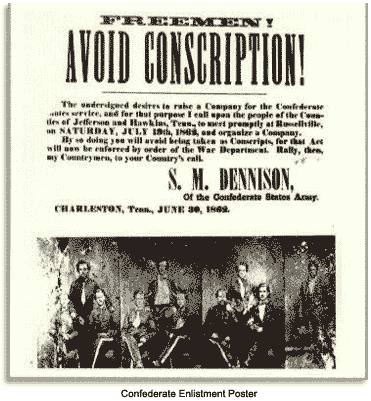
1863 – The first wartime conscription law went into effect in the U.S. ~~ The Draft in the Civil War


The initial war fever soon dissipated in both the North and South, and eaConfederate posterch side was compelled to resort to conscription. The South instituted a draft in 1862, requiring three years of service for those selected between the ages of 18 and 35; later, as the war prospects dimmed, the pool was enlarged by taking in ages 17 to 50. A large number of exemptions were allowed and there were provisions for substitutions.

The threat of a draft was used in Missouri and Iowa to speed up the rate of volunteer enlistment. The Militia Act of 1862 gave the President authority to draft 300,000 militiamen for up to nine months. It was to be a state run affair, with each county to be involved in the selection. However, the threat of conscription was for the time being enough to keep enlistments at an adequate level.
The Draft Act of 1863 was the first instance of compulsory service in the federal military services. All male citizens, as well as aliens who had declared their intention of becoming citizens, between 20 and 45 were at risk of being drafted. No married man could be drafted until all the unmarried had been taken.

for more … u-s-history.com


Stop DeJoy’s 10-year plan to privatize the USPS!


This is a repost from March

Stop DeJoy’s 10-year plan to privatize the USPS!

We need to act to save the United States Postal Service from Wall Street and Trump-appointed Postmaster General Louis DeJoy.

It’s no accident that DeJoy — the first Postmaster General in two decades without experience working in the postal service — was appointed just months after Trumps’ Office of Management and Budget released recommendations that the USPS should be privatized. The result has been the slow decimation of one of America’s most treasured institutions.

The Postal Service is a lifeline to people living in remote areas, rural communities, and Indigenous communities. For example, these communities rely on the postal service to receive medications and to vote-by-mail, because their towns are too small for polling places.

Privatizing the USPS would hurt these communities the most because — unlike UPS and FedEx — the USPS is required by law to deliver all mail to all regions at a flat rate.

Private companies won’t build offices in rural and remote areas because it’s not profitable. In fact, these private companies often rely on the USPS for “last-mile delivery” to get mail and packages to remote areas because it would be too expensive for them to do it any other way.[1]

That’s why privatization would lead to less service and higher rates. How do we know for sure? Look at what’s already happening. FedEx’s newest rate hike of 6.9% went into effect on January 2 of this year — and this is on top of previous rate hikes of 4.9% in 2021 and 5.9% in 2022.[2] These price hikes even feature a new higher surcharge of $13.25/package for some rural communities.

Now, with MAGA Republicans controlling the U.S. House, the postal service is at a greater threat than ever. It’s up to a strong USPS Postal Board to stand up to DeJoy and stop the 10-year plan before it’s too late.

Click “START WRITING” to send a message directly to the USPS Board of Governors today and demand they put a stop to Louis DeJoy’s 10-year plan to privatize the postal service now.

[2] If the US Postal Service fails, rural America will suffer the most
[3] FedEx to hike rates by 6.9% ‘given the inflationary backdrop’

22,570 Letters Sent

Only 3,030 more until our goal of 25,600

ENTER YOUR RETURN ADDRESS

FIRST NAME *LAST NAME *EMAIL *STREET ADDRESS *CITY *ZIP/POSTAL CODE *Not in US?

SPONSORED BY

Americans for Financial Reform

ADDITIONAL SPONSORS