EXCESSIVE HEAT WATCH REMAINS IN EFFECT FROM LATE TONIGHT 8/13 THROUGH THURSDAY 8/17 EVENING


What

A multi-day stretch of dangerously hot conditions with daytime temperatures in the 80s and 90s and lows in the 60s. This will pose Moderate to Major Heat Risk levels and risk of heat- related illness.

Where

Western Whatcom County, Western Skagit County, Everett and Vicinity, Bellevue and Vicinity, Seattle and Vicinity and Bremerton and Vicinity.

When

From late tonight through Thursday evening.

Impacts

Major Heat Risk level poses a major risk for heat- related illnesses for anyone without effective cooling or adequate hydration.

Tips

Monitor the latest forecasts and warnings for updates on this situation. Be prepared to drink plenty of fluids, stay in an air-conditioned room, stay out of the sun, and check up on relatives and neighbors. Young children and pets should never be left unattended in vehicles under any circumstances. This is especially true during warm or hot weather when car interiors can reach lethal temperatures in a matter of minutes.

Issued By

NWS Seattle

1841 – Frederick Douglass, an escaped slave, spoke before an audience in the North for the first time. During an anti-slavery convention on Nantucket Island, he gave a powerful, emotional account of his life as a slave. He was immediately asked to become a full-time lecturer for the Massachusetts Antislavery Society.


08 11.1 1841

On this day in 1841, Frederick Douglass, a fugitive slave, addressed a white audience for the first time when he spoke to a gathering of abolitionists on Nantucket. “It was with the utmost difficulty that I could stand erect, or that I could command and articulate two words without hesitation and stammering,” he later wrote. While his speech may have been halting, it had immediate impact. Leaders in the Massachusetts Anti-Slavery Society invited him to work with them. He quickly established himself as a formidable orator. Within five years, Douglass had a national and international reputation. He wrote three autobiographies, edited several newspapers, took a leading role in the woman’s movement, and served for over half a century as an untiring advocate for racial justice.

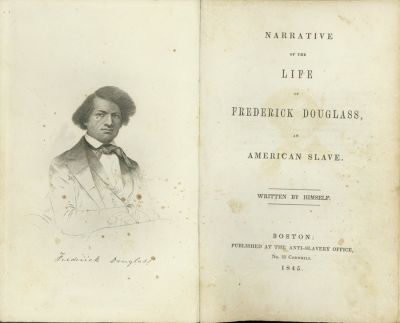
Frederick Douglass’s speeches were so eloquent and polished that his listeners sometimes questioned the authenticity of his story. How could a man who had been enslaved since birth, who had had no formal education be so knowledgeable and articulate? As a fugitive, Douglass gave few specific details of his life in the South, further fueling suspicion. Prominent members of the Massachuetts Anti-Slavery Society advised him to “have a little of the plantation speech . . . it is not best that you seem too learned.” Douglass would not degrade himself. Instead, in 1844 he wrote an autobiography, Narrative of the Life of Frederick Douglass, Written by Himself.

He was born on the Eastern Shore of Maryland in 1818. No one knows the exact date since slave births were not a matter of public record. His maternal grandparents raised him, and he remembered seeing his mother only a few times when she stole away at night to visit him. As he understood it, the man who enslaved him was his father, but this afforded him no protection from the cruelties of chattel slavery. When he was eight, he was sent to serve his master’s relatives in the port city of Baltimore.

His mistress there taught him the basics of reading, although once her husband learned of it, he put an immediate end to the tutoring. The boy understood the power of literacy and used every means possible to learn. Living now in a large city, he met free black people, had the opportunity to read about the anti-slavery movement in the North, and gained a greater degree of independence.

for the complete article massmoments.org

8/10 1846 – The Smithsonian Institution was chartered by the U.S. Congress. The “Nation’s Attic” was made possible by $500,000 given by scientist Joseph Smithson.


James Smithson and the Founding of the Smithsonian

James Smithson
James Smithson, c. 1765-1829
Artist: Hattie Elizabeth Burdette

Smithson, the illegitimate child of a wealthy Englishman, had traveled much during his life, but had never once set foot on American soil. Why, then, would he decide to give the entirety of his sizable estate—which totaled half a million dollars, or 1/66 of the United States’ entire federal budget at the time—to a country that was foreign to him?

Some speculate it was because he was denied his father’s legacy. Others argue that he was inspired by the United States’ experiment with democracy. Some attribute his philanthropy to ideals inspired by such organizations as the Royal Institution, which was dedicated to using scientific knowledge to improve human conditions. Smithson never wrote about or discussed his bequest with friends or colleagues, so we are left to speculate on the ideals and motivations of a gift that has had such significant impact on the arts, humanities, and sciences in the United States.

Visitors can pay homage to Smithson with a visit to his crypt, located on the first floor of the Smithsonian Castle.