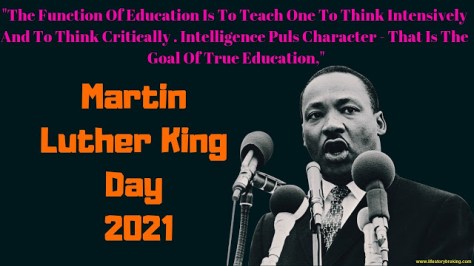
Martin Luther King – Mini BiographyDr. Martin Luther King, Jr. is widely considered the most influential leader of the American civil rights movement. He fought to overturn Jim Crow segregation laws and eliminate social and economic differences between blacks and whites.
Martin Luther King Jr. was born on January 15, 1929, in Atlanta, Georgia. King, both a Baptist minister and civil-rights activist, had a seismic impact on race relations in the United States, beginning in the mid-1950s. Among many efforts, King headed the SCLC. Through his activism, he played a pivotal role in ending the legal segregation of African-American citizens in the South and other areas of the nation, as well as the creation of the Civil Rights Act of 1964 and the Voting Rights Act of 1965. King received the Nobel Peace Prize in 1964, among several other honors. King was assassinated in April 1968, and continues to be remembered as one of the most lauded African-American leaders in history, often referenced by his 1963 speech, “I Have a Dream.”
Martin Luther King Jr. was a Baptist minister and social activist, who led the Civil Rights Movement in the United States from the mid-1950s until his death by assassination in 1968.
The establishment of a national holiday honoring Martin Luther King, Jr., marked the culmination of a long campaign that began soon after King’s assassination and ended on 2 November 1983, with the signing of legislation by President Ronald Reagan. Public Law 98–144 designated the third Monday in January as an annual federal holiday in King’s honor, and the first official celebration took place on 20 January 1986.
King’s 1968 assassination prompted various efforts to pay homage to the slain civil rights leader. Many communities throughout the nation reacted by naming streets, schools, and other public landmarks after King. Congressman John Conyers (D–MI) initially introduced a bill calling for a national holiday only four days after King’s assassination, but this proposal garnered little support until the numbers of African Americans elected to Congress increased and King holiday campaigns at the local and state levels gained momentum. The Congressional Black Caucus’ persistent attempts to pass King holiday legislation gained support from the Southern Christian Leadership Conference (SCLC), which King had led since its founding in 1957. In the early 1970s the SCLC gathered petitions bearing 3 million signatures in support of the King holiday. In 1973, the first state King holiday bill (sponsored by Assemblyman Harold Washington) was signed into law in Illinois, and in 1974, similar legislation was passed in Massachusetts and Connecticut. Most other states followed suit during the following decade.
During the late 1970s, King’s widow, Coretta Scott King, and the Atlanta-based King Center that she founded played an increasingly important role in mobilizing popular support for a holiday. In 1979, Coretta Scott King urged passage of a national King holiday bill when she testified before the Senate Judiciary Committee and joint hearings of Congress. In addition, Coretta Scott King directed King Center staff to begin intensive organizing of a nationwide citizens lobby for the holiday and garnered more than 300,000 signatures on a petition before the end of the year. With support from the Jimmy Carter administration, the King holiday bill emerged for the first time from congressional committees, but in November 1979 the bill was defeated by five votes in a floor vote in the House of Representatives.
The setback did not end the national campaign. Singer Stevie Wonder composed a song celebrating King’s birth, and his hit recording of the birthday song further increased the holiday’s popular support. On 15 January 1983, more than 100,000 people rallied at the Washington Monument to express support for the King holiday movement. With financial support from Wonder, a lobbying office was opened in Washington, D.C., and eventually this effort secured more than 6 million signatures on petitions to Congress in support of a King national holiday. The King Center began working with Wonder to organize an observance of the 20th anniversary of the 1963 March on Washington for Jobs and Freedom. More than half a million people attended this commemoration march and the rally at the Lincoln Memorial, where they heard speakers call upon the Senate and President Reagan to enact King holiday legislation.
A few weeks before the march took place, the House passed a bill creating the King holiday by an overwhelming vote of 338–90. But the subsequent Senate debate concerning the bill was nonetheless contentious, continuing into the fall of 1983. North Carolina Senator Jesse Helms sought to diminish King’s reputation by calling for the release of Federal Bureau of Investigation surveillance tapes on King that had been sealed by court order until the year 2027, while other senators complained that another paid holiday would be too costly. Senator Edward M. Kennedy (D–MA) vigorously defended King against the allegations of Helms, noting that no evidence of ties between King and the Communist Party had been uncovered. When the Senate finally voted on the bill on 19 October, the packed galleries included numerous prominent proponents of the holiday, including Coretta Scott King, SCLC President Joseph E. Lowery, and National Association for the Advancement of Colored People Executive Director Benjamin Hooks. The holiday bill was finally approved by a vote of 78–22 (37 Republicans and 41 Democrats voted in favor; 18 Republicans and 4 Democrats voted against).
After the holiday bill became law, the King Center gained congressional support to establish a King Federal Holiday Commission, which introduced a variety of commemorative activities, including tree planting ceremonies and the distribution of posters, newsletters, and guides citing the principles of King’s nonviolence teachings. In the 1990s the King holiday theme became “Remember—Celebrate—Act. A Day On, Not a Day Off.” As with other federal holidays, the observance of the King holiday applied only to federal workers rather than employees of state and local governments or of private institutions, but by January 1989 the number of states celebrating a King holiday had grown to 44 and, in June 1999, New Hampshire became the final state to pass some form of King holiday legislation.
House Bill 1000 would provide sales tax relief by expanding the Working Families Tax Credit.
House Bill 1011 would repeal the unpopular state long-term care program and payroll tax.
House Bill 1044 would create a new grant program to help school districts in economically disadvantaged areas build new schools. Learn more here.
House Bill 1162 would make it a crime to expose children and vulnerable adults to fentanyl.
House Bill 1245 would authorize the splitting of lots to create more small parcels of land to build starter homes and other forms of affordable housing. Learn more here.
House Bill 1328 would increase funding to schools and families for students not meeting academic standards and begin to address the learning loss created by Gov. Inslee’s shutdown of schools. Learn more here.
House Bill 1363 would reinstate vehicular pursuit laws so police officers can pursue individuals committing auto theft and property crimes.
House Bill 1373 would fund the removal of illegal encampments near schools, child care centers, parks, and courthouses.
House Bill 1380 would provide funding for the recruitment, retention and support of law enforcement officers.
House Bill 1401 would allow cities and counties to create a simple, standardized housing permit process for affordable housing units in areas designated for housing. Learn more here.
House Bill 1446 would incentivize cities and counties to increase employment of commissioned law enforcement officers. Learn more here.
House Bill 1456 would modify the definition of theft so that security officers can stop shoplifters when they conceal merchandise rather than only when they leave the store.
House Bill 1483 would provide property tax relief by reducing both parts of the state school levies.
House Bill 1535 would increase legislative involvement in gubernatorial proclamations relating to a state of emergency (emergency powers reform). Learn more here.
House Bill 1615 would establish the Students First Program to fund education savings accounts for students whose needs are not being met in the public school system.
House Bill 1633 would create a Homes for Heroes Program and provide down payment assistance for heroic professions Washington state needs more of, including police officers, firefighters, EMTs, and nurses. Learn more here.
House Bill 1704 would reduce the state sales and use tax rate.
House Bill 1710 would create learning recovery and acceleration programs for students who have fallen behind from learning loss.
House Bill 1716 would provide a B&O tax credit to employers that voluntarily provide child care assistance to employees.
House Bill 1720 would protect and restore riparian areas by establishing a voluntary, regionally focused riparian grant program designed to improve the ecological functions of critical riparian management zones. Learn more here.
House Bill 2002 would make it a gross misdemeanor — or a class C felony if a minor is involved — to knowingly or intentionally exhale the smoke of fentanyl, methamphetamine, or their derivatives in a public space within 10 feet of another person, or within an enclosed public space with another person. Learn more here.
House Bill 2033 would create a rent relief incentive program in which landlords who maintain current rental prices, or reduce them, would be eligible for property tax relief. Learn more here.
House Bill 2040 (Carbon Auction Rebate — CAR) would use excess revenue collected under the state’s carbon allowance auctions to distribute an equal, one-time payment of $214 to all 6.8 million registered vehicle owners in Washington. Learn more here.
House Bill 2179 would remove burdensome restrictions on child care centers.
House Bill 2202 would increase funding to counties and require them to meet minimum police officer staffing ratios.
House Bill 2324 would establish a new Bureau of Narcotics to fight sophisticated drug trafficking rings that operate across local government jurisdictional boundaries.
The badbills
House Bill 1024 would require an incarcerated person participating in a Correctional Industries work program be paid no less than the state minimum wage.
House Bill 1025 would allow police officers to be sued personally while doing their jobs protecting our communities.
House Bill 1045 would establish a basic income pilot program.
House Bill 1131 would create a complex bureaucracy to manage the waste stream from paper products and packaging, and require manufacturers to pay fees to fund a producer responsibility organization to oversee the collection and recycling of the waste.
House Bill 1174 would require each city, county and tribal jail to establish a “Jail Voting Plan” to provide resources to help incarcerated individuals vote.
House Bill 1189 would allow the release of incarcerated individuals prior to the expiration of a sentence.
House Bill 1220 would require anyone who is legally eligible to register to vote in Washington state to do so and submit a ballot.
House Bill 1244 would increase the cap on local school enrichment levies to $3,000 per pupil (same as Seattle).
House Bill 1268 would reduce some sentences by eliminating certain enhancements.
House Bill 1282 would require contractors on covered projects to provide certain environmental, health, labor, and HR data about construction materials used.
House Bill 1333 would establish the Domestic Violent Extremism Commission.
House Bill 1388 would establish annual rent increase maximum and authorize the attorney general to enforce the bill.
House Bill 1389 would establish annual maximum rent increases that cannot exceed 7%, but would also create a “banking” system for landlords to save up additional rent increases that they can use at a later date.
House Bill 1513 would prohibit law enforcement from stopping drivers committing certain violations, including nonmoving violations, certain suspended or revoked licenses, or certain misdemeanor warrants, and would require written consent of the driver and passengers to search a vehicle.
House Bill 1628 would increase the cost of multifamily housing and single family homes through increases in both state and local real estate excise taxes.
House Bill 1670 would allow cities, counties and other taxing districts to triple their annual increases in property taxes.
House Bill 1832 would implement a new per mile charge on vehicle usage of public roadways.
House Bill 1868 would ban the sale of gas-powered outdoor equipment in Washington state.
House Bill 1885 would ban corporate campaign contributions and independent expenditures.
House Bill 1882 would allow cities to remove odd-year elections without a vote of the people.
House Bill 1932 would remove odd-year elections in cities, towns, and special purpose districts depending on previous voter turnout.
House Bill 1959 would require employers with fewer than 50 employees to pay the employer portion of Paid Family and Medical Leave (PFML) premiums.
House Bill 2001 would allow judges to reduce sentences of convicted criminals after they serve 10 years if 18 years or older at time of the crime, seven years if the individual was under 17 years old at the time of the crime, or with the consent of the prosecuting attorney.






 Be a Seed for Change
You must be logged in to post a comment.