 1346 – Charles IV of Luxembourg was elected Holy Roman Emperor in Germany.
1509 – King Henry VIII married his first of six wives, Catherine of Aragon.
1770 – Captain James Cook discovered the Great Barrier Reef off of Australia when he ran aground.
1776 – In America, the Continental Congress formed a committee to draft a Declaration of Independence from Britain.
1798 – Napoleon Bonaparte took the island of Malta.
1880 – Jeanette Rankin was born. She became the first woman elected to the U.S. Congress.
1889 – The Washington Business High School opened in Washington, DC. It was the first school devoted to business in the U.S.
1895 – Charles E. Duryea received the first U.S. patent granted to an American inventor for a gasoline-driven automobile.
1910 – Jacques-Yves Cousteau was born. He was the French underwater explorer that invented the Aqua-Lung diving apparatus.
1912 – Silas Christoferson became the first pilot to take off from the roof of a hotel.
1915 – British troops took Cameroon in Africa.
1919 – Sir Barton became the first horse to capture the Triple Crown when he won the Belmont Stakes in New York City.
1927 – Charles A. Lindberg was presented the first Distinguished Flying Cross.
1930 – William Beebe dove to a record-setting depth of 1,426 feet off the coast of Bermuda. He used a diving chamber called a bathysphere.
1934 – The Disarmament Conference in Geneva ended in failure.
1936 – The Presbyterian Church of America was formed in Philadelphia, PA.
1937 – Soviet leader Josef Stalin began a purge of Red Army generals.
1940 – The Italian Air Force bombed the British fortress at Malta in the Mediterranean.
1942 – The U.S. and the Soviet Union signed a lend lease agreement to aid the Soviets in their effort in World War II.
1943 – During World War II, the Italian island of Pantelleria surrendered after a heavy air bombardment.
1947 – The U.S. government announced an end to sugar rationing.
1950 – Ben Hogan returned to tournament play after a near fatal car accident. He won the U.S. Open.
1963 – Dr. Martin Luther King, Jr. was arrested in Florida for trying to integrate restaurants.
1963 – Alabama Gov. George Wallace allowed two black students to enroll at the University of Alabama.
1967 – Israel and Syria accepted a U.N. cease-fire.
1972 – Hank Aaron tied the National League record for 14 grand-slam home runs in a career.
1973 – After a ruling by the Justice Department of the State of Pennsylvania, women were licensed to box or wrestle.
1977 – In the Netherlands, a 19-day hostage situation came to an end when Dutch marines stormed a train and a school being held by South Moluccan extremist. Two hostages and the six terrorists were killed.
1981 – The first major league baseball player’s strike began. It would last for two months.
1982 – Steven Spielberg’s movie “E.T.” opened.
1987 – Margaret Thatcher became the first British prime minister in 160 years to win a third consecutive term of office.
1990 – The U.S. Supreme Court struck down a law that would prohibit the desecration of the American Flag.
1991 – Mount Pinatubo in the Philippines erupted. The eruption of ash and gas could be seen for more than 60 miles.
1993 – The U.S. Supreme Court ruled that people who commit “hate crimes” could be sentenced to extra punishment. The court also ruled in favor of religious groups saying that they indeed had a constitutional right to sacrifice animals during worship services.
1993 – Steven Spielberg’s movie “Jurassic Park” opened.
1998 – Mitsubishi of America agreed to pay $34 million to end the largest sexual harassment case filed by the U.S. government. The federal lawsuit claimed that hundreds of women at a plant in Normal, IL, had endured groping and crude jokes from male workers.
1998 – Pakistan announced moratorium on nuclear testing and offered to talk with India over disputed Kashmir.
2010 – The FIFA World Cup opened in South Africa. It was the first time it was held in Africa.



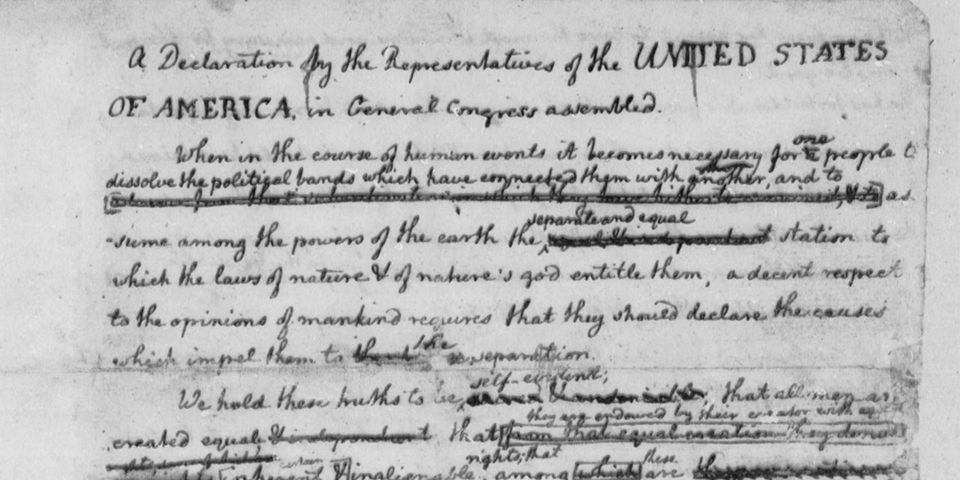 Its members were Thomas Jefferson of Virginia, John Adams of Massachusetts, Benjamin Franklin of Pennsylvania, Roger Sherman of Connecticut and Robert Livingston of New York
 Be a Seed for Change
You must be logged in to post a comment.