
Women will NOT allow the 19th Amendment to be repealed
On June 4, 1919, Congress, by joint resolution, approved the woman’s suffrage amendment and sent it to the states for ratification. The House of Representatives had voted 304-89 and the Senate 56-25 in favor of the 19th amendment.

Disagreement on whether the best strategy was to pursue enfranchisement through a federal amendment or by individual state campaigns had divided the women’s suffrage movement in 1869. Elizabeth Cady Stanton and Susan B. Anthony worked for a federal amendment under the banner of the National Woman Suffrage Association, while Lucy Stone led the American Woman Suffrage Association’s state-by-state battle for the vote.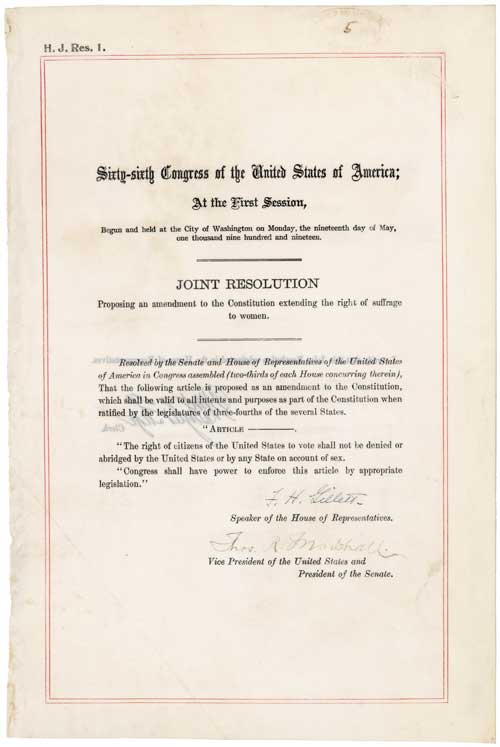
19th Amendment to the U.S. Constitution: Women’s Right to Vote
Joint Resolution of Congress proposing a constitutional amendment extending the right of suffrage to women, May 19, 1919; Ratified Amendments, 1795-1992; General Records of the United States Government; Record Group 11; National Archives.
In 1890, the two groups united to form the National American Woman Suffrage Association (NAWSA). NAWSA combined both techniques to secure voting rights for all American women. A series of well-orchestrated state campaigns took place under the dynamic direction of Carrie Chapman Catt, while the new National Woman’s Party, led by Alice Paul, used more militant tactics to obtain a federal amendment.
In his 1916 book Woman’s Suffrage By Constitutional Amendment, Congressman Henry St. George Tucker of Virginia argued that enfranchising women by constitutional amendment would violate the Constitution:
For three-fourths of the States to attempt to compel the other one-fourth of the States of the Union, by constitutional amendment, to adopt a principle of suffrage believed to be inimical to their institutions, because they may believe it to be of advantage to themselves and righteous as a general doctrine, would be to accomplish their end by subverting a principle which has been recognized from the adoption of the Constitution of the United States to this day, viz., that the right of suffrage — more properly the privilege of suffrage — is a State privilege, emanating from the State, granted by the State, and that can be curtailed alone by the State.
Woman’s Suffrage By Constitutional Amendment, by Henry St. George Tucker. New Haven: Yale University Press, 1916. p 4. National American Woman Suffrage Association Collection. Rare Book & Special Collections Division
Henry Wade Rogers, a Yale University law professor, offered a different perspective in “Federal Action and State Rights,” an essay within the 1917 collection Woman Suffrage by Federal Constitutional Amendment, compiled by Carrie Chapman Catt. He argued that previous constitutional amendments set a precedent for the demands of suffragists:
…the Fifteenth Amendment provides that “The right of citizens of the United States to vote shall not be denied or abridged by the United States or by any State on account of race, color or previous condition of servitude…” If woman suffrage is a sound principle in a republican form of government, and such I believe it to be, there is in my opinion no reason why the States should not be permitted to vote upon an Amendment to the Constitution declaring that no citizen shall be deprived of the right to vote on account of sex.
“Federal Action and State Rights,” by Henry Wade Rogers. In Woman Suffrage by Federal Constitutional Amendment. New York: published by the National Woman Suffrage Publishing Co., Inc., 1917. p 67. National American Woman Suffrage Association Collection. Rare Book & Special Collections Division
Rogers’s position prevailed. Women’s active participation in the war effort during World War I and their broadening role in society highlighted the injustice of their political powerlessness. On August 18, 1920, the Nineteenth Amendment was ratified.
National Woman’s Party activists watch Alice Paul sew a star onto the NWP Ratification Flag… National Photo Co., Washington, D.C., ca. 1919-1920. Women of Protest: Photographs from the Records of the National Woman’s Party. Prints & Photograph Division
Disagreement on whether the best strategy was to pursue enfranchisement through a federal amendment or by individual state campaigns had divided the women’s suffrage movement in 1869. Elizabeth Cady Stanton and Susan B. Anthony worked for a federal amendment under the banner of the National Woman Suffrage Association, while Lucy Stone led the American Woman Suffrage Association’s state-by-state battle for the vote.
In 1890, the two groups united to form the National American Woman Suffrage Association (NAWSA). NAWSA combined both techniques to secure voting rights for all American women. A series of well-orchestrated state campaigns took place under the dynamic direction of Carrie Chapman Catt, while the new National Woman’s Party, led by Alice Paul, used more militant tactics to obtain a federal amendment.
In his 1916 book Woman’s Suffrage By Constitutional Amendment, Congressman Henry St. George Tucker of Virginia argued that enfranchising women by constitutional amendment would violate the Constitution:
For three-fourths of the States to attempt to compel the other one-fourth of the States of the Union, by constitutional amendment, to adopt a principle of suffrage believed to be inimical to their institutions, because they may believe it to be of advantage to themselves and righteous as a general doctrine, would be to accomplish their end by subverting a principle which has been recognized from the adoption of the Constitution of the United States to this day, viz., that the right of suffrage — more properly the privilege of suffrage — is a State privilege, emanating from the State, granted by the State, and that can be curtailed alone by the State.
Woman’s Suffrage By Constitutional Amendment, by Henry St. George Tucker. New Haven: Yale University Press, 1916. p 4. National American Woman Suffrage Association Collection. Rare Book & Special Collections Division
Henry Wade Rogers, a Yale University law professor, offered a different perspective in “Federal Action and State Rights,” an essay within the 1917 collection Woman Suffrage by Federal Constitutional Amendment, compiled by Carrie Chapman Catt. He argued that previous constitutional amendments set a precedent for the demands of suffragists:
…the Fifteenth Amendment provides that “The right of citizens of the United States to vote shall not be denied or abridged by the United States or by any State on account of race, color or previous condition of servitude…” If woman suffrage is a sound principle in a republican form of government, and such I believe it to be, there is in my opinion no reason why the States should not be permitted to vote upon an Amendment to the Constitution declaring that no citizen shall be deprived of the right to vote on account of sex.
“Federal Action and State Rights,” by Henry Wade Rogers. In Woman Suffrage by Federal Constitutional Amendment. New York: published by the National Woman Suffrage Publishing Co., Inc., 1917. p 67. National American Woman Suffrage Association Collection. Rare Book & Special Collections Division
Rogers’s position prevailed. Women’s active participation in the war effort during World War I and their broadening role in society highlighted the injustice of their political powerlessness. On August 18, 1920, the Nineteenth Amendment was ratified.

 1847 – Mormon leader Brigham Young and his followers arrived in the valley of the Great Salt Lake in present-day Utah.


 Be a Seed for Change
You must be logged in to post a comment.