
Monthly Archives: July 2024

Congress Approves Nineteenth Amendment -Women’s History
Women will NOT allow the 19th Amendment to be repealed
On June 4, 1919, Congress, by joint resolution, approved the woman’s suffrage amendment and sent it to the states for ratification. The House of Representatives had voted 304-89 and the Senate 56-25 in favor of the 19th amendment.

Disagreement on whether the best strategy was to pursue enfranchisement through a federal amendment or by individual state campaigns had divided the women’s suffrage movement in 1869. Elizabeth Cady Stanton and Susan B. Anthony worked for a federal amendment under the banner of the National Woman Suffrage Association, while Lucy Stone led the American Woman Suffrage Association’s state-by-state battle for the vote.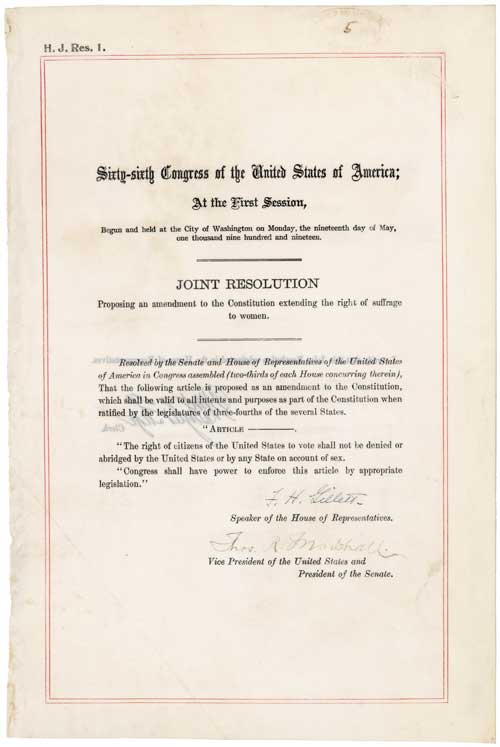
19th Amendment to the U.S. Constitution: Women’s Right to Vote
Joint Resolution of Congress proposing a constitutional amendment extending the right of suffrage to women, May 19, 1919; Ratified Amendments, 1795-1992; General Records of the United States Government; Record Group 11; National Archives.
In 1890, the two groups united to form the National American Woman Suffrage Association (NAWSA). NAWSA combined both techniques to secure voting rights for all American women. A series of well-orchestrated state campaigns took place under the dynamic direction of Carrie Chapman Catt, while the new National Woman’s Party, led by Alice Paul, used more militant tactics to obtain a federal amendment.
In his 1916 book Woman’s Suffrage By Constitutional Amendment, Congressman Henry St. George Tucker of Virginia argued that enfranchising women by constitutional amendment would violate the Constitution:
For three-fourths of the States to attempt to compel the other one-fourth of the States of the Union, by constitutional amendment, to adopt a principle of suffrage believed to be inimical to their institutions, because they may believe it to be of advantage to themselves and righteous as a general doctrine, would be to accomplish their end by subverting a principle which has been recognized from the adoption of the Constitution of the United States to this day, viz., that the right of suffrage — more properly the privilege of suffrage — is a State privilege, emanating from the State, granted by the State, and that can be curtailed alone by the State.
Woman’s Suffrage By Constitutional Amendment, by Henry St. George Tucker. New Haven: Yale University Press, 1916. p 4. National American Woman Suffrage Association Collection. Rare Book & Special Collections Division
Henry Wade Rogers, a Yale University law professor, offered a different perspective in “Federal Action and State Rights,” an essay within the 1917 collection Woman Suffrage by Federal Constitutional Amendment, compiled by Carrie Chapman Catt. He argued that previous constitutional amendments set a precedent for the demands of suffragists:
…the Fifteenth Amendment provides that “The right of citizens of the United States to vote shall not be denied or abridged by the United States or by any State on account of race, color or previous condition of servitude…” If woman suffrage is a sound principle in a republican form of government, and such I believe it to be, there is in my opinion no reason why the States should not be permitted to vote upon an Amendment to the Constitution declaring that no citizen shall be deprived of the right to vote on account of sex.
“Federal Action and State Rights,” by Henry Wade Rogers. In Woman Suffrage by Federal Constitutional Amendment. New York: published by the National Woman Suffrage Publishing Co., Inc., 1917. p 67. National American Woman Suffrage Association Collection. Rare Book & Special Collections Division
Rogers’s position prevailed. Women’s active participation in the war effort during World War I and their broadening role in society highlighted the injustice of their political powerlessness. On August 18, 1920, the Nineteenth Amendment was ratified.
National Woman’s Party activists watch Alice Paul sew a star onto the NWP Ratification Flag… National Photo Co., Washington, D.C., ca. 1919-1920. Women of Protest: Photographs from the Records of the National Woman’s Party. Prints & Photograph Division
Disagreement on whether the best strategy was to pursue enfranchisement through a federal amendment or by individual state campaigns had divided the women’s suffrage movement in 1869. Elizabeth Cady Stanton and Susan B. Anthony worked for a federal amendment under the banner of the National Woman Suffrage Association, while Lucy Stone led the American Woman Suffrage Association’s state-by-state battle for the vote.
In 1890, the two groups united to form the National American Woman Suffrage Association (NAWSA). NAWSA combined both techniques to secure voting rights for all American women. A series of well-orchestrated state campaigns took place under the dynamic direction of Carrie Chapman Catt, while the new National Woman’s Party, led by Alice Paul, used more militant tactics to obtain a federal amendment.
In his 1916 book Woman’s Suffrage By Constitutional Amendment, Congressman Henry St. George Tucker of Virginia argued that enfranchising women by constitutional amendment would violate the Constitution:
For three-fourths of the States to attempt to compel the other one-fourth of the States of the Union, by constitutional amendment, to adopt a principle of suffrage believed to be inimical to their institutions, because they may believe it to be of advantage to themselves and righteous as a general doctrine, would be to accomplish their end by subverting a principle which has been recognized from the adoption of the Constitution of the United States to this day, viz., that the right of suffrage — more properly the privilege of suffrage — is a State privilege, emanating from the State, granted by the State, and that can be curtailed alone by the State.
Woman’s Suffrage By Constitutional Amendment, by Henry St. George Tucker. New Haven: Yale University Press, 1916. p 4. National American Woman Suffrage Association Collection. Rare Book & Special Collections Division
Henry Wade Rogers, a Yale University law professor, offered a different perspective in “Federal Action and State Rights,” an essay within the 1917 collection Woman Suffrage by Federal Constitutional Amendment, compiled by Carrie Chapman Catt. He argued that previous constitutional amendments set a precedent for the demands of suffragists:
…the Fifteenth Amendment provides that “The right of citizens of the United States to vote shall not be denied or abridged by the United States or by any State on account of race, color or previous condition of servitude…” If woman suffrage is a sound principle in a republican form of government, and such I believe it to be, there is in my opinion no reason why the States should not be permitted to vote upon an Amendment to the Constitution declaring that no citizen shall be deprived of the right to vote on account of sex.
“Federal Action and State Rights,” by Henry Wade Rogers. In Woman Suffrage by Federal Constitutional Amendment. New York: published by the National Woman Suffrage Publishing Co., Inc., 1917. p 67. National American Woman Suffrage Association Collection. Rare Book & Special Collections Division
Rogers’s position prevailed. Women’s active participation in the war effort during World War I and their broadening role in society highlighted the injustice of their political powerlessness. On August 18, 1920, the Nineteenth Amendment was ratified.
Share this:

on this day 7/24
 1847 – Mormon leader Brigham Young and his followers arrived in the valley of the Great Salt Lake in present-day Utah.
1847 – Richard M. Hoe patented the rotary-type printing press.
1849 – Georgetown University in Washington, DC, presented its first Doctor of Music Degree. It was given to Professor Henry Dielman.
1866 – Tennessee became the first state to be readmitted to the Union after the U.S. Civil War.
1923 – The Treaty of Lausanne, which settled the boundaries of modern Turkey, was concluded in Switzerland.
1929 – U.S. President Hoover proclaimed the Kellogg-Briand Pact, which renounced war as an instrument of foreign policy.
1948 – Soviet occupation forces in Germany blockaded West Berlin. The U.S.-British airlift began the following day.
1956 – Dean Martin and Jerry Lewis ended their team. They ended the partnership a decade after it began on July 25, 1946.
1969 – The Apollo 11 astronauts splashed down safely in the Pacific Ocean.
1974 – The U.S. Supreme Court unanimously ruled that President Nixon had to turn over subpoenaed White House tape recordings to the Watergate special prosecutor.
Share this:

12 Ways To Celebrate International Self-Care Day
Story by Kamrin Baker

July 24 is International Self-Care Day! This annual celebration is an opportunity to raise awareness about the importance of self-care around the globe, promote self-care in your organizations or communities, and of course, take good care of yourself, as well.
The date of International Self-Care Day can be written as 7/24 – a subtle reference to the idea that self-care should be performed seven days per week, 24 hours per day.
Source: internet … check out the author and read the complete article
Share this:

What is Ocean Acidification… ?
Ocean acidification is a change in the properties of ocean water that can be harmful for plants and animals. Scientists have observed that the ocean is becoming more acidic as its water absorbs carbon dioxide from the atmosphere.
Ocean waves off the coast of New Zealand. Credit: Public domain
Have you ever heard someone call water “H2O”? That nickname means that water is a combination of two chemicals called hydrogen (H) and oxygen (O). All water contains hydrogen and oxygen. However, most water has a lot of other stuff in it, too.
For example, ocean water has salt in it, while water from a river or lake does not. The amount of salt is one feature, or property, of water. This property is very important to living things. Most freshwater plants and animals can’t survive if water is too salty — and most ocean life can’t survive in the fresh water of rivers and lakes.
Clownfish need to live in the salty ocean water to survive. Credit: Public domain
Water also has other properties that need to stay in balance for living things to thrive. One of those properties is called acidity.
What is acidity?
An acid is a substance that can cause certain changes when it is combined with water or a metal. Acidity is the amount of acid in water.
Lemon juice and vinegar are examples of foods that have acids in them. The acid in lemon juice is what makes it taste sour.
Acids can cause chemical reactions when they touch metal, rocks or other surfaces. The chemical reactions are known for eating away at, dissolving or damaging other substances.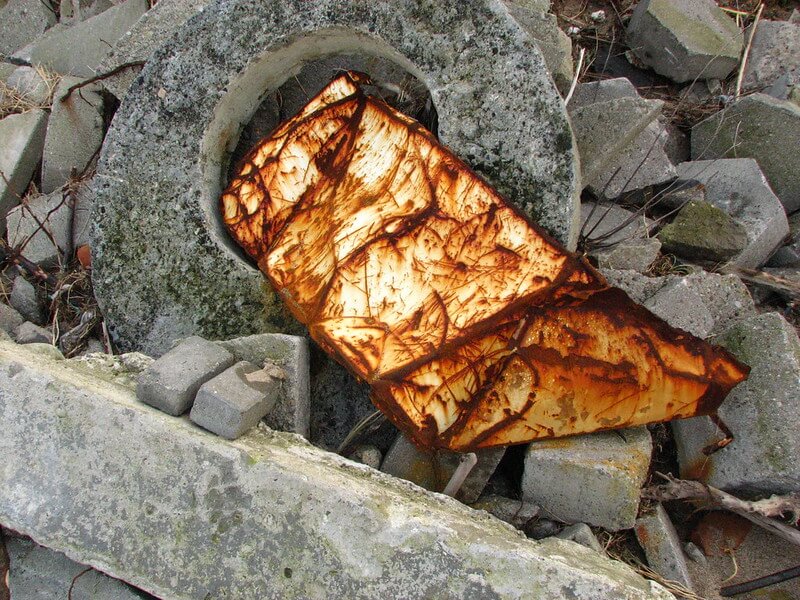
Metal that comes into contact with acid can form rust on the surface. Credit: Public domain
The acidity of a substance is measured using the pH scale. A substance with a pH of 7 is considered neutral. An acid has a pH less than 7. Anything with a pH higher than 7 is called a base.
Here is a list of how everyday things measure up on the pH scale:
- 0: Battery Acid
- 1: Stomach Acid
- 2: Vinegar
- 3: Orange Juice
- 4: Tomato Juice
- 5: Coffee
- 6: Milk
- 7: Pure Water
- 8: Ocean Water
- 9: Toothpaste
- 10: Mild detergent
- 11: Window cleaner
- 12: Hair straighteners
- 13: Bleach
- 14: Drain Cleaner
What causes ocean acidification?
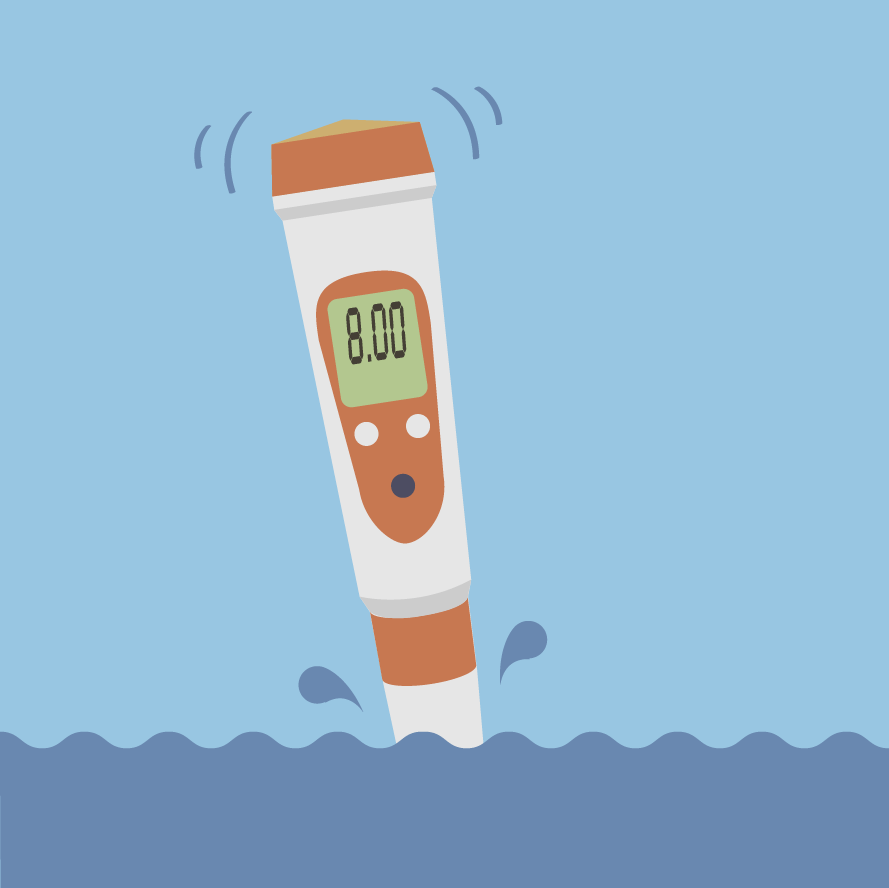
Ocean water is approximately pH 8. Credit: NASA/JPL-Caltech
As you probably noticed in the list above, ocean water has a pH of approximately 8. That means ocean water is fairly neutral — and slightly basic. However, in the past 100-200 years, scientists have observed that ocean water has become 30 percent more acidic.
Why is this happening? Well, many human activities — such as exhaust from cars and factories—release a gas called carbon dioxide into the air. Extra carbon dioxide can cause problems in the atmosphere, and it can also have an impact on the acidity of the ocean.
Extra carbon dioxide gas in the atmosphere is absorbed by the top layer of the ocean. And when carbon dioxide absorbs into water, it makes the water more acidic.
Why does ocean acidification matter?

Coral reefs are important to ocean ecosystems. Credit: Greg McFall/NOAA
Just like acids can cause rust and other damage to surfaces on land, acidic ocean water can affect surfaces underwater. Acids can break down the shells of animals that live in the sea. Because ocean water has become more acidic, some animals — like certain oysters and clams — can no longer make or keep their shells.
For example, acidic ocean water can cause coral to grow more slowly and weaken coral reefs. These reefs are an important home for many living things. Their health is essential to many ecosystems.
How is NASA studying ocean acidification?

The red areas in this map are spots with high levels of carbon dioxide in the atmosphere. The map was created using information collected by NASA’s OCO-2 satellite. Credit: NASA/JPL-Caltech
NASA satellites are orbiting and collecting information about Earth all the time. One satellite, called Orbiting Carbon Observatory-2 (OCO-2), collects information about carbon dioxide in our atmosphere while it circles Earth.
Scientists can use these measurements to better understand the relationship between carbon dioxide and changes in the ocean’s acidity.

 Be a Seed for Change
You must be logged in to post a comment.