on this day 10/17


1739 – Thomas Coram was granted a Royal Charter from George II so a “hospital for the maintenance and education of exposed and deserted young children” in London, England.

1777 – American troops defeated British forces in Saratoga, NY. It was the turning point in the American Revolutionary War.

1787 –  Prince Hall submitted, to the State Legislature of Boston, Massachusetts, a petition asking for equal educational rights. His petition was not granted.

1871 – President Grant suspended the writ of habeas corpus and declared martial law in nine South Carolina counties affected by Klan disturbances.

1888 – Capital Savings Bank of Washigton, D.C., the first Black bank, opened in Washington, D.C. The Savings Bank of the Order of True Reformers (Richmond, Va.) was chartered on March 2, 1888.

1888 – The first issue of “National Geographic Magazine” was released at newsstands.

1931 – Al Capone was convicted on income tax evasion and was sentenced to 11 years in prison. He was released in 1939.

1933 – “News-Week” appeared for the first time at newsstands. The name was later changed to “Newsweek.”

1933 – Dr. Albert Einstein moved to Princeton, NJ, after leaving Germany.

1945 – Colonel Juan Peron became the dictator of Argentina after staging a coup in Buenos Aires.

1973 – The Organization of Petroleum Exporting Countries (OPEC) began an oil-embargo against several countries including the U.S. and Great Britain. The incident stemmed from Western support of Israel when Egypt and Syria attacked the nation on October 6, 1973. The embargo lasted until March of 1974.

1978 – U.S. President Carter signed a bill that restored full U.S. citizenship rights to Confederate President Jefferson Davis.

1979 – Mother Teresa of India was awarded the Nobel Peace Prize.

1987 – U.S. First Lady Nancy Reagan underwent a modified radical mastectomy at Bethesda Naval Hospital in Maryland.

1989 – An earthquake measuring 7.1 on the Richter Scale hit the San Francisco Bay area in California. The quake caused about 67 deaths, 3,000 injuries, and damages up to $7 billion.

1994 – Israel and Jordan initiated a draft peace treaty.

1994 – The Angolan government and rebels agreed to a peace treaty that ended their 19 years of civil war.

1997 – The remains of revolutionary Ernesto “Che” Guevara were laid to rest in his adopted Cuba, 30 years after his execution in Bolivia.

2000 – In New York City, Madame Tussaud’s Wax Museum opened to the public. The 42nd Street location joined Tussaud’s other exhibitions already in London, Hong Kong, Amsterdam and Las Vegas.

2000 – Patrick Roy (Colorado Avalanche) achieved his 448th victory as a goalie in the NHL. Roy passed Terry Sawchuck to become the record holder for career victories.

2001 – Israel’s tourism minister was killed. A radical Palestinian faction claimed that it had carried out the assassination to avenge the killing of its leader by Israel 2 months earlier.

2001 – Pakistan placed its armed forces on high alert because of troop movements by India in the disputed territory of Kashmir. India said that the movements were part of a normal troop rotation.

2001 – Italian priest Giuseppe “Beppe” Pierantoni was kidnapped by the terrorist group the “Pentagon.” He was released on April 8, 2002.

2003 – In the U.S., the Food and Drug Administration approved a drug, known as memantine, to help people with Alzheimer’s symptoms.

2003 – In Taipei, Taiwan, construction crews finished 1,676-foot-tall-building called Taipei 101. The building was planned to open for business in 2004.

2003 – In northwest England, the Carnforth railway station reopened as a heritage center.

1854 Lincoln speaks out against slavery 10/16 – Black History


slavesinchainsOn this day in 1854, an obscure lawyer and Congressional hopeful from the state of Illinois named Abraham Lincoln delivers a speech regarding the Kansas-Nebraska Act, which Congress had passed five months earlier.
In his speech, the future president denounced the act and outlined his views on slavery, which he called “immoral.”Under the terms of the Kansas-Nebraska Act, two new territories—Kansas and Nebraska—would be allowed into the Union and each territory’s citizens would be given the power to determine whether slavery would be allowed within the territory’s borders. It was believed that the act would set a precedent for determining the legality of slavery in other new territories. Controversy over the act influenced political races across the country that fall.
Abolitionists, like Lincoln, hoped to convince lawmakers in the new territories to reject slavery.Lincoln, who was practicing law at the time, campaigned on behalf of abolitionist Republicans in Illinois and attacked the Kansas-Nebraska Act. He denounced members of the Democratic Party for backing a law that “assumes there can be moral right in the enslaving of one man by another.” He believed that the law went against the founding American principle that “all men are created equal.” Lincoln was an abolitionist at heart, but he realized that the outlawing of slavery in states where it already existed might lead to civil war. Instead, he advocated outlawing the spread of slavery to new states. He hoped this plan would preserve the Union and slowly eliminate slavery by confining it to the South, where, he believed, “it would surely die a slow death.”Lincoln and his fellow abolitionists were dismayed when Kansans voted a pro-slavery candidate into Congress in November. As Lincoln’s political career picked up momentum over the next several years, he continually referred to the Kansas-Nebraska Act and the seeming inevitability that Kansas should become a slave state as “a violence…it was conceived in violence, passed in violence, is maintained in violence, and is being executed in violence.”Lincoln continued to actively campaign against slavery in Kansas and helped to raise money to support anti-slavery candidates in that state.
Meanwhile he continued his law practice and ran for the U.S. Senate in 1859. Although he lost to Democrat Stephen Douglas, Lincoln began to make a name for himself in national politics and earned increasing support from the North and abolitionists across the nation. It was this constituency that helped him win the presidency in 1860.

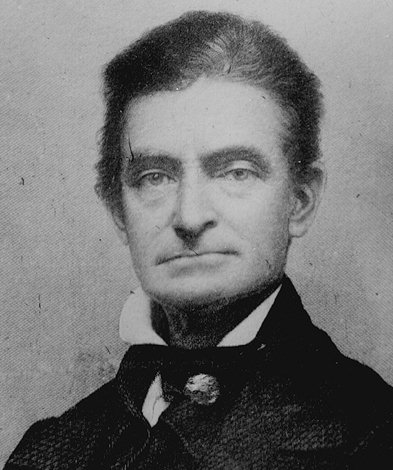
Abolitionist leader John Brown


In Charles Town, Virginia, militant abolitionist John Brown is executed on charges of treason, murder, and insurrection. Brown, born in Connecticut in 1800, first became militant during the mid-1850s, when as a leader of the Free State forces in Kansas he fought pro-slavery settlers in the sharply divided U.S. territory.

Abolitionist leader John Brown (1800-1859) was born in Torrington, Connecticut. He led an attack on the federal arsenal at Harpers Ferry in October of 1859, to secure weapons for his “army of emancipation” to liberate slaves. Inside the arsenal, Brown and his followers held 60 hostages and managed to hold out against the local militia but finally surrendered to U.S. Marines under the command of Colonel Robert E. Lee. Ten of Brown’s men, including two of his sons, were killed. Brown was taken prisoner. He was convicted by the Commonwealth of Virginia of treason, murder, and inciting slaves to rebellion, and hanged on December 2, 1859.

Resources: wiki, thehistoryplace.com

on this day 10/16


Halloween
1701 – The Collegiate School was founded in Killingworth, CT. The school moved to New Haven in 1745 and changed its name to Yale College.

1793 – During the French Revolution, Queen Marie Antoinette was beheaded after being convicted of treason.

1829 – In Boston, MA, the first modern hotel in America opened. The Tremont Hotel had 170 rooms that rented for $2 a day and included four meals.

1859 – Abolitionist John Brown led a raid on Harper’s Ferry, VA (now located in West Virginia). 

1869 – A hotel in Boston became the first in the U.S. to install indoor plumbing.

1916 – Margaret Sanger opened the first birth control clinic in New York City, NY.

1923 – Walt Disney contracted with M.J. Winkler to distribute the Alice Comedies. This event is recognized as the start of the Disney Company.
Disney movies, music and books

1928 – Marvin Pipkin received a patent for the frosted electric light bulb.

1939 – “Right To Happiness” debuted on the NBC-Blue network.

1939 – “The Man Who Came to Dinner” opened on Broadway.

1941 – The Nazis advanced to within 60 miles of Moscow. Romanians entered Odessa, USSR, and began exterminating 150,000 Jews.

1942 – The ballet “Rodeo” premiered in New York City.

1943 – Chicago’s new subway system was officially opened with a ribbon cutting ceremony.

1944 – “The Robe,” by Lloyd Douglas, was published for the first time.

1945 – “His Honor the Barber” debuted on NBC Radio.

1955 – Mrs. Jules Lederer replaced Ruth Crowley in newspapers using the name Ann Landers.

1962 – U.S. President Kennedy was informed that there were missile bases in Cuba, beginning the Cuban missile crisis. 

1964 – China detonated its first atomic bomb becoming the world’s fifth nuclear power. 

1967 – NATO headquarters opened in Brussels.

1970 – Anwar Sadat was elected president of Egypt to succeed Gamal Abdel Nassar.

1973 – Henry Kissinger and Le Duc Tho were named winners of the Nobel Peace Prize. The Vietnamese official declined the award.

1978 – Poland’s Karol Josef Wojtyla was elected Pope John Paul II.

1982 – China announced that it had successfully fired a ballistic missile from a submarine. 

1987 – Rescuers freed Jessica McClure from the abandoned well that she had fallen into in Midland, TX. She was trapped for 58 hours.

1989 – U.S. President George H.W. Bush signed the Gramm-Rudman budget reduction law that ordered federal programs be cut by $16.1 billion.

1990 – Comedian Steve Martin and his wife Victoria Tennant visited U.S. soldiers in Saudi Arabia.

1993 – The U.N. Security Council approved the deployment of U.S. warships to enforce a blockade on Haiti to increase pressure on the controlling military leaders. 

1994 – German Chancellor Helmut Kohl was re-elected to a fourth term.

1995 – The “Million Man March” took place in Washington, DC.

1997 – Charles M. Schulz and his wife Jeannie announced that they would give $1 million toward the construction of a D-Day memorial to be placed in Virginia.

2000 – It was announced that Chevron Corp. would be buying Texaco Inc. for $35 billion. The combined company was called Chevron Texaco Corp. and became the 4th largest oil company in the world.

2002 – It was reported that North Korea had told the U.S. that it had a secret nuclear weapons program in violation of an 1994 agreement with the U.S. 

2002 – The Arthur Andersen accounting firm was sentenced to five years probation and fined $500,000 for obstructing a federeal investigation of the energy company Enron.

2008 – The iTunes Music Store reached 200 billion television episodes sold.