Dec. 1st ~ What is World AIDS Day?


Each year, on 1 December, the world commemorates World AIDS Day. People around the world unite to show support for people living with HIV and to remember those who have died from AIDS-related illnesses.

Each World AIDS Day focuses on a specific theme, which this year will be Take the rights path

This year’s theme joins a growing list of challenges that World AIDS Day has alerted people to globally. Founded in 1988, World AIDS Day was the first ever international day for global health. Every year, United Nations agencies, governments and civil society join together to campaign around specific themes related to HIV.

Source: unaids.org

1862 ~ Lincoln sends message to Congress


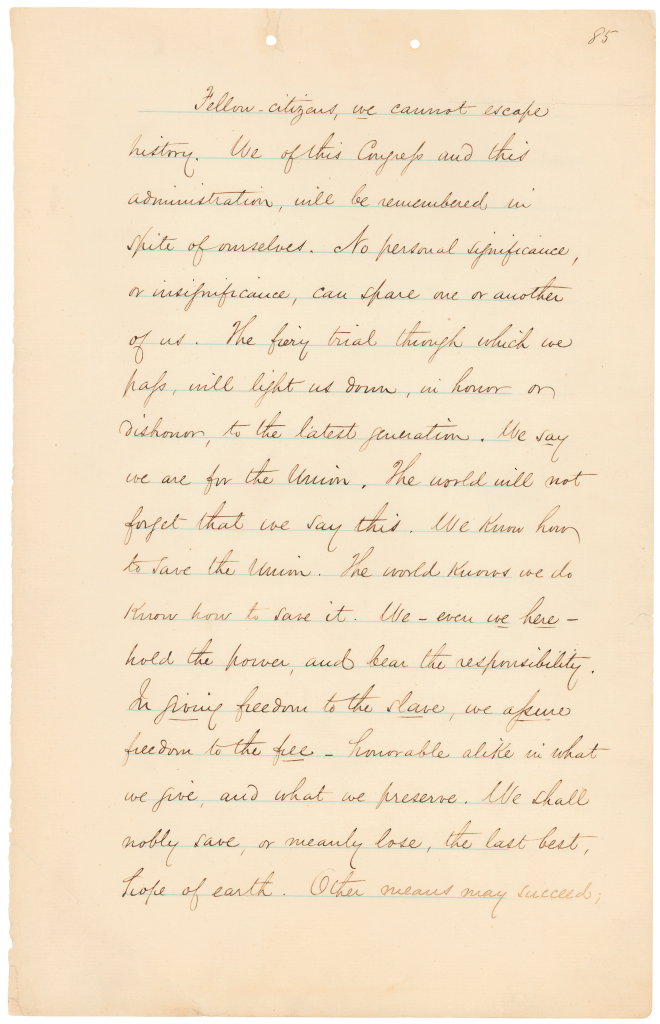
One month before signing the Emancipation Proclamation, President Lincoln sent a long message to Congress which was largely routine, but also proposed controversial measures such as voluntary colonization of slaves and compensated emancipation.

Lincoln devoted so much attention to preparing the message that his friend David Davis said, “Mr. Lincoln’s whole soul is absorbed in his plan of remunerative emancipation.” The concluding paragraphs shown below demonstrate Lincoln’s passion for this plan and contain some of the most famous statements he ever wrote. Composer Aaron Copland used excerpts in his evocative “Lincoln Portrait.”

I do not forget the gravity which should characterize a paper addressed to the Congress of the nation by the Chief Magistrate of the nation. Nor do I forget that some of you are my seniors, nor that many of you have more experience than I, in the conduct of public affairs. Yet I trust that in view of the great responsibility resting upon me, you will perceive no want of respect yourselves, in any undue earnestness I may seem to display.

Is it doubted, then, that the plan I propose, if adopted, would shorten the war, and thus lessen its expenditure of money and of blood? Is it doubted that it would restore the national authority and national prosperity, and perpetuate both indefinitely? Is it doubted that we here–Congress and Executive–can secure its adoption? Will not the good people respond to a united, and earnest appeal from us? Can we, can they, by any other means, so certainly, or so speedily, assure these vital objects? We can succeed only by concert. It is not “can any of us imagine better?” but, “can we all do better?” The dogmas of the quiet past, are inadequate to the stormy present. The occasion is piled high with difficulty, and we must rise — with the occasion. As our case is new, so we must think anew, and act anew. We must disenthrall ourselves, and then we shall save our country.

Fellow-citizens, we cannot escape history. We of this Congress and this administration, will be remembered in spite of ourselves. No personal significance, or insignificance, can spare one or another of us. The fiery trial through which we pass, will light us down, in honor or dishonor, to the latest generation. We say we are for the Union. The world will not forget that we say this. We know how to save the Union. The world knows we do know how to save it. We — even we here — hold the power, and bear the responsibility. In giving freedom to the slave, we assure freedom to the free — honorable alike in what we give, and what we preserve. We shall nobly save, or meanly lose, the last best hope of earth. Other means may succeed; this could not fail. The way is plain, peaceful, generous, just — a way which, if followed, the world will forever applaud, and God must forever bless.

abrahamlincolnonline.org

on this day


1835 – Hans Christian Andersen published his first book of fairy tales.

1909 – The Pennsylvania Trust Company, of Carlisle, PA, became the first bank in the in the U.S. to offer a Christmas Club account.

1913 – Ford Motor Co. began using a new movable assembly line that ushered in the era of mass production.

1913 – The first drive-in automobile service station opened, in Pittsburgh, PA.

1919 – Lady Astor was sworn in as the first female member of the British Parliament.

1925 – The Locarno Pact finalized the treaties between World War I protagonists.

1934 – Sergei M. Kirov, a collaborator of Joseph Stalin, was assassinated at the Leningrad party headquarters.

1941 – In the U.S., the Civil Air Patrol was created. In April 1943 the Civil Air Patrol was placed under the jurisdiction of the Army Air Forces.

1942 – In the U.S., nationwide gasoline rationing went into effect.

1943 – In Teheran, leaders of the United States, the USSR and the United Kingdom met to reaffirm the goal set on October 30, 1943. The previous meeting called for an early establishment of an international organization to maintain peace and security.

1952 – In Denmark, it was announced that the first successful sex-change operation had been performed.

1955 – Rosa Parks, a black seamstress in Montgomery, AL, refused to give up her seat to a white man. Mrs. Parks was arrested marking a milestone in the civil rights movement in the U.S. 

1959 – 12 countries, including the U.S. and USSR, signed a treaty that set aside Antarctica as a scientific preserve, which would be free from military activity.

1965 – An airlift of refugees from Cuba to the United States began.

1969 – The U.S. government held its first draft lottery since World War II.

1984 – A remote-controlled Boeing 720 jetliner was deliberately crashed into California’s Mojave Desert to test an anti-flame fuel additive. The test proved to be disappointing.

1986 – U.S. President Ronald Reagan said he would welcome an investigation of the Iran-Contra affair if it were recommended by the Justice Department.

1987 – Construction began on the Channel Tunnel between the United Kingdom and France.

1987 – NASA announced four companies had been given contracts to help build a space station. The companies were Boeing Aerospace, G. E.’s Astro-Space Division, McDonnell Douglas Aeronautics, and Rocketdyne Division of Rockwell International.

1989 – Dissidents in the Philippine military launched an unsuccessful coup against Corazon Aquino’s government.

1989 – East Germany’s Parliament abolished the Communist Party’s constitutional guarantee of supremacy.

1990 – Iraq accepted a U.S. offer to talk about resolving the Persian Gulf crisis.

1990 – British and French workers digging the Channel Tunnel finally met under the English Channel.

1991 – Ukrainians voted overwhelmingly for independence from the Soviet Union.

1992 – Russian President Boris Yeltsin survived an impeachment attempt by hard-liners at the opening of the Russian Congress.

1994 – The U.S. Senate gave final congressional approval to the 124-nation General Agreement on Tariffs and Trade.

1998 – Exxon announced that it was buying Mobil for $73.7 billion creating the largest company in the world to date.

95 die in Chicago School Fire


A fire at a grade school in Chicago kills 87 children and three nuns on December 1, 1958; five more children later died as a result of their injuries.

The Our Lady of Angels School was operated by the Sisters of Charity in Chicago. In 1958, there were well over 1,200 students enrolled at the school, which occupied a large, old building. Unfortunately, little in the way of fire prevention was done before December 1958. The building did not have any sprinklers and no regular preparatory drills were conducted. When a small fire broke out in a pile of trash in the basement, it led to disaster.

The fire probably began about 2:30 p.m. and, within minutes, teachers on the first floor smelled it. These teachers led their classes outside, but did not sound a general alarm. The school’s janitor discovered the fire at 2:42 and shouted for the alarm to be rung. However, he was either not heard or the alarm system did not operate properly, and the students in classrooms on the second floor were completely unaware of the rapidly spreading flames beneath them.

Source: history.com for the complete article