1969 ~ Murder at the Altamont Festival brings the 1960s to a violent end


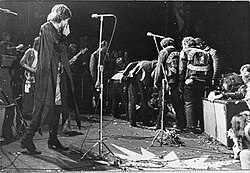
Mick Jagger stops performing to address Hells Angels

On December 6, 1969, in a shocking act of violence, a Hells Angel biker stabs to death an 18-year-old concertgoer during a set by the British rock group Rolling Stones at the Altamont music festival.

Altamont, a new festival in Northern California, was the brainchild of the Stones, who hoped to cap off their U.S. tour in late 1969 with a concert that would be the West Coast equivalent of Woodstock, in both scale and spirit. Unlike Woodstock, however, which was the result of months of careful planning by a team of well-funded organizers, Altamont was a largely improvised affair that did not even have a definite venue arranged just days before the event.

It was only on Thursday, December 4, 1969, that organizers settled on the Altamont Speedway location for a free concert that was by then scheduled to include Santana, the Jefferson Airplane, Crosby, Stills, Nash and Young and the Grateful Dead, all in support of the headlining Stones. The event would also include, infamously, several dozen members the Hells Angels motorcycle gang acting as informal security staff in exchange for $500 worth of beer as a “gratuity.”

1865 – The 13th Amendment to the U.S. Constitution was ratified. The amendment abolished slavery in the U.S.


On December 6, 1865, the 13th Amendment to the U.S. Constitution, officially ending the institution of slavery, is ratified. “Neither slavery nor involuntary servitude, except as a punishment for crime whereof the party shall have been duly convicted, shall exist within the United States, or any place subject to their jurisdiction.”

1868 1st blacks on US trial jury appointed for Jefferson Davis trial


According to the web search results, the first blacks on US trial jury were appointed for the trial of Jefferson Davis, the former president of the Confederate States of America, on December 3, 1868123. This was a historic event that marked the integration of the American jury system and the recognition of black citizens’ rights and citizenship. The jury consisted of six white men and six black men, who were selected by a lottery from various counties in Virginia4The trial lasted for two weeks and resulted in Davis being found not guilty on all charges4The jury service was a rare and remarkable achievement for black activists who had been campaigning for years to abolish the all-white jury system in antebellum America5.

Posted: 23 Oct 2023

Thomas Frampton

University of Virginia School of Law

Date Written: September 5, 2023

Abstract

Supreme Court opinions involving race and the jury invariably open with the Fourteenth Amendment, the Civil Rights Act of 1875, or landmark cases like Strauder v. West Virginia (1880). Legal scholars and historians unanimously report that free people of color did not serve as jurors, in either the North or South, until 1860. In fact, this Article shows, Black men served as jurors in antebellum America decades earlier than anyone has previously realized. While instances of early Black jury service were rare, campaigns insisting upon Black citizens’ admission to the jury-box were not. From the late 1830s onward, Black activists across the country organized to abolish the all-white jury. They faced, and occasionally overcame, staunch resistance. This Article uses jury lists, court records, convention minutes, diaries, bills of sale, tax rolls, and other overlooked primary sources to recover these forgotten efforts, led by activists who understood the jury-box to be both a marker and maker of citizenship. A broader historical perspective—one that centers Black activists in the decades before the ratification of the Fourteenth Amendment in 1868—offers a new way of thinking about the relationship between race, rights, citizenship, and the jury.

Keywords: race, juries, legal history, citizenship, abolition

Suggested Citation:

Frampton, Thomas, The First Black Jurors and the Integration of the American Jury (September 5, 2023). New York University Law Review, 2024, Available at SSRN: https://ssrn.com/abstract=4562373

The First Black Jurors and the Integration of the American Jury

New York University Law Review, 2024

Source:

Gwendolyn Brooks


 American poet and educator (born June 7, 1917, TopekaKansas, U.S.—died December 3, 2000, Chicago, Illinois) American poet whose works deal with the everyday life of urban Blacks. She was the first African American poet to win the Pulitzer Prize (1950), and in 1968 she was named the poet laureate of Illinois.

Brooks graduated from Wilson Junior College in Chicago in 1936. Her early verses appeared in the Chicago Defender, a newspaper written primarily for that city’s African American community. Her first published collection, A Street in Bronzeville (1945), reveals her talent for making the ordinary life of her neighbours extraordinary. Annie Allen (1949), for which she won the Pulitzer Prize, is a loosely connected series of poems related to an African American girl’s growing up in Chicago. The same theme was used for Brooks’s novel Maud Martha (1953).

2006 – 649-day tree sit-in at the University of California, Berkley


649-day tree sit-in at the University of California, Berkeley begins

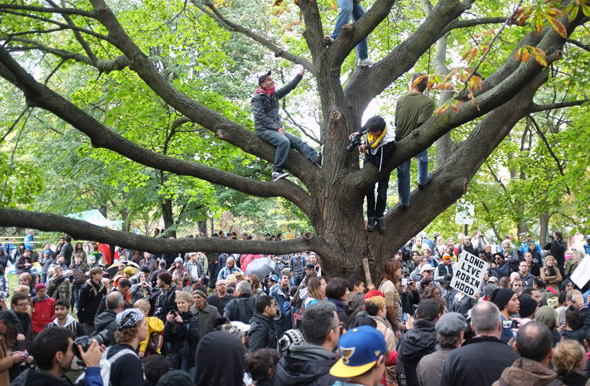
On December 2, 2006, four students at the University of California, Berkeley, inhabit the treetops of an oak grove on campus to protest the university’s plans to demolish over an acre of the forest to build a new athletic center, kicking off an epic 21-month standoff. It was one of the longest tree sit-ins in history.

Tree sit-ins are a form of civil disobedience in which protestors physically occupy a tree to prevent it from being cut down, often for long periods of time. At its peak, the Berkeley protest saw over a dozen people living on the limbs of the grove’s oak and redwood trees; volunteers and others brought them food, water and supplies.

Source: history.com