
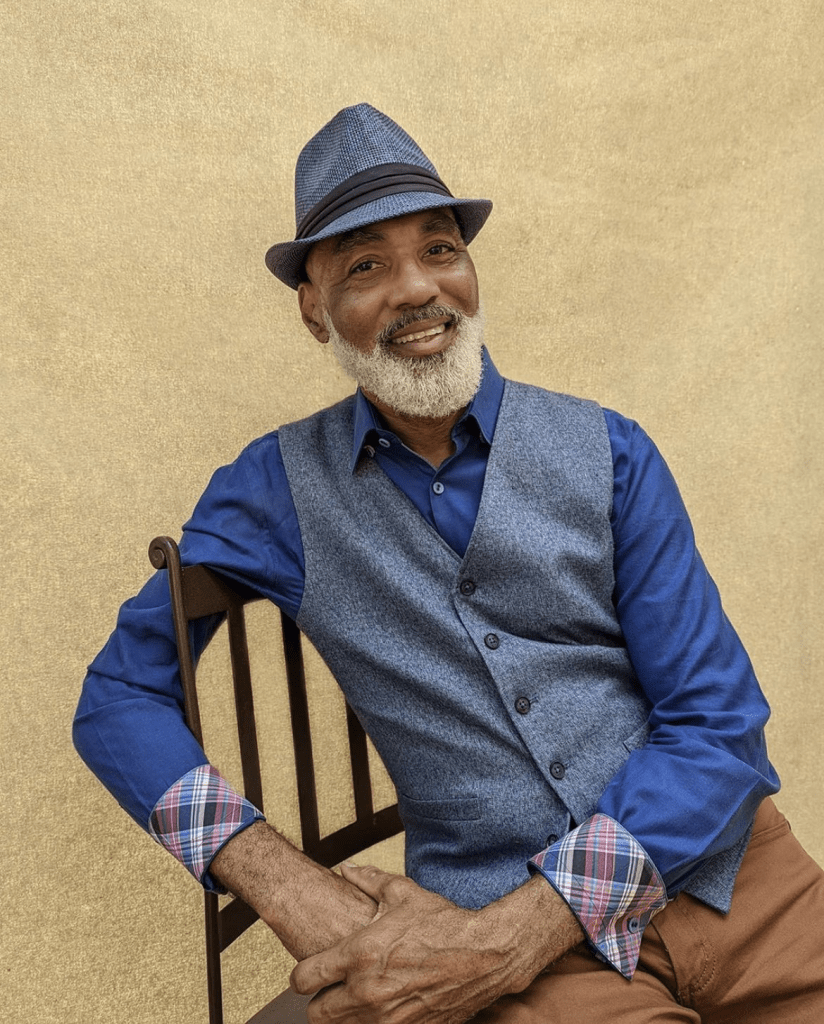
Phill Wilson, Aids Activist


“Don’t buy the hype that the HIV/AIDS pandemic is over for Black people just because of medical advances that have disproportionately benefited white people. Black people and poor people are still acquiring, getting sick, and dying from AIDS in America.”

— Phill Wilson

I have been living with HIV/AIDS for nearly 43 years. It has been a roller coaster for me, my communities, and the world. I’ve lost count of the eulogies’ I’ve delivered, the death beds I’ve sat beside, the hospital rooms I’ve visited, or the number of times I’ve comforted someone after they found out they were HIV positive. I would always tell them, “It was going to be OK,” even when I didn’t believe it.

I know we’ve made a lot of advances since Michael Gottlieb identified the first AIDS cases at UCLA Medical Center in 1981. We have new diagnostic tools, new surveillance tools, new prevention tools, and new treatment tools. We can diagnose someone within the first 24 hours of exposure to the virus. We can identify the pandemic down to the zip code or census tract. We can prevent HIV transmission and HIV acquisition. We made policy advances in access and fought stigma and discrimination. At the very least, I hoped and prayed that we might have learned something—that if something else were to happen, we would know how to handle it. And then COVID-19 happened. It became painfully clear that no one was listening to our pain, tears, screams, grief, and trauma.

The parallels are scary. First, the denial, then the blaming, the slow response, the missed opportunities, and finally, the disproportionate impact on Black, other POC, and poor communities. All the earliest information about how the COVID-19 pathogen was transmitted said that Black, brown, and poor people would be disproportionately impacted. And yet, those in power did not develop strategies targeting those communities. The opposite happened. BIPOC and poor people were designated “essential workers” and sentenced to put themselves in harm’s way to protect the rest of society. And again, the premature declaration of the end of the COVID-19 pandemic places us at continued risk.

Source: For the complete article, thereckoningmag.com

1639 – The first colonial constitution


In Hartford, Connecticut, the first constitution in the American colonies, the “Fundamental Orders,” is adopted by representatives of Wethersfield, Windsor, and Hartford. The Dutch discovered the Connecticut River in 1614, but English Puritans from Massachusetts largely …read more

Citation Information

Article Title

The first colonial constitution

AuthorHistory.com Editors

Website Name

HISTORY

URL

https://www.history.com/this-day-in-history/the-first-colonial-constitution

Access Date

January 13, 2023

Publisher

A&E Television Networks

Last Updated

July 27, 2019

Original Published Date

February 9, 2010

1784, the Continental Congress ratifies the Treaty of Paris, ending the War for Independence.


On January 14, 1784, the Continental Congress ratifies the Treaty of Paris, ending the War for Independence.

In the document, which was known as the Second Treaty of Paris because the Treaty of Paris was also the name of the agreement that had ended the Seven Years’ War in 1763, Britain officially agreed to recognize the independence of its 13 former colonies as the new United States of America.

In addition, the treaty settled the boundaries between the United States and what remained of British North America. U.S. fishermen won the right to fish in the Grand Banks, off the Newfoundland coast, and in the Gulf of Saint Lawrence. Both sides agreed to ensure payment to creditors in the other nation of debts incurred during the war and to release all prisoners of war. The United States promised to return land confiscated during the war to its British owners, to stop any further confiscation of British property and to honor the property left by the British army on U.S. shores, including Negroes or slaves. Both countries assumed perpetual rights to access the Mississippi River.

for the complete article, history.com

On January 14, 1784, the Treaty of Paris was ratified by the Congress of the United States, while they met in the Senate Chamber of the Maryland State House. The Treaty formally ended the Revolutionary War and established the United States as a free and independent nation.

The Treaty had been signed by delegates from the Unites States and Great Britain, as well as France and Spain, in Paris on September 3, 1783. Congress� assent was required for the Treaty to take effect, and delegates were called to convene at Annapolis, then serving as the nation’s capital, in November, 1783. The Treaty stipulated that Congress approve and return the document to England within six months of being signed. However, representatives from nine of the thirteen states were required to be present in order for Congress to proceed, and it was nearly six weeks until enough members assembled to hold a vote. Mindful of the nearly two months required to cross the Atlantic, Congress grew concerned that a sufficient number of delegates would not arrive in time, and in early January, 1784, began to consider voting on ratification with the delegates already present.

However, upon the arrival of Richard Beresford of South Carolina in Annapolis just a few days later, a quorum was reached, and Congress voted unanimously to ratify the Treaty. Congress then ordered �That a proclamation be immediately issued, notifying�the states of the union� that the Treaty had been signed.

Dunlap Broadside

John Dunlap, Congress� official printer, printed the broadside seen here, which was �to notify� all the good citizens of these United States� that the Treaty had been ratified, and that American independence was assured. The proclamation was also to serve as official notice of the Treaty, a task of particular importance in an era when communication was limited. Of the thirteen copies Dunlap printed�one for each state�only a handful are known to survive today. This copy, held at the Maryland State Archives, bears the embossed seal of Congress and the signatures of Thomas Mifflin, president of Congress, and Charles Thompson, secretary. Several others are in the collections of the Library of Congress. Another copy in private hands sold at auction for over $300,000 in December, 2007.
 
Congress also directed that each state inform its people that the Treaty had been ratified, and that peace was at hand. Thus, six days later, Governor William Paca gave a proclamation informing the people of Maryland that the Treaty had been ratified, seen on the right. Paca asked that “all the good citizens of this state…observe, and carry into effect” the Treaty’s requirements to properly live as citizens of the new republic.
 
 For the complete article:
 
 Additional Resources:

National Archives and Records Administration
Treaty of Paris

Maryland State Archives Special Collections (Maryland Gazette Collection) MSA SC 2731
Special edition of the Maryland Gazette announcing the ratification of the treaty, 16 January 1784

Maryland State Archives Special Collections (Maryland Gazette Collection) MSA SC 2731
Gov. Paca’s proclamation of the treaty, printed in the Maryland Gazette, 22 January 1784

Library of Congress: A Century of Lawmaking for the New Nation
Journal of the Continental Congress, 14 January 1784

Library of Congress: Documents from the Continental Congress
Proclamation printed by Dunlap, announcing ratification of the Treaty


This web site is presented for reference purposes under the doctrine of fair use. When this material is used, in whole or in part, proper citation and credit must be attributed to the Maryland State Archives. PLEASE NOTE: The site may contain material from other sources which may be under copyright. Rights assessment, and full originating source citation, is the responsibility of the user.

Source: maryland.gov

history… January 14


1639 – Connecticut’s first constitution, the “Fundamental Orders,” was adopted.

1784 – The United States ratified a peace treaty with England ending the Revolutionary War.

1858 – French emperor Napoleon III escaped an attempt on his life.

1873 – John Hyatt’s 1869 invention ‘Celluloid’ was registered as a trademark.

1878 – Alexander Graham Bell demonstrated the telephone for Britain’s Queen Victoria.

1882 – The Myopia Hunt Club, in Winchester, MA, became the first country club in the United States.

1907 – An earthquake killed over 1,000 people in Kingston, Jamaica.

1939 – “Honolulu Bound” was heard on CBS radio for the first time.

1943 – U.S. President Franklin D. Roosevelt became the first U.S. President to fly in an airplane while in office. He flew from Miami, FL, to French Morocco where he met with British Prime Minister Winston Churchill to discuss World War II.

1951 – The first National Football League Pro Bowl All-Star Game was played in Los Angeles, CA.

1952 – NBC’s “Today” show premiered.

1953 – Josip Broz Tito was elected president of Yugoslavia by the country’s Parliament.

1954 – Marilyn Monroe and Joe DiMaggio were married. The marriage only lasted nine months.

1954 – The Hudson Motor Car Company merged with Nash-Kelvinator. The new company was called the American Motors Corporation.

1963 – George C. Wallace was sworn in as governor of Alabama.

1969 – An explosion aboard the U.S. aircraft carrier Enterprise off Hawaii killed 25 crew members.

1972 – NBC-TV debuted “Sanford & Son.”

1973 – The Miami Dolphins defeated the Washington Redskins in Super Bowl VII and became the first NFL team to go undefeated in a season.

1985 – Martina Navratilova won her 100th tournament. She joined Jimmy Connors and Chris Evert Lloyd as the only professional tennis players to win 100 tournaments.

1985 – Former Miss America, Phyllis George, joined Bill Kurtis as host of “The CBS Morning News”.

1986 – “Rambo: First Blood, Part II” arrived at video stores. It broke the record set by “Ghostbusters”, for first day orders. 435,000 copies of the video were sold.

1993 – Television talk show host David Letterman announced he was moving from NBC to CBS.

1993 – The British government pledged to introduce legislation to criminalize invasions of privacy by the press.

1994 – U.S. President Clinton and Russian President Boris Yeltsin signed Kremlin accords to stop aiming missiles at any nation and to dismantle the nuclear arsenal of Ukraine.

1996 – Jorge Sampaio was elected president of Portugal.

1996 – Juan Garcia Abrego was arrested by Mexican agents. The alleged drug lord was handed over to the FBI the next day.

1998 – Whitewater prosecutors questioned Hillary Rodham Clinton at the White House for 10 minutes about the gathering of FBI background files on past Republican political appointees.

1998 – In Dallas, researchers report an enzyme that slows the aging process and cell death.

1999 – The impeachment trial of U.S. President Clinton began in Washington, DC.

1999 – The U.S. proposed the lifting of the U.N. ceilings on the sale of oil in Iraq. The restriction being that the money be used to buy medicine and food for the Iraqi people.

2000 – A U.N. tribunal sentenced five Bosnian Croats to up to 25 years for the 1993 massacre of over 100 Muslims in a Bosnian village.

2000 – The Dow Jones industrial average hit a new high when it closed at 11,722.98. Earlier in the session, the Dow had risen to 11,750.98. Both records stood until October 3, 2006.

2002 – NBC’s “Today” celebrated its 50th anniversary on television.

2004 – In St. Louis, a Lewis and Clark Exhibition opened at the Missouri History Museum. The exhibit featured 500 rare and priceless objects used by the Corps of Discovery.

2005 – A probe, from the Cassini-Huygens mission, sent back pictures during and after landing on Saturn’s moon Titan. The mission was launched on October 15, 1997

on-this-day.com