
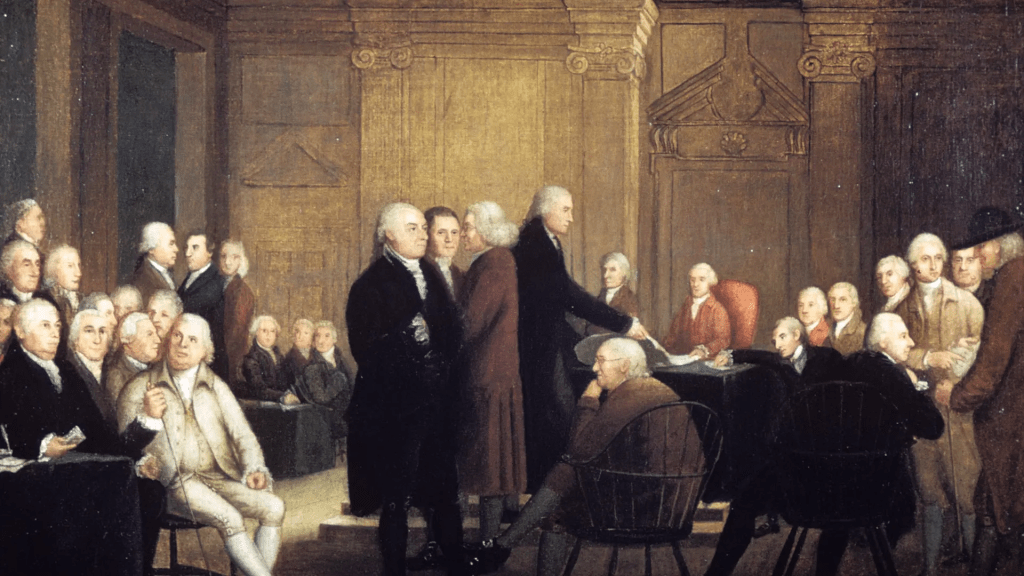
On January 14, 1784, the Continental Congress ratifies the Treaty of Paris, ending the War for Independence.
In the document, which was known as the Second Treaty of Paris because the Treaty of Paris was also the name of the agreement that had ended the Seven Years’ War in 1763, Britain officially agreed to recognize the independence of its 13 former colonies as the new United States of America.
In addition, the treaty settled the boundaries between the United States and what remained of British North America. U.S. fishermen won the right to fish in the Grand Banks, off the Newfoundland coast, and in the Gulf of Saint Lawrence. Both sides agreed to ensure payment to creditors in the other nation of debts incurred during the war and to release all prisoners of war. The United States promised to return land confiscated during the war to its British owners, to stop any further confiscation of British property and to honor the property left by the British army on U.S. shores, including Negroes or slaves. Both countries assumed perpetual rights to access the Mississippi River.
for the complete article, history.com
On January 14, 1784, the Treaty of Paris was ratified by the Congress of the United States, while they met in the Senate Chamber of the Maryland State House. The Treaty formally ended the Revolutionary War and established the United States as a free and independent nation.

The Treaty had been signed by delegates from the Unites States and Great Britain, as well as France and Spain, in Paris on September 3, 1783. Congress� assent was required for the Treaty to take effect, and delegates were called to convene at Annapolis, then serving as the nation’s capital, in November, 1783. The Treaty stipulated that Congress approve and return the document to England within six months of being signed. However, representatives from nine of the thirteen states were required to be present in order for Congress to proceed, and it was nearly six weeks until enough members assembled to hold a vote. Mindful of the nearly two months required to cross the Atlantic, Congress grew concerned that a sufficient number of delegates would not arrive in time, and in early January, 1784, began to consider voting on ratification with the delegates already present.
However, upon the arrival of Richard Beresford of South Carolina in Annapolis just a few days later, a quorum was reached, and Congress voted unanimously to ratify the Treaty. Congress then ordered �That a proclamation be immediately issued, notifying�the states of the union� that the Treaty had been signed.
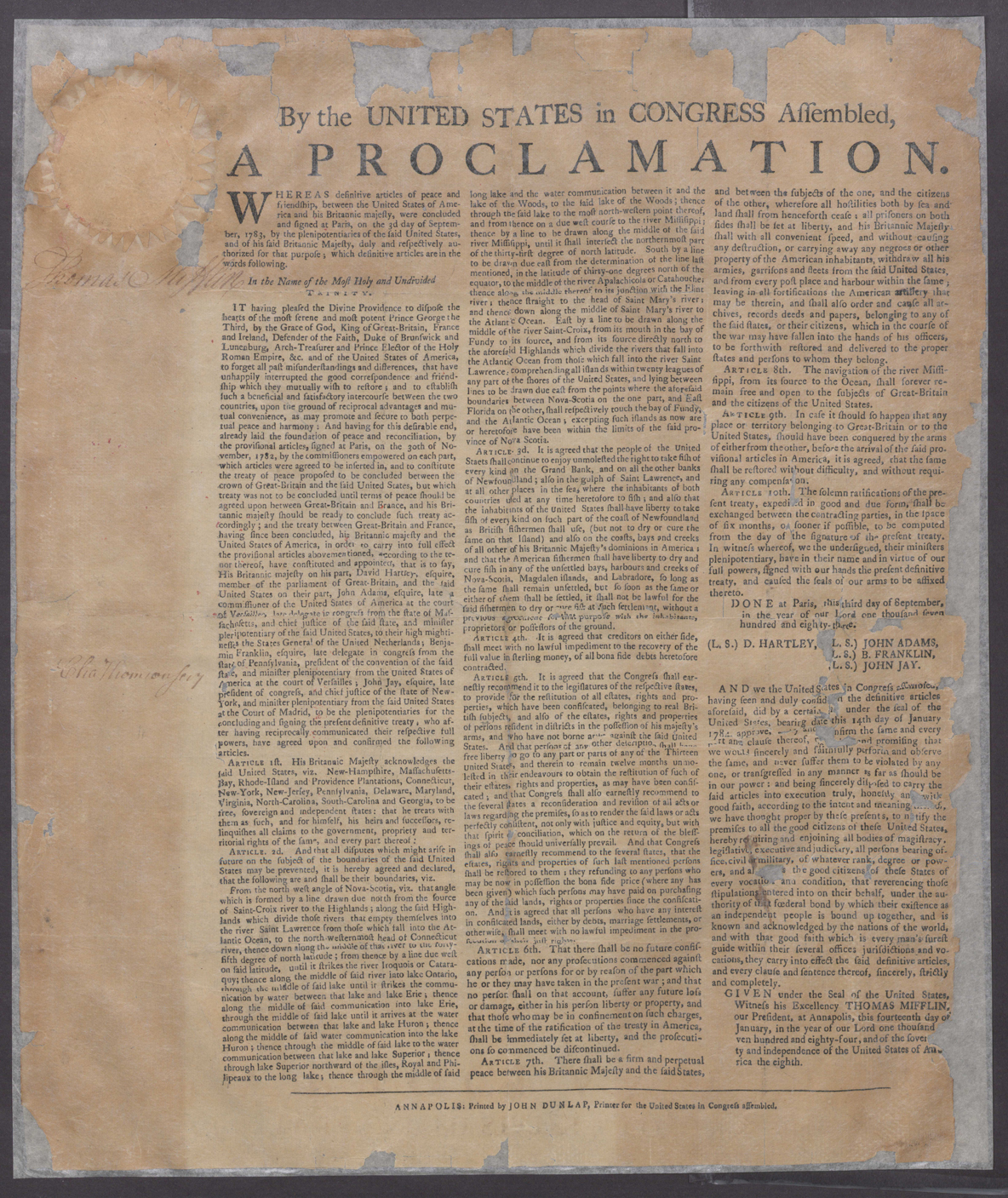
John Dunlap, Congress� official printer, printed the broadside seen here, which was �to notify� all the good citizens of these United States� that the Treaty had been ratified, and that American independence was assured. The proclamation was also to serve as official notice of the Treaty, a task of particular importance in an era when communication was limited. Of the thirteen copies Dunlap printed�one for each state�only a handful are known to survive today. This copy, held at the Maryland State Archives, bears the embossed seal of Congress and the signatures of Thomas Mifflin, president of Congress, and Charles Thompson, secretary. Several others are in the collections of the Library of Congress. Another copy in private hands sold at auction for over $300,000 in December, 2007.
Congress also directed that each state inform its people that the Treaty had been ratified, and that peace was at hand. Thus, six days later, Governor William Paca gave a proclamation informing the people of Maryland that the Treaty had been ratified, seen on the right. Paca asked that “all the good citizens of this state…observe, and carry into effect” the Treaty’s requirements to properly live as citizens of the new republic.
For the complete article:
Additional Resources:
National Archives and Records Administration
Treaty of Paris
Maryland State Archives Special Collections (Maryland Gazette Collection) MSA SC 2731
Special edition of the Maryland Gazette announcing the ratification of the treaty, 16 January 1784
Maryland State Archives Special Collections (Maryland Gazette Collection) MSA SC 2731
Gov. Paca’s proclamation of the treaty, printed in the Maryland Gazette, 22 January 1784
Library of Congress: A Century of Lawmaking for the New Nation
Journal of the Continental Congress, 14 January 1784
Library of Congress: Documents from the Continental Congress
Proclamation printed by Dunlap, announcing ratification of the Treaty
This web site is presented for reference purposes under the doctrine of fair use. When this material is used, in whole or in part, proper citation and credit must be attributed to the Maryland State Archives. PLEASE NOTE: The site may contain material from other sources which may be under copyright. Rights assessment, and full originating source citation, is the responsibility of the user. |
Source: maryland.gov

 Be a Seed for Change
You must be logged in to post a comment.