
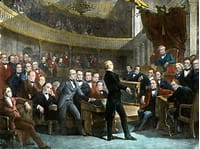
1850 ~ Henry Clay


1850 – Henry Clay introduced in the Senate a compromise bill on slavery that included the admission of California into the Union as a free state

The Compromise was actually a series of bills passed mainly to address issues related to slavery. The bills provided for slavery to be decided by popular sovereignty in the admission of new states, prohibited the slave trade in the District of Columbia, settled a Texas boundary dispute, and established a stricter fugitive slave act.

By 1850 sectional disagreements related to slavery were straining the bonds of union between the North and South. These tensions became especially critical when Congress began to consider whether western lands acquired after the Mexican-American War would permit slavery. In 1849, California requested permission to enter the Union as a “free state” – meaning one where slavery was banned. Adding more “free state” senators to Congress would destroy the balance between “slave” and “free” states that had existed since the Missouri Compromise of 1820.

Because everyone looked to the Senate to defuse the growing crisis, Senator Henry Clay of Kentucky proposed a series of resolutions designed to “adjust amicably all existing questions of controversy…arising out of the institution of slavery.” Clay attempted to frame his compromise so that nationally minded senators would vote for legislation in the interest of the Union.

In one of the most famous congressional debates in American history, the Senate discussed Clay’s solution for seven months. It initially voted down his legislative package, but Senator Stephen A. Douglas of Illinois stepped forward with substitute bills, which passed both Houses. With the Compromise of 1850, Congress had addressed the immediate crisis created by the recent territorial expansion.

Source: archives.gov

1863 – The Bear River Massacre: New Historical Evidence


by Harold Schindler

See the source image

Controversy has dogged the Bear River Massacre from the first.

The event in question occurred when, on January 29, 1863, volunteer soldiers under Colonel Patrick Edward Connor attacked a Shoshoni camp on the Bear River, killing nearly three hundred men, women, and children. The bloody encounter culminated years of increasing tension between whites and the Shoshonis, who, faced with dwindling lands and food sources, had resorted to theft in order to survive. By the time of the battle, confrontations between the once-friendly Indians and the settlers and emigrants were common.

So it was that “in deep snow and bitter cold”

Connor set forth from Fort Douglas with nearly three hundred men, mostly cavalry, late in January 1863. Intelligence reports had correctly located Bear Hunter’s village on Bear River about 140 miles north of Salt Lake City, near present Preston, Idaho. Mustering three hundred warriors by Connor’s [p. 301] estimate, the camp lay in a dry ravine about forty feet wide and was shielded by twelve-foot embankments in which the Indians had cut firing steps. . . .

When the soldiers appeared shortly after daybreak on January 27 [sic], the Shoshonis were waiting in their defenses.

About two-thirds of the command succeeded in fording ice-choked Bear River. While Connor tarried to hasten the crossing, Major [Edward] McGarry dismounted his troops and launched a frontal attack. It was repulsed with heavy loss. Connor assumed control and shifted tactics, sending flanking parties to where the ravine issued from some hills. While detachments sealed off the head and mouth of the ravine, others swept down both rims, pouring a murderous enfilading fire into the lodges below. Escape blocked, the Shoshonis fought desperately in their positions until slain, often in hand-to-hand combat. Of those who broke free, many were shot while swimming the icy river. By mid-morning the fighting had ended.

On the battlefield the troops counted 224 bodies, including that of Bear Hunter, and knew that the toll was actually higher. They destroyed 70 lodges and quantities of provisions, seized 175 Indian horses, and captured 160 women and children, who were left in the wrecked village with a store of food. The Californians had been hurt, too: 14 dead, 4 officers and 49 men wounded (of whom 1 officer and 6 men died later), and 75 men with frostbitten feet. Even so, it had been a signal victory, winning Connor the fulsome praise of the War Department and prompt promotion to brigadier general.[1]

Controversies over the battle have tainted it ever since. For one thing, Chief Justice John F. Kinney of the Utah Supreme Court had issued warrants for the arrest of several Shoshoni chiefs for the murder of a miner. But critics have questioned whether the warrants could legally be served, since the chiefs were no longer within the court’s jurisdiction.[2] The legality of the federal writs was irrelevant, however, to Colonel Connor, commander of the California Volunteers at Camp Douglas. At the onset of his expedition against the Bear River band, he announced that he was satisfied that these Indians were among those who had been murdering emigrants on the Overland Mail Route for the previous fifteen years. Because of their apparent role as “principal actors and leaders in the horrid massacres of the past summer, I determined . . . to chastise them if possible.” He told U.S. marshal Isaac L. Gibbs that Gibbs could accompany the troops with his federal warrants if he wanted, but “it [p. 302] was not intended to have any prisoners.”[3] However—and this is another controversy—there have been many who have questioned whether Connor’s soldiers actually tangled with the guilty Indians.

Source: rsc.byu.edu

1845“The Raven” is published


Edgar Allan Poe’s famous poem “The Raven,” beginning “Once upon a midnight dreary,” is published on this day in the New York Evening Mirror. Poe’s dark and macabre work reflected his own tumultuous and difficult life. Born in Boston in 1809, Poe was orphaned at age three and went …read more

In Memory -1998 – A bomb exploded at an abortion clinic in Birmingham, AL, killing an off-duty policeman and severely wounding a nurse. Eric Rudolph was charged with this bombing and three other attacks in Atlanta.


See the source image

Emily Lyons, the victim of an ‘Army of God’ bombing at a Birmingham, Ala., women’s clinic, describes her horrific experience in this interview.

On Jan. 29, a nail-packed bomb exploded outside the New Woman All Women Health Care Center in Birmingham, Ala., killing off-duty police officer Robert “Sande” Sanderson and maiming nurse Emily Lyons.

Lyons, the 42-year-old mother of two daughters, had her shins blasted away, her left eye destroyed and her right eye severely damaged. Her entire body was riddled with nails and shrapnel.

for more … splcenter.org

Eric Robert Rudolph (born September 19, 1966), also known as the Olympic Park Bomber, is an American terrorist convicted for a series of anti-abortion and anti-gay -motivated bombings across the southern United States between 1996 and 1998, which killed three people and injured 150 others.

wiki image