
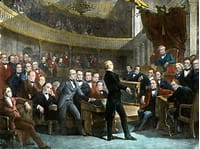
1850 – Henry Clay introduced in the Senate a compromise bill on slavery that included the admission of California into the Union as a free state
The Compromise was actually a series of bills passed mainly to address issues related to slavery. The bills provided for slavery to be decided by popular sovereignty in the admission of new states, prohibited the slave trade in the District of Columbia, settled a Texas boundary dispute, and established a stricter fugitive slave act.
By 1850 sectional disagreements related to slavery were straining the bonds of union between the North and South. These tensions became especially critical when Congress began to consider whether western lands acquired after the Mexican-American War would permit slavery. In 1849, California requested permission to enter the Union as a “free state” – meaning one where slavery was banned. Adding more “free state” senators to Congress would destroy the balance between “slave” and “free” states that had existed since the Missouri Compromise of 1820.
Because everyone looked to the Senate to defuse the growing crisis, Senator Henry Clay of Kentucky proposed a series of resolutions designed to “adjust amicably all existing questions of controversy…arising out of the institution of slavery.” Clay attempted to frame his compromise so that nationally minded senators would vote for legislation in the interest of the Union.
In one of the most famous congressional debates in American history, the Senate discussed Clay’s solution for seven months. It initially voted down his legislative package, but Senator Stephen A. Douglas of Illinois stepped forward with substitute bills, which passed both Houses. With the Compromise of 1850, Congress had addressed the immediate crisis created by the recent territorial expansion.
Source: archives.gov

 Be a Seed for Change
You must be logged in to post a comment.