
Daily Archives: 02/10/2025

hidden figures – Dorothy J. Vaughan … wife, mom and NASA manager

Full Name: Dorothy Johnson Vaughan
Birthdate: September 20, 1910
Birthplace: Kansas City, MO
Education: BA, Mathematics, Wilberforce University 1929
Center: Langley Research Center
Work Dates: 1943 – 1971
Position(s): Computer; Section Head, West Area Computers; Mathematician, ACD
Group(s): West Computers; ACD
Specialties: Flight paths; Scout Project; FORTRAN programming
Biography:
In an era when NASA is led by an African American man (Administrator Charles Bolden) and a woman (Deputy Administrator Dava Newman), when recent NASA Center Directors come from a variety of backgrounds, it’s easy to overlook the people who paved the way for the agency’s current robust and diverse workforce and leadership. Those who speak of NASA’s pioneers rarely mention the name Dorothy Vaughan, but as the head of the NACA’s segregated West Area Computing Unit, Vaughan was both a respected mathematician and NASA’s first African-American manager.
Dorothy Vaughan came to the Langley Memorial Aeronautical Laboratory in 1943, during the height of World War II, leaving her position as the math teacher at Robert Russa Moton High School in Farmville, VA to take what she believed would be a temporary war job. Two years after President Roosevelt signed Executive Order 8802 into law, prohibiting racial, religious and ethnic discrimination in the country’s defense industry, the laboratory began hiring black women to meet the skyrocketing demand for processing aeronautical research data. Urgency and twenty-four hour shifts prevailed– as did Jim Crow laws which required newly-hired “colored” mathematicians to work separately from their white female counterparts. Dorothy Vaughan was assigned to the segregated “West Area Computing” unit, an all-black group of female mathematicians, who were originally required to use separate dining and bathroom facilities. Over time, both individually and as a group, the West Computers distinguished themselves with contributions to virtually every area of research at Langley.
The group’s original section heads (first Margery Hannah, then Blanche Sponsler) were white. In 1949, Dorothy Vaughan was promoted to lead the group, making her the NACA’s first black supervisor, and one of the NACA’s few female supervisors (see also Virginia Tucker). The Section Head title gave Dorothy rare centerwide visibility, and she collaborated with other well-known computers like Vera Huckel and Sara Bullock on projects such as compiling a handbook for algebraic methods for calculating machines. Vaughan was a steadfast advocate for the women of West Computing, and even intervened on behalf of white computers in other groups who deserved promotions or pay raises. Engineers valued her recommendations as to the best “girls” for a particular project, and for challenging assignments they often requested that she personally handle the work.
Dorothy Vaughan helmed West Computing for nearly a decade. In 1958, when the NACA made the transition to NASA, segregated facilities, including the West Computing office, were abolished. Dorothy Vaughan and many of the former West Computers joined the new Analysis and Computation Division (ACD), a racially and gender-integrated group on the frontier of electronic computing. Dorothy Vaughan became an expert FORTRAN programmer, and she also contributed to the Scout Launch Vehicle Program.
Dorothy Vaughan retired from NASA in 1971. She sought, but never received, another management position at Langley. Her legacy lives on in the successful careers of notable West Computing alumni, including Mary Jackson, Katherine Johnson, Eunice Smith and Kathryn Peddrew, and the achievements of second-generation mathematicians and engineers such as Christine Darden.
Share this:

Carter G. Woodson, b. 1875 – From Negro History Week to Black History Month
In 1926, the great historian and author Carter G. Woodson pioneered “Negro History Week” — a time set aside to honor African Americans and their contributions to our history.
“If a race has no history, it has no worthwhile tradition,” Woodson once wrote. “It becomes a negligible factor in the thought of the world, and it stands in danger of being exterminated.”
Share this:

The Proud Legacy of the Buffalo Soldiers
Lonnie Bunch, museum director, historian, lecturer, and author, is proud to present A Page from Our American Story, a regular on-line series for Museum supporters. It will showcase individuals and events in the African American experience, placing these stories in the context of a larger story — our American story.A Page From Our American Story
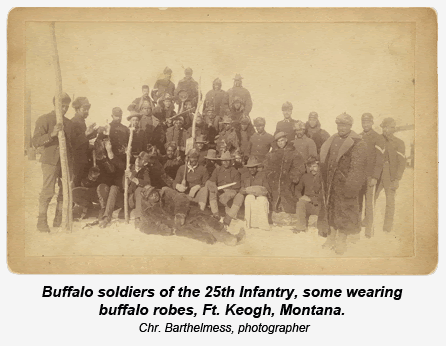
In 1866, an Act of Congress created six all-black peacetime regiments, later consolidated into four –– the 9th and 10th Cavalry, and the 24th and 25th Infantry –– who became known as “The Buffalo Soldiers.” There are differing theories regarding the origin of this nickname. One is that the Plains Indians who fought the Buffalo Soldiers thought that their dark, curly hair resembled the fur of the buffalo. Another is that their bravery and ferocity in battle reminded the Indians of the way buffalo fought. Whatever the reason, the soldiers considered the name high praise, as buffalo were deeply respected by the Native peoples of the Great Plains. And eventually, the image of a buffalo became part of the 10th Cavalry’s regimental crest. Initially, the Buffalo Soldier regiments were commanded by whites, and African-American troops often faced extreme racial prejudice from the Army establishment. Many officers, including George Armstrong Custer, refused to command black regiments, even though it cost them promotions in rank. In addition, African Americans could only serve west of the Mississippi River, because many whites didn’t want to see armed black soldiers in or near their communities. And in areas where Buffalo Soldiers were stationed, they sometimes suffered deadly violence at the hands of civilians.
P.S. We can only reach our $250 million goal with your help. I hope you will consider making a donation or becoming a Charter Member today. |
Share this:

Bernard Whitfield Robinson ~ June 18, 1942 – Black History

Bernard W. Robinson, the first African American Naval officer, commissioned in the US Naval Reserve. Robinson attended Harvard Medical School and became a prominent radiologist after the war. Dedicated to the care of veterans, Robinson served in the Veterans Administration Hospitals system for the remainder of his career, interrupted only by his re-enlistment in the Navy from 1953-55. Robinson passed away suddenly in his Allen Park, Michigan home on August 23rd, 1972.
Robinson’s commission marks one of many firsts for African Americans during WWII, despite unfavorable odds. African Americans were not only fighting for victory abroad, but also victory at home against racial prejudice. On the Home Front and the battlefronts, blacks encountered restrictions solely based on the color of their skin. The military was segregated and African Americans struggled to find jobs in defense factories. If they did manage to secure work, it was usually at a much lower pay than their white counterparts.
Robinson’s experiences mirror other successes, acts of courage, and achievements of African Americans throughout the war. The Tuskegee Airmen became the first black pilots of the war, with a stellar flying record. The Montford Point Marines, who served in the Marshall Islands, Saipan, Guam, Iwo Jima and Okinawa, became the first African American Marines in the Corps’ 167 year history. The all-black 761st Tank Battalion spent 183 days in continuous combat, far surpassing the average of 17 days in continuous service.
 Recognizing the accomplishments and sacrifices of returning black veterans, Harry Truman desegregated the military in 1948. Proving their skill and leadership on the battlefield, former servicemen like Ralph Abernathy, Whitney Young and Medger Evers began to fight for the second part of the Double Victory campaign – Victory at Home- as they returned to the United States at the war’s conclusion.
To learn more and download a fact sheet, visit WWII at a Glance
Teachers! Bring the experiences of African Americans during WWII into your classroom. Book our Double Victory Virtual Field Trip.
Posted by Chrissy Gregg, Virtual Classroom Coordinator at The National WWII Museum.
Resource nww2m.com

 Be a Seed for Change
You must be logged in to post a comment.