Bernard Whitfield Robinson ~ June 18, 1942 – Black History


Bernard W. Robinson, the first African American Naval officer, commissioned in the US Naval Reserve.  Robinson attended Harvard Medical School and became a prominent radiologist after the war. Dedicated to the care of veterans, Robinson served in the Veterans Administration Hospitals system for the remainder of his career, interrupted only by his re-enlistment in the Navy from 1953-55. Robinson passed away suddenly in his Allen Park, Michigan home on August 23rd, 1972.

Robinson’s commission marks one of many firsts for African Americans during WWII, despite unfavorable odds. African Americans were not only fighting for victory abroad, but also victory at home against racial prejudice. On the Home Front and the battlefronts, blacks encountered restrictions solely based on the color of their skin. The military was segregated and African Americans struggled to find jobs in defense factories. If they did manage to secure work, it was usually at a much lower pay than their white counterparts.

Robinson’s experiences mirror other successes, acts of courage, and achievements of African Americans throughout the war. The Tuskegee Airmen became the first black pilots of the war, with a stellar flying record. The Montford Point Marines, who served in the Marshall Islands, Saipan, Guam, Iwo Jima and Okinawa, became the first African American Marines in the Corps’ 167 year history. The all-black 761st Tank Battalion spent 183 days in continuous combat, far surpassing the average of 17 days in continuous service.

Recognizing the accomplishments and sacrifices of returning black veterans, Harry Truman desegregated the military in 1948. Proving their skill and leadership on the battlefield, former servicemen like Ralph Abernathy, Whitney Young and Medger Evers began to fight for the second part of the Double Victory campaign – Victory at Home- as they returned to the United States at the war’s conclusion.

To learn more and download a fact sheet, visit WWII at a Glance

Teachers! Bring the experiences of African Americans during WWII into your classroom. Book our Double Victory Virtual Field Trip.

Posted by Chrissy Gregg, Virtual Classroom Coordinator at The National WWII Museum.

Resource nww2m.com

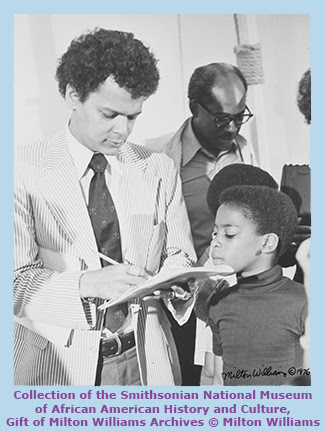
Horace Julian Bond


NMAAHC -- National Museum of African American History and Culture

“We are better people because he walked
among us for a while.”

 
Julian Bond

Julian Bond came of age during that critical time in this nation’s history when winning equal rights for all took a great deal: a clear head, a big heart, a razor-sharp intellect, and a way with words.

Julian Bond had it all. And he could wrap all of it up to create whatever was needed at the time – either a tool or a weapon, a poem or a sermon. He was driven by a commitment to make America better.

While a Morehouse-based member of Student Nonviolent Coordinating Committee (SNCC), helping to organize the Freedom Summer of 1964 and its massive voter registration drive in Mississippi, Julian Bond took to task the American public and President Lyndon B. Johnson.

“We have learned through bitter experience in the past three years that the judicial, legislative and executive bodies of Mississippi form a wall of absolute resistance to granting civil rights to Negroes. It is our conviction that only a massive effort by the country backed by the full power of the President can offer some hope for even minimal change in Mississippi.”

Those words came from a letter Julian Bond wrote on April 28, 1964 to one of America’s most inspiring writers, James Baldwin. He was writing to encourage Baldwin to join a “jury” to hear “testimony” about Civil Rights violations from African Americans facing discrimination in employment, housing, and voting rights in Mississippi. Under a plan designed by SNCC and other members of the Council of Federated Organizations, the testimony would be presented to the President so he would be moved to create a government-sanctioned way to protect the Freedom Summer workers.

“The President must be made to understand that this responsibility rests with him, and him alone, and that neither he nor the American people can afford to jeopardize the lives of the people who will be working in Mississippi this summer by failing to take the necessary precautions before the summer begins.”

Bond’s letter to Baldwin has entered the collections of the National Museum of African American History and Culture. It will be used alongside similar documents to show how people like Julian Bond helped design and fuel the Civil Rights Movement.

Bond was so committed to helping us tell that story well, that he became a member of the museum’s Civil Rights History Project advisory committee. In that role he helped us land interviews with some of the most important workers in the movement; he also conducted two of the more than 150 interviews for this oral history project. One was with Lawrence Guyot, the director of the 1964 Freedom Summer project in Hattiesburg, Mississippi.

Julian Bond wrote his letter to James Baldwin in 1964 at the age of 23. Less than three years later he would be awarded his seat in the Georgia House of Representatives by a unanimous decision of the U.S. Supreme Court. Four years after that, in 1971, he would become the founding president of the Southern Poverty Law Center. Nearly 30 years later, in 1998, he would take the helm of the NAACP serving as its national chairman for an astonishing 12 years.

Julian Bond has spent his life as a champion in the campaign for equality. Much of what we as a nation know about compassion and commitment, we have learned from Julian Bond, the people he emulated and the people he inspired. We are sad because he has left us. And we are deeply honored that we had him for as long as we did … to help us help America live up to her promises. We are better people because he walked among us for a while.

Thank you, Horace Julian Bond.

Lonnie_Signature.jpg
Lonnie G. Bunch
Founding Director
Smithsonian
National Museum of African American History and Culture

1855 ~ US citizenship laws amended; all children of US parents born abroad granted US citizenship


Article I, Section 8, Clause 4: ArtI.S8.C4.1.4.1 Citizenship and Children Born Abroad

[The Congress shall have Power . . . ] To establish an uniform Rule of Naturalization, and uniform Laws on the subject of Bankruptcies throughout the United States; . . .

Apart from the general requirements for the naturalization of aliens in the United States, and the collective naturalization of certain classes of aliens, Congress has also addressed the naturalization of children born abroad to U.S. citizen parents. The concept of naturalization of foreign-born children may be traced to early English laws that allowed children born abroad to English subjects to inherit the rights of their parents.1 The Supreme Court has recognized that this concept of nationality by descent is rooted in statute rather than common law.2 According to the Court, [p]ersons not born in the United States acquire citizenship by birth only as provided by Acts of Congress.3

From the outset, Congress has conferred citizenship on children born outside the United States to U.S. citizen parents. Under the original Naturalization Act of 1790, children of U.S. citizens born outside the United States were considered U.S. citizens unless their fathers had never resided in the United States.4 For the next two centuries, Congress continued to pass legislation providing for the naturalization of children born abroad to U.S. citizens if specified requirements were met.5 These requirements included, among others, establishing a parent’s residence in the United States before the child’s birth; and, with respect to some earlier laws, proving the child’s continuous residence in the United States for specified periods if one of the parents was not a U.S. citizen.6