
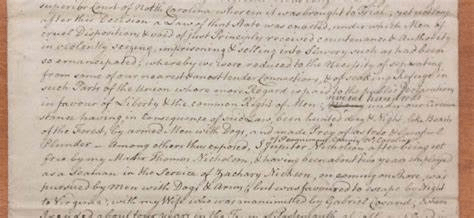
In 1797, four free African Americans, Jupiter Nicholson, Jacob Nicholson, Joe Albert, and Thomas Pritchet, submitted a petition to the U.S. Congress to protect freed slaves from capture and resale, which they believed was “a direct violation of the declared fundamental principles of the Constitution” 1. The petition was presented by Congressman John Swanwick on January 30, 1797, but the House of Representatives denied its hearing in committee 1. This petition was one of the first African American petitions to the U.S. Congress 2.
The petitioners were residents of Philadelphia, Pennsylvania, and had been freed by their owners in North Carolina over a decade earlier 1. They recounted that they had been freed by Quaker slaveholders in North Carolina, but armed men had tried to capture and re-enslave them 3. North Carolina had passed a law in 1788 allowing the capture and sale of any former slave who had been freed without court approval, with twenty percent of the sale price going to the person who reported the illegal manumission 1. Many freed African Americans fled the state to avoid being captured and sold back into slavery 1.
Source: Bing AI

 Be a Seed for Change
You must be logged in to post a comment.