
Monthly Archives: February 2025

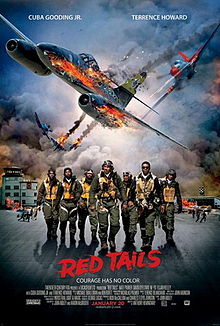
Red Tails …. The story of the Tuskegee Airmen – HD Movie Trailer – Lucas film Official Trailer
by movieclipsTRAILERSon Jul 29, 2011
First Public Promotional Trailer for the feature film RED TAILS.
1944. World War II rages and the fate of the free world hangs in the balance. Meanwhile the black pilots of the experimental Tuskegee training program are courageously waging two wars at once — one against enemies overseas, and the other against discrimination within the military and back home. Racial prejudices have long held ace airman Martin “Easy” Julian (Nate Parker) and his black pilots back at base — leaving them with little to do but further hone their flying skills — while their white counterparts are shipped out to combat after a mere three months of training. Mistakenly deemed inferior and assigned only second-rate planes and missions, the pilots of Tuskegee have mastered the skies with ease but have not been granted the opportunity to truly spread their wings. Until now.
As the war in Europe continues to take its dire toll on Allied forces, Pentagon brass has no recourse but to reconsider these under-utilized pilots for combat duty. Just as the young Tuskegee men are on the brink of being shut down and shipped back home, Col. A.J. Bullard (Terrence Howard) awards them the ultimate chance to prove their mettle high above. Undaunted by the prospect of providing safe escort to bombers in broad daylight — a mission so dangerous that the RAF has refused it and the white fighter groups have sustained substantial losses — Easy’s pilots at last join the fiery aerial fray. Against all the odds, with something to prove and everything to lose, these intrepid young airmen take to the skies in a heroic endeavor to combat the enemy — and the discrimination that has kept them down for so long.
Directed by: Anthony Hemingway.
Starring: Cuba Gooding, Jr., Terrence Howard, Bryan Cranston, Brandon T. Jackson and Nate Parker.
Red Tails is an upcoming film directed by Anthony Hemingway, from a script by John Ridley and story by executive producer George Lucas. It is based on the Tuskegee Airmen, a group of African American combat pilots during World War II, and is the first Lucasfilm Ltd. production since Radioland Murders (1994) not to be associated with the Indiana Jones or Star Wars franchises.
George Lucas began developing Red Tails around 1988. He compared it to Tucker: The Man and His Dream as “a story too good to be true”. Thomas Carter was his original choice to direct. A number of writers worked on the project until John Ridley was hired in 2007 to write the final screenplay. Lucas held discussions with Samuel L. Jackson regarding Jackson possibly directing and acting in the film. Although Jackson praised the script, he did not commit to either role. Anthony Hemingway was finally chosen to direct in 2008. In researching the film, Lucasfilm invited some of the surviving Tuskegee Airmen to Skywalker Ranch, where they were interviewed about their experiences during World War II. Lucasfilm was also given access to the original mission logbooks used by some of the pilots.
Production began in March 2009. High-definition Sony F35 cameras were used for principal photography, which took place in the Czech Republic, Italy, Croatia and England. While shooting in the Czech Republic, the actors underwent a “boot camp” program, during which they lived in similar conditions as the actual Tuskegee Airmen. Editing began while the production was in Prague. Avid editing systems were used simultaneously in a Prague studio and at Lucasfilm. A vehicle was fitted with a “technical center” so that the production could quickly move between locations. In March 2010, Lucas took over direction of reshoots, as Hemingway was busy working on episodes of the HBO series Treme. Hemingway will have final approval over the footage.
Share this:

Nina Simone – Black History

Septima Poinsette – activist,teacher, wife – Black History
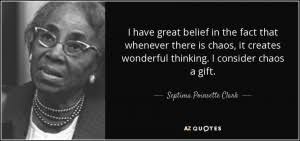
Septima Poinsette Clark was a teacher and civil rights activist whose citizenship schools helped enfranchise and empower African Americans.
Born on May 3, 1898, in Charleston, South Carolina, Septima Poinsette Clark branched out into social action with the NAACP while working as a teacher. As part of the Southern Christian Leadership Conference, she set up citizenship schools that helped many African Americans register to vote. Clark was 89 when she died on December 15, 1987, on South Carolina’s Johns Island.
Early Life
Septima Poinsette Clark was born on in Charleston, South Carolina, May 3, 1898, the second of eight children. Her father—who had been born a slave—and mother both encouraged her to get an education. Clark attended public school, then worked to earn the money needed to attend the Avery Normal Institute, a private school for African Americans.
Teaching and Early Activism
Clark qualified as a teacher, but Charleston did not hire African Americans to teach in its public schools. Instead, she became an instructor on South Carolina’s Johns Island in 1916.
In 1919, Clark returned to Charleston to teach at the Avery Institute. She also joined with the National Association for the Advancement of Colored People in trying to get the city to hire African-American teachers. By gathering signatures in favor of the change, Clark helped ensure that the effort was successful.
Clark married Nerie Clark in 1920. Her husband died of kidney failure five years later. She then moved to Columbia, South Carolina, where she continued teaching and also joined the local chapter of the NAACP. Clark worked with the organization—and with Thurgood Marshall—on a 1945 case that sought equal pay for black and white teachers. She described it as her “first effort in a social action challenging the status quo.” Her salary increased threefold when the case was won.
Civil Rights Leader
Clark was next hired by Tennessee’s Highlander Folk School, an institution that supported integration and the Civil Rights Movement. She had previously participated in and led workshops there during breaks from school (Rosa Parks had attended one of her workshops in 1955).
Clark soon was directing Highlander’s Citizenship School program. These schools helped regular people learn how to instruct others in their communities in basic literacy and math skills. One particular benefit of this teaching was that more people were then able to register to vote (at the time, many states used literacy tests to disenfranchise African Americans).
In 1961, the Southern Christian Leadership Conference took over this education project. Clark then joined the SCLC as its director of education and teaching. Under her leadership, more than 800 citizenship schools were created.
Awards and Legacy
Clark retired from the SCLC in 1970. In 1979, Jimmy Carter honored her with a Living Legacy Award. She received the Order of the Palmetto, South Carolina’s highest civilian honor, in 1982. In 1987, Clark’s second autobiography, Ready from Within: Septima Clark and Civil Rights, won an American Book Award (her first autobiography, Echo in My Soul, had been published in 1962).
Clark was 89 when she died on Johns Island on December 15, 1987. Over her long career of teaching and civil rights activism, she helped many African Americans begin to take control of their lives and discover their full rights as citizens.
Fact Check
We strive for accuracy and fairness. If you see something that doesn’t look right, contact us!
Share this:

Remembering the Harlem Hellfighters – Black History is American History
|

|

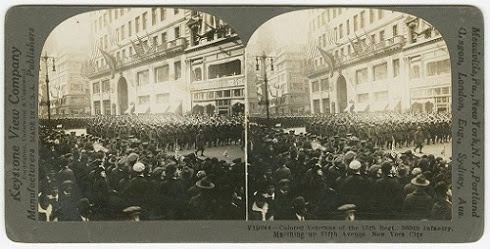 Stereograph of homecoming parade for the Harlem Hellfighters, 1919. Collection of the Smithsonian National Museum of African American History and Culture.
 All the best,

 Be a Seed for Change
You must be logged in to post a comment.