1995 – Bernard Harris becomes the first Black Man to Walk in Space


BornBernard Anthony Harris Jr.
June 26, 1956 (age 67)
Temple, Texas, U.S.
EducationUniversity of Houston (BSMBA)
Texas Tech University (MD)
University of Texas, Galveston (MS)
Space career
NASA astronaut
Time in space18d 6h 8m
SelectionNASA Group 13 (1990)
Total EVAs1
Total EVA time4h 39m
MissionsSTS-55
STS-63
Mission insignia

NASA astronaut Bernard Harris becomes the first Black man to walk in space. His mission contributes to a burgeoning collaboration between the United States and Russia in space exploration.

The Space Race

Bernard Harris stepped out of the space shuttle Discovery in orbit on February 9, 1995. He first embarked on the unlikely journey toward his historic spacewalk as a child, inspired by stargazing in his home state of Texas. Harris described his determination to become an astronaut as a “big leap of faith” at a time when the Apollo 11 moon landing shared headlines with the struggle for civil rights. “The main challenge was the color of my skin.”

Harris earned his medical degree and completed a residency at the Mayo Clinic before joining NASA as a flight surgeon. As an M.D. at NASA, Harris researched how human bone reacts to space flight, and he designed medical devices to help astronauts’ bodies adapt. In 1990, NASA selected him as part of its 13th astronaut class. In his career as an astronaut, Harris spent 18 days in space—and about five hours on his historic spacewalk. He recalled the awe of floating in space, seeing “this blue and white planet…against this backdrop of stars that I initially saw from Earth, and now see in space… Everything had its place. I have a greater sense of belonging, of the connectedness of all of us.” Throughout his NASA career, he traveled more than 7.2 million miles in space.

For the complete article: history.com

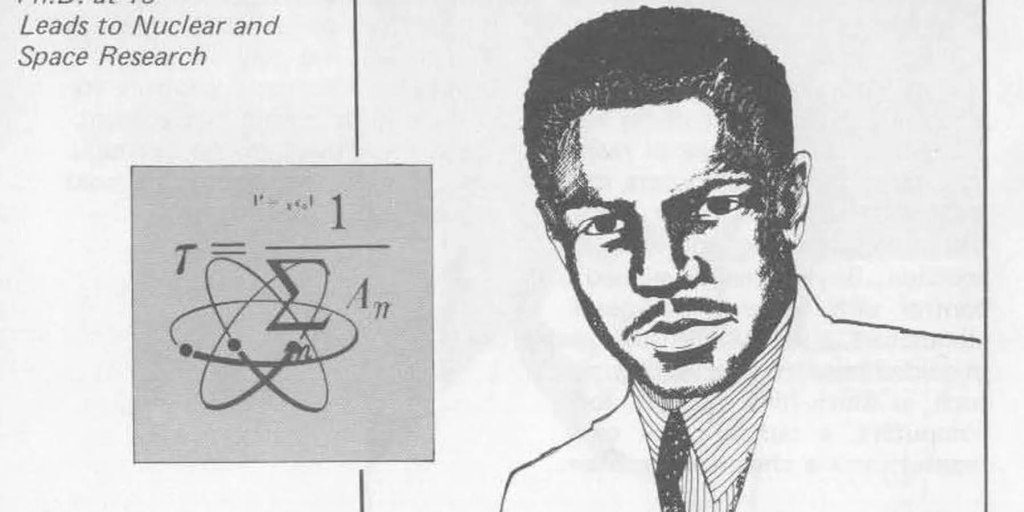
The Unsung African American Scientists of the Manhattan Project


BY: FARRELL EVANS

At least 12 Black chemists and physicists worked as primary researchers on the team that developed the technology behind the atomic bomb.

ZURI SWIMMER/ALAMY STOCK PHOTO

During the height of World War II between 1942 and 1945, the U.S. government’s top-secret program to build an atomic bomb, code-named the Manhattan Project, cumulatively employed some 600,000 people, including scientists, technicians, janitors, engineers, chemists, maids, and day laborers.

While rarely acknowledged, African American men and women were among them—their ranks bolstered by greater wartime employment opportunities and President Franklin D. Roosevelt’s Executive Order 8802 of 1941 outlawing racial discrimination in the defense industries.

At the project’s rural production sites in Oak Ridge, Tennessee, and Hanford, Washington, Black workers were relegated to mostly menial jobs like janitors, cooks, and laborers, regardless of education or experience. But in the project’s urban research centers—the Chicago Metallurgical Laboratory and at Columbia University in New York—several Black scientists were able to play key roles in the development of the two atomic bombs that were released on Hiroshima and Nagasaki in August 1945, effectively ending the war.

For the complete article, go to: history.com

Redefining rape? a repost and reminder


when you vote! #VoteBlueToSaveYourRights

Dear MoveOn member,

Think “no” means “no”?

Well, 173 members of Congress don’t.

A far-reaching anti-choice bill, introduced by Republican Chris Smith and supported by 173 members of the House, includes a provision that could redefine rape and set women’s rights back by decades.1

Right now, federal dollars can’t be used for abortion except in cases of rape, incest, or when the woman’s life is in danger.

But according to the New York Times, the Smith bill would narrow that use to “cases of ‘forcible’ rape but not statutory or coerced rape.”2 This could mean cases where women are “drugged or given excessive amounts of alcohol, rapes of women with limited mental capacity, and many date rapes” would no longer count as rape.3

As far too many women know, bruises and broken bones do not define rape—a lack of consent does. The Smith bill is scary. And with 173 supporters it already has a frightening chance of passage—unless the public speaks up right away with an outcry that can’t be ignored.

Can you sign the petition to Congress today, demanding they oppose the sexist, anti-choice Smith bill? >> http://pol.moveon.org

Federal funds are already severely restricted when it comes to reproductive rights and women’s health care, a situation that ends up hurting lower-income women in particular, who tend to use federally-funded services more often than wealthy women. The last thing we ought to be doing is legislating to make these laws more stringent.

In addition, the Smith bill is full of dangerous anti-choice provisions as well as the rape redefinition. Called “Stupak on Steroids” by NARAL Pro-Choice America in reference to Rep. Bart Stupak‘s failed attempt to push stringent restrictions on insurance coverage for abortion during the health care debate, it would “force millions of American families to pay more taxes if their health plan covers abortion care, jeopardizing abortion coverage in the private market.”4

The Smith bill is just the first of many attacks on women’s rights to come in the new GOP-controlled House.5 If it moves forward, it would set an incredibly dangerous precedent for GOP action in the House for the next two years.

Can you sign the petition asking Congress to denounce the Smith bill to redefine rape?

http://pol.moveon.org

Thanks for all you do.

–Kat, Eli, Milan, Carrie, and the rest of the team

Sources:

1. “The House GOP’s Plan to Redefine Rape,” Mother Jones, January 28, 2011

http://www.moveon.org/r?r=205936&id=25965-9640874-dbC4j7x&t=5

“Stupak on Steroids,” The Hill, January 25, 2011

http://www.moveon.org/r?r=205938&id=25965-9640874-dbC4j7x&t=6

2. “The Two Abortion Wars: A Highly Intrusive Federal Bill,” New York Times, January 29, 2011

http://www.nytimes.com/2011/01/30/opinion/30sun1.html

3. “The House GOP’s Plan to Redefine Rape,” Mother Jones, January 28, 2011

http://www.moveon.org/r?r=205936&id=25965-9640874-dbC4j7x&t=7

“Stupak on Steroids,” The Hill, January 25, 2011

http://www.moveon.org/r?r=205938&id=25965-9640874-dbC4j7x&t=8

5. Ibid.

1956 – The U.S. Supreme Court affirmed the ban on segregation in public schools. – Black History


but the story…. from state to state was much different

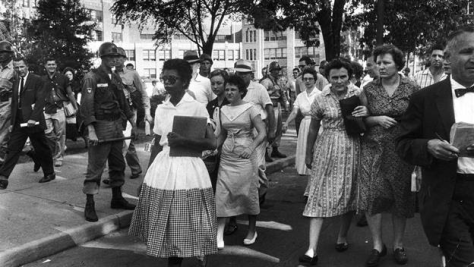
In March 1956, 101 of 128 Southern congressmen signed “The Southern Manifesto,” denouncing the decision. Many Southern communities followed their lead, resisting integration with protest and violence.

When the school board of Mansfield, Texas, a farming town of 1500 people, admitted 12 Black students to all-white Mansfield High School, white residents took to the streets in protest. On August 30, 1956, the first day of school, mobs of white pro-segregationists patrolled the streets with guns and other weapons to prevent Black children from registering.

The mob hung an African American effigy at the top of the school’s flag pole and set it on fire. Attached to each pant leg was a sign. One read, “This Negro tried to enter a white school. This would be a terrible way to die,” and the other read, “Stay away, niggers.” A second effigy was hung on the front of the school building. Soon afterward, the Mansfield School Board voted to “exhaust all legal remedies to delay segregation.” In December 1956, the United States Supreme Court ordered the Mansfield school district to integrate immediately, but Mansfield public schools did not officially desegregate until 1965.

Violent opposition and resistance to desegregation was common throughout the country. In August 1967, more than 13 years after the Brown decision, a report by the U.S. Commission on Civil Rights observed that “violence against Negroes continues to be a deterrent to school desegregation.”