On “Bloody Sunday” March 1965 600 civil rights marchers took to US Rte 80 ~ In Memory


The Selma-to-Montgomery March for voting rights ended three weeks–and three events–that represented the political and emotional peak of the modern civil rights movement.

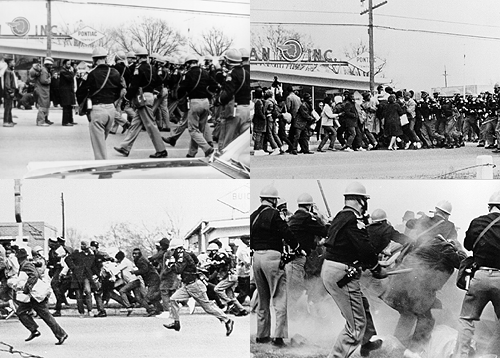
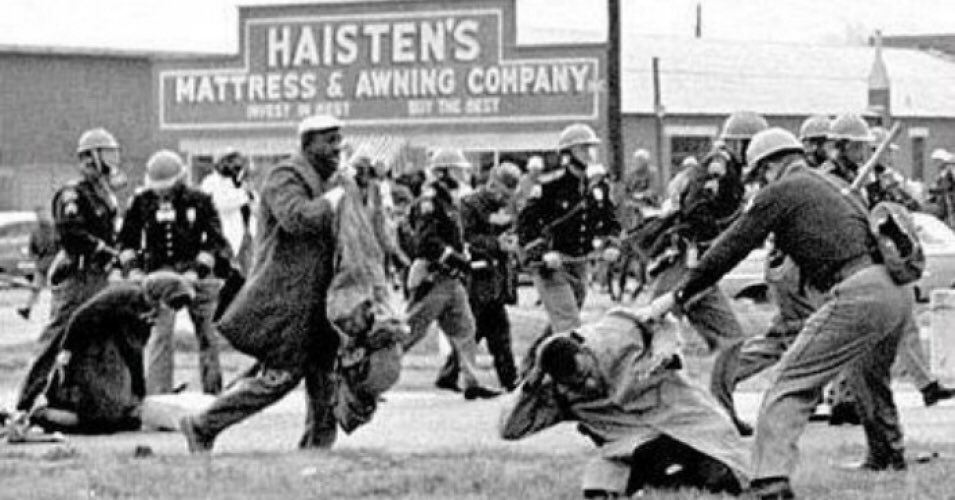
On “Bloody Sunday,” March 7, 1965, some 600 civil rights marchers headed east out of Selma on U.S. Route 80. They got only as far as the Edmund Pettus Bridge six blocks away, where state and local lawmen attacked them with billy clubs and tear gas and drove them back into Selma. Two days later on March 9, Martin Luther King, Jr., led a “symbolic” march to the bridge. Then civil rights leaders sought court protection for a third, full-scale march from Selma to the state capitol in Montgomery. Federal District Court Judge Frank M. Johnson, Jr., weighed the right of mobility against the right to march and ruled in favor of the demonstrators. “The law is clear that the right to petition one’s government for the redress of grievances may be exercised in large groups…,” said Judge Johnson, “and these rights may be exercised by marching, even along public highways.

” On Sunday, March 21, about 3,200 marchers set out for Montgomery, walking 12 miles a day and sleeping in fields. By the time they reached the capitol on Thursday, March 25, they were 25,000-strong. Less than five months after the last of the three marches, President Lyndon Johnson signed the Voting Rights Act of 1965–the best possible redress of grievances.

The Selma-to-Montgomery March, National Historic Trail & All-American Road is one of the subjects of an online lesson plan, The Selma to Montgomery Voting Rights March: Shaking the Conscience of the Nation, produced by Teaching with Historic Places, a program that offers classroom-ready lesson plans on places listed in the National Register of Historic Places. To learn more, visit the Teaching with Historic Places home page.

In 1996 the Selma-to-Montgomery National Historic Trail was created by Congress under the National Trails System Act of 1968. Like other “historic” trails covered in the legislation, the Alabama trail is an original route of national significance in American history. An inter-agency panel of experts recommended, and the Secretary of Transportation designated the trail an “All-American Road”–a road that has national significance, cannot be replicated, and is a destination unto itself. This designation is the highest tribute a road can receive under the Federal Highway Administration’s National Scenic Byways Program, created by the Intermodal Surface Transportation Efficiency Act of 1991.

“remember the ladies” a letter from Abigail Adams


womens_day_2013GOOGLEfeatured photo is from google

In a letter dated March 31, 1776, Abigail Adams writes to her husband, John Adams, urging him and the other members of the Continental Congress not to forget about the nation’s women when fighting for America’s independence from Great Britain.

The future First Lady wrote in part, “I long to hear that you have declared an independency. And, by the way, in the new code of laws which I suppose it will be necessary for you to make, I desire you would remember the ladies and be more generous and favorable to them than your ancestors. Do not put such unlimited power into the hands of the husbands. Remember, all men would be tyrants if they could. If particular care and attention is not paid to the ladies, we are determined to foment a rebellion, and will not hold ourselves bound by any laws in which we have no voice or representation.”

Nearly 150 years before the House of Representatives voted to pass the 19th Amendment giving women the right to vote, Adams letter was a private first step in the fight for equal rights for women. Recognized and admired as a formidable woman in her own right, the union of Abigail and John Adams persists as a model of mutual respect and affection; they have since been referred to as “America’s first power couple.” Their correspondence of over 1,000 letters written between 1762 and 1801 remains in the Massachusetts Historical Society and continues to give historians a unique perspective on domestic and political life during the revolutionary era.

Abigail bore six children, of whom five survived. Abigail and John’s eldest son, John Quincy Adams, served as the sixth president of the United States. Only two women, Abigail Adams and Barbara Bush, have been both wives and mothers of American presidents.

http://www.history.com

on this day … 3/7 Finland granted women the right to vote.


0322 BC – Aristotle, the Greek philosopher, died.

1774 – The British closed the port of Boston to all commerce.

1799 – In Palestine, Napoleon captured Jaffa and his men massacred more than 2,000 Albanian prisoners.

1848 – In Hawaii, the Great Mahele was signed.

1849 – The Austrian Reichstag was dissolved.

1850 – U.S. Senator Daniel Webster endorsed the Compromise of 1850 as a method of preserving the Union.

1854 – Charles Miller received a patent for the sewing machine.

1876 – Alexander Graham Bell received a patent (U.S. Patent No. 174,465) for his telephone.

1901 – It was announced that blacks had been found enslaved in parts of South Carolina.

1904 – The Japanese bombed the Russian town of Vladivostok.

1904 – In Springfield, OH, a mob broke into a jail and shot a black man accused of murder.

1906 – Finland granted women the right to vote.

1908 – Cincinnati’s Mayor Leopold Markbreit announced before the city council that, “Women are not physically fit to operate automobiles.”

1911 – Willis Farnworth patented the coin-operated locker.

1911 – In the wake of the Mexican Revolution, the U.S. sent 20,000 troops to the border of Mexico.

1918 – Finland signed an alliance treaty with Germany.

1925 – The Soviet Red Army occupied Outer Mongolia.

1927 – A Texas law that banned Negroes from voting was ruled unconstitutional by the U.S. Supreme Court.

1933 – CBS radio debuted “Marie The Little French Princess.” It was the first daytime radio serial.

1933 – The board game Monopoly was invented.

1935 – Malcolm Campbell set an auto speed record of 276.8 mph in Florida.

1936 – Hitler sent German troops into the Rhineland in violation of the Locarno Pact and the Treaty of Versailles.

1942 – Japanese troops landed on New Guinea.

1945 – During World War II, U.S. forces crossed the Rhine River at Remagen, Germany.

1947 – John L. Lewis declared that only a totalitarian regime could prevent strikes.

1951 – U.N. forces in Korea under General Matthew Ridgeway launched Operation Ripper against the Chinese.

1954 – Russia appeared for the first time in ice-hockey competition. Russia defeated Canada 7-2 to win the world ice-hockey title in Stockholm, Sweden.

1955 – “Peter Pan” was presented as a television special for the first time.

1955 – Baseball commissioner Ford Frick said that he was in favor of legalizing the spitball.

1955 – Phyllis Diller made her debut at the Purple Onion in San Francisco, CA.

1959 – Melvin C. Garlow became the first pilot to fly over a million miles in jet airplanes.

1965 – State troopers and a sheriff’s posse broke up a march by civil rights demonstrators in Selma, AL.

1968 – The Battle of Saigon came to an end.

1971 – A thousand U.S. planes bombed Cambodia and Laos.

1975 – The U.S. Senate revised the filibuster rule. The new rule allowed 60 senators to limit debate instead of the previous two-thirds.

1981 – Anti-government guerrillas in Colombia executed the kidnapped American Bible translator Chester Allen Bitterman. The guerrillas accused Bitterman of being a CIA agent.

1983 – TNN (The Nashville Network) began broadcasting.

1985 – “Commonwealth” magazine ceased publication after five decades.

1985 – The first AIDS antibody test, an ELISA-type test, was released.

1987 – Mike Tyson became the youngest heavyweight titleholder when he beat James Smith in a decision during a 12-round fight in Las Vegas, NV.

1989 – Poland accused the Soviet Union of a World War II massacre in Katyn.

1994 – The U.S. Supreme Court ruled that parodies that poke fun at an original work can be considered “fair use” that does not require permission from the copyright holder.

1994 – In Moldova, a referendum was rejected by 90% of voters to form a union with Rumania.

1999 – In El Salvador, Francisco Flores Pérez of the ruling Nationalist Republican Alliance (Arena) was elected president.

2002 – A federal judge awarded Anna Nicole Smith more than $88 million in damages. The ruling was the latest in a legal battle over the estate of Smith’s late husband, J. Howard Marshall II.

2003 – Scientists at the Stanford Linear Accelerator Center announced that they had transferred 6.7 gigabytes of uncompressed data from Sunnyvale, CA, to Amsterdam, Netherlands, in 58 seconds. The data was sent via fiber-optic cables and traveled 6,800 miles.

2009 – NASA’s Kepler Mission, a space photometer for searching for extra-solar planets in the Milky Way galaxy, was launched from Cape Canaveral Air Force Station, Florida.

2012 – The successor to Apple’s iPad2 was unveiled.

Bloody Sunday…


READ MORE: How Selma’s ‘Bloody Sunday’ Became a Turning Point in the Civil Rights Movement

Citation Information

Article Title

Civil rights protesters beaten in “Bloody Sunday” attack

AuthorHistory.com Editors

Website Name

HISTORY

URL

https://www.history.com/this-day-in-history/bloody-sunday-civil-rights-protesters-beaten-selma

Access Date

March 6, 2023

Publisher

A&E Television Networks

Last Updated

January 11, 2023

Original Published Date

March 4, 2020