

Monthly Archives: March 2025

on this day … 3/25 1965 – Martin Luther King Jr. led a group of 25,000 to the state capital in Montgomery, AL.
 0421 – The city of Venice was founded.
1306 – Robert the Bruce was crowned king of Scotland.
1409 – The Council of Pisa opened.
1609 – Henry Hudson left on an exploration for Dutch East India Co.
1634 – Lord Baltimore founded the Catholic colony of Maryland.
1655 – Puritans jailed Governor Stone after a military victory over Catholic forces in the colony of Maryland.
1655 – Christian Huygens discovered Titan. Titan is Saturn’s largest satellite.
1669 – Mount Etna in Sicily erupted destroying Nicolosi. 20,000 people were killed.
1700 – England, France and Netherlands ratify the 2nd Extermination Treaty.
1753 – Voltaire left the court of Frederik II of Prussia.
1774 – English Parliament passed the Boston Port Bill.
1776 – The Continental Congress authorized a medal for General George Washington.
1802 – France, Netherlands, Spain and England signed the Peace of Amiens.
1807 – The first railway passenger service began in England.
1807 – British Parliament abolished the slave trade.
1813 – The frigate USS Essex flew the first U.S. flag in battle in the Pacific.
1814 – The Netherlands Bank was established.
1820 – Greece freedom revolt against anti Ottoman attack
1821 – Greece gained independence from Turkey.
1856 – A. E. Burnside patented Burnside carbine.
1857 – Frederick Laggenheim took the first photo of a solar eclipse.
1865 – The SS General Lyon at Cape Hatteras caught fire and sank. 400 people were killed.
1865 – During the American Civil War, Confederate forces captured Fort Stedman in Virginia.
1879 – Japan invaded the kingdom of Liuqiu (Ryukyu) Islands, formerly a vassal of China.
1895 – Italian troops invaded Abyssinia (Ethiopia).
1898 – The Intercollegiate Trapshooting Association was formed in New York City.
1900 – The U.S. Socialist Party was formed in Indianapolis.
1901 – 55 people died when a Rock Island train derailed near Marshalltown, IA.
1901 – The Mercedes was introduced by Daimler at the five-day “Week of Nice” in Nice, France.
1901 – It was reported in Washington, DC, that Cubans were beginning to fear annexation.
1902 – Irving W. Colburn patented the sheet glass drawing machine.
1902 – In Russia, 567 students were found guilty of “political disaffection.” 95 students were exiled to Siberia.
1904 – E.D. Morel and Roger Casement formed the Congo Reform Association in Liverpool.
1905 – Rebel battle flags that were captured during the American Civil War were returned to the South.
1905 – Russia received Japan’s terms for peace.
1907 – Nicaraguan troops took Tegucigalpa, the capital of Honduras.
1908 – Wilhelm II paid an official visit to Italy’s king in Venice.
1909 – In Russia, revolutionary Popova was arrested on 300 murder charges.
1911 – In New York City, 146 women were killed in fire at the Triangle Shirtwaist Company in New York City. The owners of the company were indicted on manslaughter charges because some of the employees had been behind locked doors in the factory. The owners were later acquitted, and in 1914 they were ordered to pay damages to each of the twenty-three families that had sued.
1913 – The Palace Theatre opened in New York City.
1915 – 21 people died when a U.S. F-4 submarine sank off the Hawaiian coast.
1919 – The Paris Peace Commission adopted a plan to protect nations from the influx of foreign labor.
1923 – The British government granted Trans-Jordan autonomy.
1931 – Fifty people were killed in riots that broke out in India. Gandhi was one of many people assaulted.
1931 – The Scottsboro Boys were arrested in Alabama.
1936 – The Detroit Red Wings defeated the Montreal Maroons in the longest hockey game to date. The game lasted for 2 hours and 56 minutes.
1940 – The U.S. agreed to give Britain and France access to all American warplanes.
1941 – Yugoslavia joined the Axis powers.
1941 – The first paprika mill was incorporated in Dollon, SC.
1947 – A coalmine explosion in Centralia, IL, killed 111 people.
1947 – John D. Rockefeller III presented a check for $8.5 million to the United Nations for the purchase of land for the site of the U.N. center.
1953 – The USS Missouri fired on targets at Kojo, North Korea.
1954 – RCA manufactured its first color TV set and began mass production.
1957 – The European Economic Community was established with the signing of the Treaty of Rome.
1960 – A guided missile was launched from a nuclear powered submarine for the first time.
1965 – Martin Luther King Jr. led a group of 25,000 to the state capital in Montgomery, AL.
1966 – The U.S. Supreme Court ruled that the “poll tax” was unconstitutional.
1970 – The Concorde made its first supersonic flight.
1971 – The Boston Patriots became the New England Patriots.
1972 – Bobby Hull joined Gordie Howe to become only the second National Hockey League player to score 600 career goals.
1975 – King Faisal of Saudi Arabia was shot to death by a nephew. The nephew, with a history of mental illness, was beheaded the following June.
1981 – The U.S. Embassy in San Salvador was damaged when gunmen attacked using rocket propelled grenades and machine guns.
1981 – The Down Jones industrial avarage of selected stocks on the New York Stock Exchanged closed at its highest level in more than eight years.
1982 – Wayne Gretzky became the first player in the NHL to score 200 points in a season.
1983 – The U.S. Congress passed legislation to rescue the U.S. social security system from bankruptcy.
1985 – It was reported that a U.S. Army Major stationed in East Germany had been shot and killed by a Soviet Border Guard.
1986 – U.S. President Ronald Reagan ordered emergency aid for the Honduran army. U.S. helicopters took Honduran troops to the Nicaraguan border.
1988 – Robert E. Chambers Jr. pled guilty to first-degree manslaughter in the death of 18-year-old Jennifer Levin. The case was known as New York City’s “preppie murder case.”
1989 – In Paris, the Louvre reopened with I.M. Pei’s new courtyard pyramid.
1990 – A fire in Happy Land, an illegal New York City social club, killed 87 people.
1990 – Estonia voted for independence from the Soviet Union.
1991 – Iraqi President Saddam Hussein launched a major counter-offensive to recapture key towns from Kurds in northern Iraq.
1992 – Soviet cosmonaut Sergei Krikalev returned to Earth after spending 10 months aboard the orbiting Mir space station.
1993 – President de Klerk admitted that South Africa had built six nuclear bombs, but said that they had since been dismantled.
1994 – United States troops completed their withdrawal from Somalia.
1995 – Boxer Mike Tyson was released from jail after serving 3 years.
1996 – An 81-day standoff by the antigovernment Freemen began at a ranch near Jordan, MT.
1996 – The U.S. issued a newly redesigned $100 bill for circulation.
1998 – A cancer patient was the first known to die under Oregon‘s doctor-assisted suicide law.
1998 – The FCC nets $578.6 million at auction for licenses for new wireless technology.
1998 – Quinn Pletcher was found guilty on charges of extortion. He had threatened to kill Bill Gates unless he was paid $5 million.
2002 – The Federal Communications Commission (FCC) dismissed complaints against Walt Disney Co.’s ABC network broadcast of a Victoria’s Secret fashion show in November 2001.
2004 – The U.S. Senate voted (61-38) on the Unborn Victims of Violence Act (H.R. 1997) to make it a separate crime to harm a fetus during the commission of a violent federal crime.
Share this:

Women’s History Month


on this day … 3/25 The 16th Amendment to the U.S. Constitution was ratified
1570 – England’s Queen Elizabeth I was excommunicated by Pope Pius V.
1751 – Edward Willet displayed the first trained monkey act in the U.S.
1791 – First Bank of the United States (The President, Directors and Company, of the Bank of the United States) was chartered by the U.S. Congress and signed by President Washington.
1793 – The department heads of the U.S. government met with U.S. President Washington for the first Cabinet meeting on U.S. record.
1836 – Samuel Colt received U.S. Patent No. 138 (later 9430X) for a “revolving-cylinder pistol.” It was his first patent.
1901 – The United States Steel Corp. was incorporated by J.P. Morgan.
1913 – The 16th Amendment to the U.S. Constitution was ratified. It authorized a graduated income tax.
1919 – The state of Oregon became the first state to place a tax on gasoline. The tax was 1 cent per gallon.
1928 – The Federal Radio Commission issued the first U.S. television license to Charles Jenkins Laboratories in Washington, DC.
1930 – The bank check photographing device was patented.
1933 – The aircraft carrier Ranger was launched. It was the first ship in the U.S. Navy to be designed and built from the keel up as an aircraft carrier.
1837 – Thomas Davenport patented the first commercial electrical motor. There was no practical electical distribution system available and Davenport went bankrupt.
1940 – The New York Rangers and the Montreal Canadiens played in the first hockey game to be televised in the U.S. The game was aired on W2WBS in New York with one camera in a fixed position. The Rangers beat the Canadiens 6-2.
1948 – Communists seized power in Czechoslovakia.
1950 – “Your Show of Shows” debuted on NBC.
1956 – Soviet leader Nikita Khrushchev criticized the late Josef Stalin in a speech before a Communist Party congress in Moscow.
1972 – Germany gave a $5 million ransom to Arab terrorists who had hijacked a jumbo jet.
1986 – Filippino President Ferdinand E. Marcos fled the Philippines after 20 years of rule after a tainted election.
1999 – William King was sentenced to death for the racial murder of James Byrd Jr in Jasper, TX. Two other men charged were later convicted for their involvement.
1999 – In Moscow, China’s Prime Minister Zhu Rongji and Russia’s President Boris Yeltsin discussed trade and other issues.
2000 – In Albany, NY, a jury acquitted four New York City police officers of second-degree murder and lesser charges in the February 1999 shooting death of Amadou Diallo.
2005 – Dennis Rader was arrested for the BTK serial killings in Wichita, KS. He later pleaded guilty and was sentenced to 10 life prison terms.
Share this:

Slavery Emancipation and freedom- the journey of – In Memory
By Lestey Gist, The Gist of Freedom
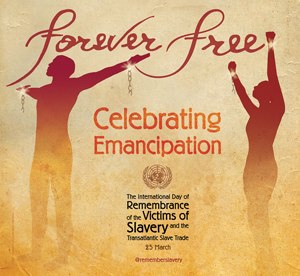
Celebration: The Abolishment of Slavery Worldwide!
The annual observance in March of the International Day of Remembrance for the Victims of Slavery and the Transatlantic Slave Trade
This year’s theme, “Forever Free: Celebrating Emancipation,” pays tribute to the emancipation of slaves in nations across the world. This year is particularly important with many key anniversaries, including 220 years since France’s General Emancipation decree liberated all slaves in present-day Haiti; 180 years since the Slavery Abolition Act of 1833 ended slavery in Canada, the British West Indies and the Cape of Good Hope; and 170 years ago, the Indian Slavery Act of 1843 was signed. Slavery was also abolished 165 years ago in France; 160 years ago in Argentina; 150 years ago in the Dutch colonies; and 125 years ago in Brazil.
2013 is also the anniversary of the Emancipation Proclamation in the United States, which declared that, on 1 January 1863, all persons held as slaves within any States, or designated part of the State, the people whereof shall be in rebellion against the United States, shall be then, thenceforward, and forever free.
For over 400 years, more than 15 million men, women, and children were the victims of the tragic transatlantic slave trade, one of the darkest chapters in human history.
The annual observance of 25 March as the International Day of Remembrance for the Victims of Slavery and the Transatlantic Slave Trade serves as an opportunity to honor and remember those who suffered and died at the hands of the brutal slavery system, and to raise awareness about the dangers of racism and prejudice today.
220 years since France’s General Emancipation decree liberated all slaves in present-day Haiti;
180 years since the Slavery Abolition Act of 1833 ended slavery in Canada, the British West Indies and the Cape of Good Hope; and
170 years ago, the Indian Slavery Act of 1843 was signed.
165 years ago it was abolished in France;
160 years ago in Argentina;
150 years ago in the Dutch colonies; and
125 years ago in Brazil.
Source: blackthen.com

 Be a Seed for Change
You must be logged in to post a comment.