
|
Daily Archives: 04/20/2025



1871 – Third Force Act – Ku Klux Klan Act passed by Congress
With passage of the Third Force Act, popularly known as the Ku Klux Act, Congress authorizes President Ulysses S. Grant to declare martial law, impose heavy penalties against terrorist organizations and use military force to suppress the Ku Klux Klan (KKK).
Founded in 1865 by a group of Confederate veterans, the KKK rapidly grew from a secret social fraternity to a paramilitary force bent on reversing the federal government’s progressive Reconstruction Era-activities in the South, especially policies that elevated the rights of the local African American population. The name of the Ku Klux Klan was derived from the Greek word kyklos, meaning “circle,” and the Scottish-Gaelic word “clan,” which was probably chosen for the sake of alliteration. Under a platform of philosophized white racial superiority, the group employed violence as a means of pushing back Reconstruction and its enfranchisement of African-Americans. Former Confederate General Nathan Bedford Forrest was the KKK’s first grand wizard and in 1869 unsuccessfully tried to disband it after he grew critical of the Klan’s excessive violence.Play Video
Ku Klux Klan
Most prominent in counties where the races were relatively balanced, the KKK engaged in terrorist raids against African Americans and white Republicans at night, employing intimidation, destruction of property, assault and murder to achieve its aims and influence upcoming elections. In a few Southern states, Republicans organized militia units to break up the Klan. In 1871, passage of the Ku Klux Act led to nine South Carolina counties being placed under martial law and thousands of arrests. In 1882, the U.S. Supreme Court declared the Ku Klux Act unconstitutional, but by that time Reconstruction had ended, and much of the KKK had faded away.
Source: history.com
For the complete article, click the link above
Share this:

on this day … 4/20 The Columbine High School massacre
1139 – The Second Lateran Council opened in Rome.

1534 – Jacques Cartier, a French explorer, set sail from St. Malo to explore the North American coastline.
1653 – In England, Oliver Cromwell expelled the Long Parliament for trying to pass the Perpetuation Bill that would have kept Parliament in the hands of only a few members.
1657 – English Admiral Robert Blake fought his last battle when he destroyed the Spanish fleet in Santa Cruz Bay.
1689 – The siege of Londonderry began. Supporters of James II attacked the city.
1769 – Ottawa Chief Pontiac was murdered by an Illinois Indian in Cahokia.
1775 – American troops began the siege of British-held Boston.
1792 – France declared war on Austria, Prussia, and Sardinia. It was the start of the French Revolutionary wars.
1809 – Napoleon defeated Austria at Battle of Abensberg, Bavaria.
1832 – Hot Springs National Park was established by an act of the U.S. Congress. It was the first national park in the U.S.
1836 – The U.S. territory of Wisconsin was created by the U.S. Congress.
1837 – Erastus B. Bigelow was granted a patent for his power loom.
1841 – In Philadelphia, PA, Edgar Allen Poe’s first detective story, “The Murders in the Rue Morgue,” was published in Graham’s Magazine.
1861 – Robert E. Lee resigned from U.S. Army.
1865 – Safety matches were first advertised.
1879 – First mobile home (horse drawn) was used in a journey from London to Cyprus.
1902 – Scientists Marie and Pierre Curie isolated the radioactive element radium.
1912 – Fenway Park opened as the home of the Boston Red Sox.
1916 – Sir Roger Casement landed in Ireland to incite rebellion against the British. Casement, a British diplomat, was captured within hours and was hanged for high treason on August 3.
1916 – Chicago’s Wrigley Field held its first Cubs game with the first National League game at the ballpark. The Cubs beat the Cincinnati Reds 7-6 in 11 innings.
1919 – The Polish Army captured Vilno, Lithuania from the Soviets.
1940 – The First electron microscope was demonstrated by RCA.
1942 – Pierre Laval, the premier of Vichy France, in a radio broadcast, establishes a policy of “true reconciliation with Germany.”
1945 – Soviet troops began their attack on Berlin.
1945 – During World War II, Allied forces took control of the German cities of Nuremberg and Stuttgart.
1953 – Operation Little Switch began in Korea. It was the exchange of sick and wounded prisoners of war. Thirty Americans were freed.
1953 – The Boston marathon was won by Keizo Yamada with a record time of 2:18:51.
1959 – “Desilu Playhouse” on CBS-TV presented a two-part show titled “The Untouchables.”
1961 – FM stereo broadcasting was approved by the FCC.
1962 – The New Orleans Citizens’ Council offered a free one-way ride for blacks to move to northern states.
1967 – U.S. planes bombed Haiphong for first time during the Vietnam War.
1971 – The U.S. Supreme Court upheld the use of busing to achieve racial desegregation in schools.
1972 – The manned lunar module from Apollo 16 landed on the moon.
1977 – Woody Allen’s film “Annie Hall” premiered.
1981 – A spokesman for the U.S. Nave announced that the U.S. was accepting full responsibility for the sinking of the Nissho Maru on April 9.
1982 – The Activision game Pitfall! was released for the Atari 2600 game system.
1984 – Britain announced that its administration of Hong Kong would cease in 1997.
1985 – In Madrid, Santiago Carillo was purged from the Communist Party. Carillo was a founder of Eurocommunism.
1987 – In Argentina, President Raul Alfonsin quelled a military revolt.
1988 – The U.S. Air Forces’ Stealth (B-2 bomber) was officially unveiled.
1989 – Scientist announced the successful testing of high-definition TV.
1991 – Mikhail Gorbachev became the first Soviet head of state to visit South Korea.
1992 – The worlds largest fair, Expo ’92, opened in Seville, Spain.
1998 – Kenyan runner Moses Tanui, 32, won the Boston Marathon for the second time. He also registered the third fastest time with 2 hours 7 minutes and 34 seconds.
1999 – The Columbine High School massacre was a school shooting that occurred on April 20, 1999, at Columbine High School in Columbine, an unincorporated area of Jefferson County in the American state of Colorado.wiki
Share this:

1962 – The New Orleans Citizens’ Council offered a free one-way ride for blacks to move to northern states.
Reverse Freedom Rides were attempts in 1962 by segregationists in the Southern United States to send African Americans from southern cities to mostly northern, and some western, cities by bus.[1][2] They were given free one-way bus tickets and were promised guaranteed high-paying jobs and free housing. Those promises were intended to lure African Americans in. In reality, there was no guaranteed free housing or jobs waiting for them. Some of those arriving were able to find work; most could not.[3]
People need to hear see and witness this ugly part of American History so it never ever happens again!
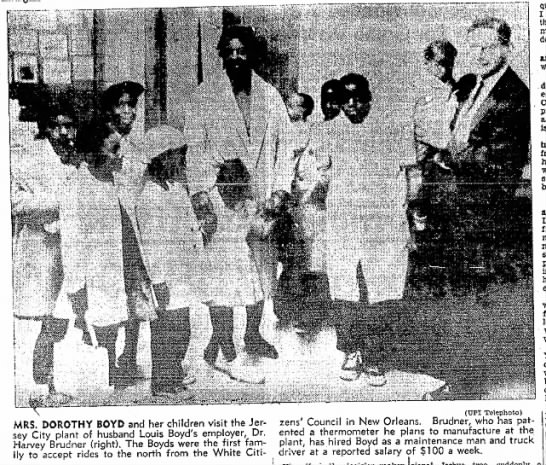
The first Reverse Freedom Riders were the Boyd family were sent from New Orleans to New York City. Lewis and Dorothy Boyd arrived at the Port Authority Bus Terminal in New York City after a forty-three-hour ride with their eight children.
There was no job waiting for them, but the media was. With each ride sent, the Citizens’ Council would tip off the press to ensure media coverage.
The Boyds were chosen as the first family as they knew the media would be particularly attracted to them and Singelmann viewed them as high priority to remove from the state, since they already had eight children, were expecting one more and Lewis Boyd had been unemployed for three years.[10][1][3][8]Source: wiki
If you find any errors, please let me know. The topic above has slim to no real information available and this was very disappointing. This was a true wtf moment in History… We cannot go back to these times
wiki has quite a few articles on the 1962 attempt. It is up to the reader to decide which ones are accurate

 Be a Seed for Change
You must be logged in to post a comment.