1963 – Letter from a Birmingham Jail


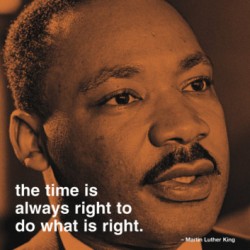
On April 16, 1963, days after being jailed in Birmingham, Alabama, for a series of anti-segregation protests, Dr. Martin Luther King, Jr. pens a response to his critics on some scraps of paper. This open letter, now known as his “Letter from a Birmingham Jail,” offered a forceful defense of the protest campaign. It is now regarded as one of the greatest texts of the American civil rights movement.

On April 16, 1963, days after being jailed in Birmingham, Alabama, for a series of anti-segregation protests, Dr. Martin Luther King, Jr. pens a response to his critics on some scraps of paper. This open letter, now known as his “Letter from a Birmingham Jail,” offered a forceful defense of the protest campaign. It is now regarded as one of the greatest texts of the American civil rights movement.

for the complete article: history.com

Easter …history of


Easter, which celebrates Jesus Christ’s resurrection from the dead, is Christianity’s most important holiday. It has been called a moveable feast because it doesn’t fall on a set date every year, as most holidays do.

Instead, Christian churches in the West celebrate Easter on the first Sunday following the full moon after the vernal equinox on March 21. Therefore, Easter is observed anywhere between March 22 and April 25 every year. Orthodox Christians use the Julian calendar to calculate when Easter will occur and typically celebrate the holiday a week or two after the Western churches, which follow the Gregorian calendar.

The exact origins of this religious feast day’s name are unknown. Some sources claim the word Easter is derived from Eostre, a Teutonic goddess of spring and fertility. Other accounts trace Easter to the Latin term hebdomada alba, or white week, an ancient reference to Easter week and the white clothing donned by people who were baptized during that time. Through a translation error, the term later appeared as esostarum in Old High German, which eventually became Easter in English. In Spanish, Easter is known as Pascua; in French, Paques. These words are derived from the Greek and Latin Pascha or Pasch, for Passover. Jesus‘ crucifixion and resurrection occurred after he went to Jerusalem to celebrate Passover (or Pesach in Hebrew), the Jewish festival commemorating the ancient Israelites’ exodus from slavery in Egypt. Pascha eventually came to mean Easter.

Did You Know?

Over 90 million chocolate Easter bunnies are made each year

Easter is really an entire season of the Christian church year, as opposed to a single-day observance. Lent, the 40-day period leading up to Easter Sunday, is a time of reflection and penance and represents the 40 days that Jesus spent alone in the wilderness before starting his ministry, a time in which Christians believe he survived various temptations by the devil. The day before Lent, known as Mardi Gras or Fat Tuesday, is a last hurrah of food and fun before the fasting begins. The week preceding Easter is called Holy Week and includes Maundy Thursday, which commemorates Jesus’ last supper with his disciples; Good Friday, which honors the day of his crucifixion; and Holy Saturday, which focuses on the transition between the crucifixion and resurrection. The 50-day period following Easter Sunday is called Eastertide and includes a celebration of Jesus’ ascension into heaven.

In addition to Easter’s religious significance, it also has a commercial side, as evidenced by the mounds of jelly beans and marshmallow chicks that appear in stores each spring. As with Christmas, over the centuries various folk customs and pagan traditions, including Easter eggs, bunnies, baskets and candy, have become a standard part of this holy holiday.

History.com

1775 – The first abolitionist society in U.S. was organized in Philadelphia with Ben Franklin as president.


Pennsylvania Society for Promoting

the Abolition of Slavery

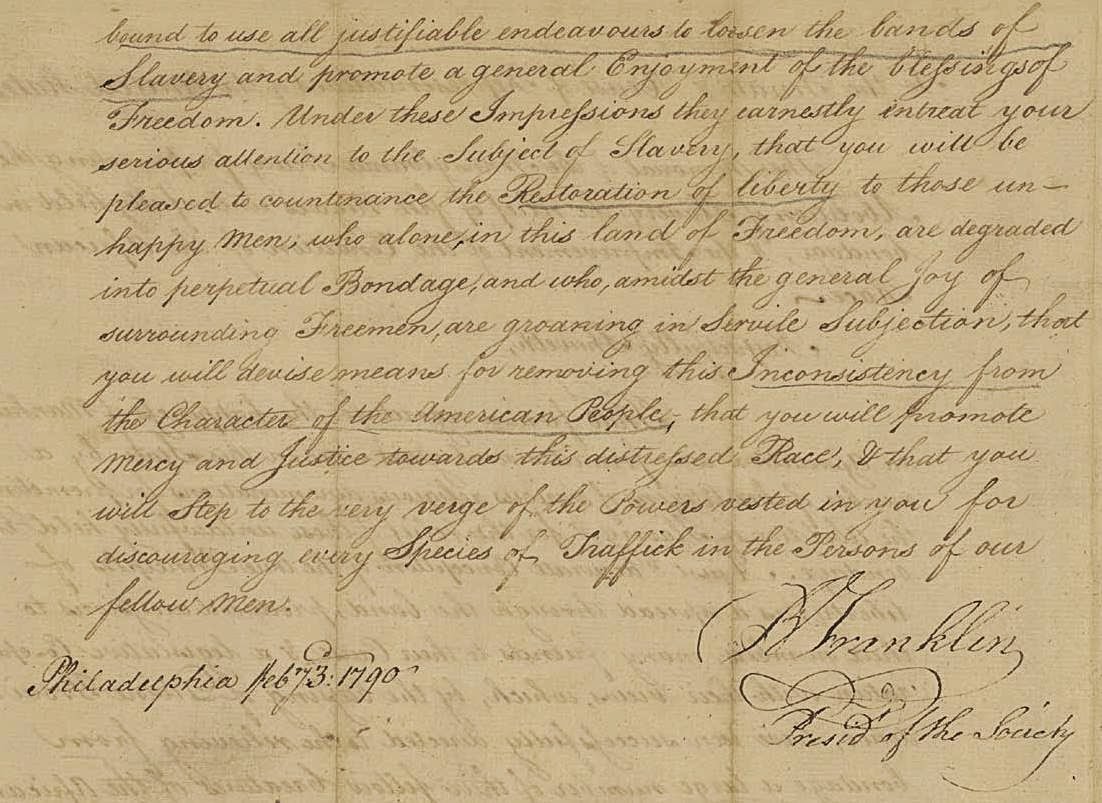
In his later years, Benjamin Franklin became vocal as an abolitionist and in 1787 began to serve as President of the Pennsylvania Society for Promoting the Abolition of Slavery. This Constitution was enacted by Franklin just one month before he would join the Constitutional Convention of 1787 held in Philadelphia.

The Society was originally formed April 14, 1775, in Philadelphia, as The Society for the Relief of Free Negroes Unlawfully Held in Bondage; it was reorganized April 16 in 1784, and, in 1787, it enacted this constitution which appeared in print for the first time in this Philadelphia Magazine while the delegates were all assembled at the Constitutional Convention. The Society not only advocated the abolition of slavery, but made efforts to integrate freed slaves into American society.

For the complete article:

source: benjaminfranklin.org

history… April 14


1775 – The first abolitionist society in U.S. was organized in Philadelphia with Ben Franklin as president.

1793 – A royalist rebellion in Santo Domingo was crushed by French republican troops.

1828 – The first edition of Noah Webster’s dictionary was published under the name “American Dictionary of the English Language.”

1860 – The first Pony Express rider arrived in San Francisco with mail originating in St. Joseph, MO.

1865 – U.S. President Abraham Lincoln was assassinated in Ford’s Theater by John Wilkes Booth. He actually died early the next morning.

1889 – The first international Conference of American States began in Washington, DC.

1894 – First public showing of Thomas Edison’s kinetoscope took place.

1902 – James Cash (J.C.) Penney opened his first retail store in Kemmerer, WY. It was called the Golden Rule Store.

1910 – U.S. President William Howard Taft threw out the first ball for the Washington Senators and the Philadelphia Athletics.

1912 – The Atlantic passenger liner Titanic, on its maiden voyage hit an iceberg and began to sink. 1,517 people lost their lives and more than 700 survived.

1918 – The U.S. First Aero Squadron engaged in America’s first aerial dogfight with enemy aircraft over Toul, France.

1925 – WGN became the first radio station to broadcast a regular season major league baseball game. The Cubs beat the Pirates 8-2.

1931 – King Alfonso XIII of Spain went into exile and the Spanish Republic was proclaimed.

1939 – The John Steinbeck novel “The Grapes of Wrath” was first published.

1946 – The civil war between Communists and nationalist resumed in China.

1953 – Viet Minh invaded Laos with 40,00 troops.

1956 – Ampex Corporation of Redwood City, CA, demonstrated the first commercial magnetic tape recorder for sound and picture.

1959 – The Taft Memorial Bell Tower was dedicated in Washington, DC.

1969 – For the first time, a major league baseball game was played in Montreal, Canada.

1981 – America’s first space shuttle, Columbia, returned to Earth after a three-day test flight. The shuttle orbited the Earth 36 times during the mission.

1984 – The Texas Board of Education began requiring that the state’s public school textbooks describe the evolution of human beings as “theory rather than fact”.

1985 – The Russian paper “Pravda” called U.S. President Reagan‘s planned visit to Bitburg to visit the Nazi cemetery an “act of blasphemy”.

1986 – U.S. President Reagan announced the U.S. air raid on military and terrorist related targets in Libya.

1987 – Soviet leader Mikhail Gorbachev proposed banning all missiles from Europe.

1988 – Representatives from the U.S.S.R., Pakistan, Afghanistan and the U.S. signed an agreement that called for the withdrawal of Soviet forces from Afghanistan starting on May 15. The last Soviet troop left Afghanistan on February 15, 1989.

1988 – In New York, real estate tycoons Harry and Leona Helmsley were indicted for income tax evasion.

1990 – Cal Ripken of the Baltimore Orioles began a streak of 95 errorless games and 431 total chances by a shortstop.

1994 – Two American F-15 warplanes inadvertently shot down two U.S. helicopters over northern Iraq. 26 people were killed including 15 Americans.

1998 – The state of Virginia ignored the requests from the World Court and executed a Paraguayan for the murder of a U.S. woman.

1999 – Pakistan test-fired a ballistic missile that was capable of carrying a nuclear warhead and reaching its rival neighbor India.

2000 – After five years of deadlock, Russia approved the START II treaty that calls for the scrapping of U.S. and Russian nuclear warheads. The Russian government warned it would abandon all arms-control pacts if Washington continued with an anti-missile system.

2002 – U.S. President George W. Bush sent a letter of congratulations to JCPenny’s associates for being in business for 100 years. James Cash (J.C.) Penney had opened his first retail store on April 14, 1902.

2002 – Venezuelan President Hugo Chavez returned to office two days after being arrested by his country’s military.

2008 – Delta Air Lines and Northwest Airlines announced they were combining.

Source:

on-this-day.com