Apollo 13 oxygen tank explodes


On April 13, 1970, disaster strikes 200,000 miles from Earth when oxygen tank No. 2 blows up on Apollo 13, the third manned lunar landing mission. Astronauts James A. Lovell, John L. Swigert, and Fred W. Haise had left Earth two days before for the Fra Mauro highlands of the moon but were forced to turn their attention to simply making it home alive.

For the complete article … history.com

Citation Information

Article Title

Apollo 13 oxygen tank explodes

AuthorHistory.com Editors

Website Name

HISTORY

URL

https://www.history.com/this-day-in-history/apollo-13-oxygen-tank-explodes

Access Date

April 13, 2022

Publisher

A&E Television Networks

Last Updated

April 12, 2021

Original Published Date

February 9, 2010

SPACE

BY

 HISTORY.COM EDITORS

FACT CHECK: We strive for accuracy and fairness. But if you see something that doesn’t look right, click here to contact us! HISTORY reviews and updates its content regularly to ensure it is complete and accurate

Image of Astronauts: apollo13page.tripod.com

1873 – Colfax Massacre


An armed group of white supremacists attacks a courthouse guarded by a mostly-Black militia in the town of Colfax, Louisiana on April 13, 1873. A bloodbath ensues, as the militia surrenders and the white supremacists carry out a day-long campaign of terror that came to be known as the Colfax Massacre.

Source: For the complete article: history.com

Citation Information

Article Title

The Colfax Massacre

AuthorHistory.com Editors

Website Name

HISTORY

URL

https://www.history.com/this-day-in-history/colfax-massacre-louisiana

Date

April 12, 2023

Publisher

A&E Television Networks

Last Updated

April 5, 2023

Original Published Date

April 5, 2023

1963 – April 3rd – April 12th


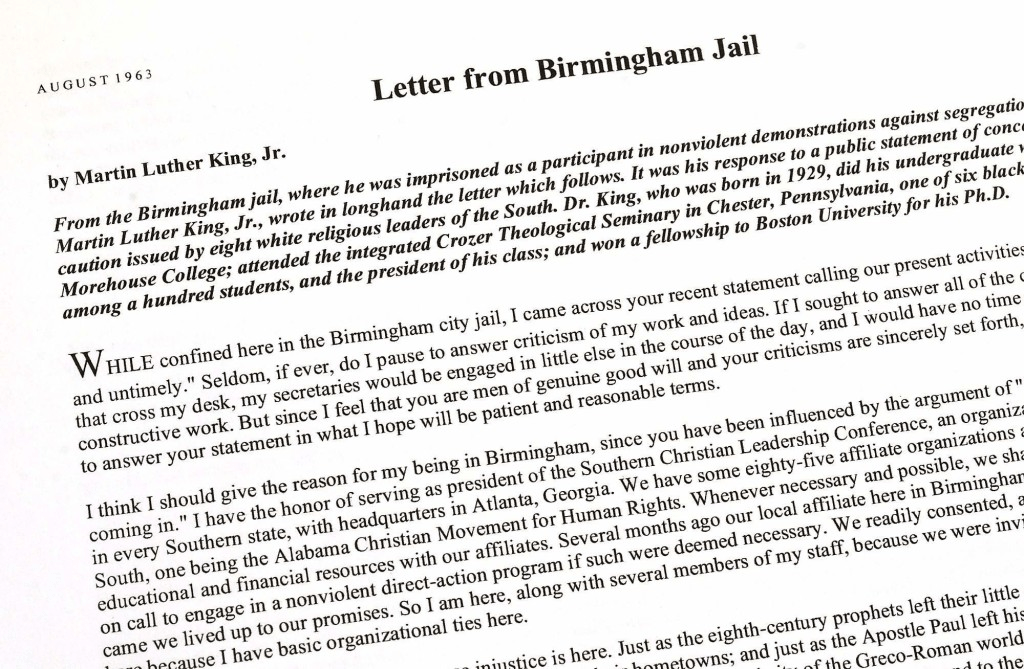
Martin Luther King Jr. is jailed; writes “Letter from a Birmingham Jail”

On April 3, 1963, the Rev. Dr. Martin Luther King Jr., his Southern Christian Leadership Conference and their partners in the Alabama Christian Movement for Human Rights led a campaign of protests, marches and sit-ins against segregation in Birmingham, Alabama. By April 12, King was in prison along with many of his fellow activists. While imprisoned, King penned an open letter now known as his “Letter from a Birmingham Jail,” a full-throated defense of the Birmingham protest campaign that is now regarded as one of the greatest texts of the civil rights movement.

On April 12, , King and dozens of his fellow protestors were arrested for continuing to demonstrate in the face of an injunction obtained by Commissioner of Public Safety Theophilus Eugene “Bull” Connor. Connor, who had just lost the mayoral election, remains one of the most notorious pro-segregationists in American history thanks to the brutal methods his forces employed against the Birmingham protestors that summer. The man who had won the election, Albert Boutwell, was also a segregationist, and he was one of many who accused “outsiders”—he clearly meant King—of stirring up trouble in Birmingham. As he sat in a solitary jail cell without even a mattress to sleep on, King began to pen a response to his critics on some scraps of paper.  …read more

history.com

Article Title

Martin Luther King Jr. is jailed; writes “Letter from a Birmingham Jail”

AuthorHistory.com Editors

Website Name

HISTORY

URL

https://www.history.com/this-day-in-history/martin-luther-king-jr-writes-letter-from-a-birmingham-jail

Access Date

April 11, 2022

Publisher

A&E Television Networks

Last Updated

January 18, 2022

Original Published Date

January 12, 2021

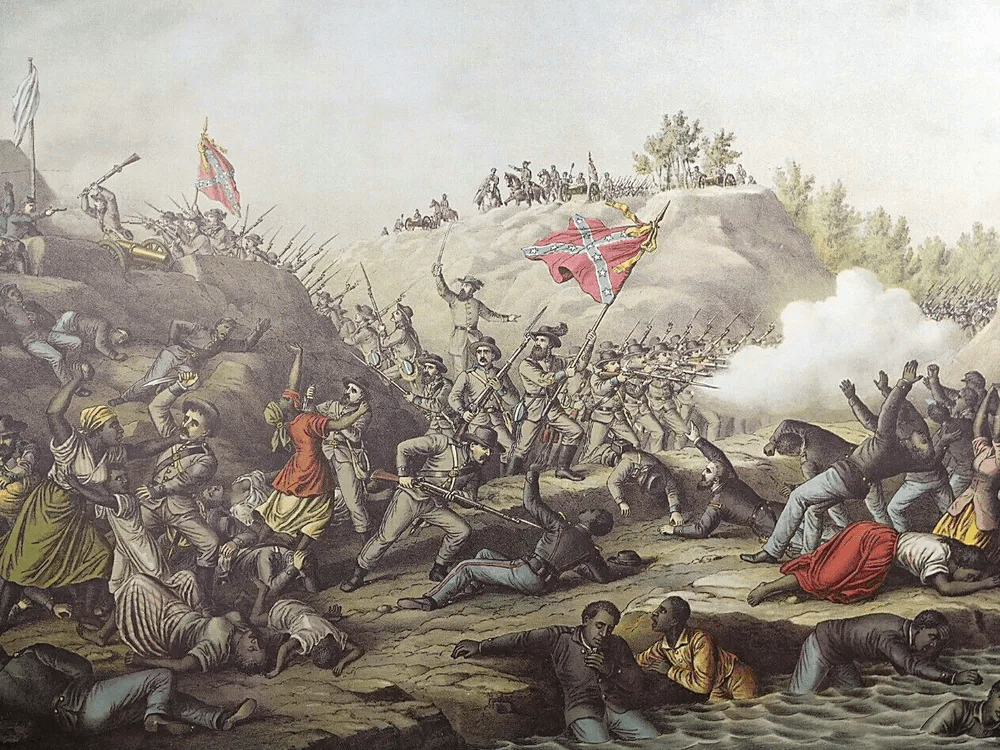
1864 – Confederate Gen. Nathan Bedford Forrest captured Fort Pillow, in Tennessee and slaughters the black Union troops there.


A hand-colored 1892 print of the Battle of Fort Pillow Public domain via Wikimedia Commons

When Yulanda Burgess first visited Tennessee’s Fort Pillow State Historic Park in 2006, she hoped to see where her great-grandfather Armstead Burgess, a member of the United States Colored Troops (USCT), was taken captive by Confederate soldiers on April 12, 1864. Burgess wanted to walk the same ground as her ancestor. Instead, she got lost.

For nearly a decade, Yulanda Burgess has come to the historic park every April 12 to read the names of the dead and lay wreaths of white carnations and rosemary. Courtesy of Yulanda Burgess

The park’s trails were washed out by years of heavy rain and spotty maintenance. The few pathways that remained open were poorly marked, with faded paper signs in plastic sleeves nailed to the occasional tree. “That’s how it was before Robby Tidwell took charge,” Burgess says.

Tidwell, the Tennessee State Parks ranger who now manages the site, whacked weeds on Fort Pillow’s earthen fortifications when he was in high school. He found himself drawn to the fort, where one of the greatest tragedies of the Civil War took place—a battle that resulted in the deaths of almost 250 Union soldiers, the majority of whom were Black.

Source: smithsonianmag.com