

Slavery is a central paradox of much of American history. In fact, most of the country’s founding fathers owned slaves.

On April 19, 1809, former President Thomas Jefferson writes up a contract for the sale of an indentured servant named John Freeman to newly sworn-in President James Madison.
Slavery and indentured servitude were major components of the early American economy. Enslaved workers performed most of the manual and domestic labor on the large plantations owned by several presidents and their colonial ancestors, including George Washington, Thomas Jefferson, James Madison and Andrew Jackson. While enslaved workers were primarily African and Native Americans, indentured servants in the late 1600s to early 1700s were usually impoverished white men of English descent who resorted to selling themselves into servitude in exchange for room and board, and sometimes wages. Relatively few African Americans in late 18th-century America became indentured servants. By the time of the American Revolution, the practice of indentured servitude had declined in favor of using “cheaper” enslaved Africans.

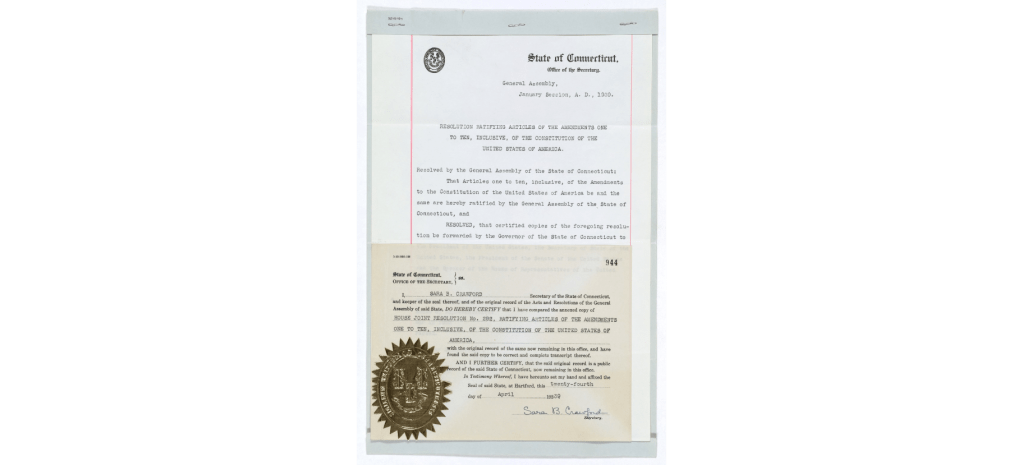
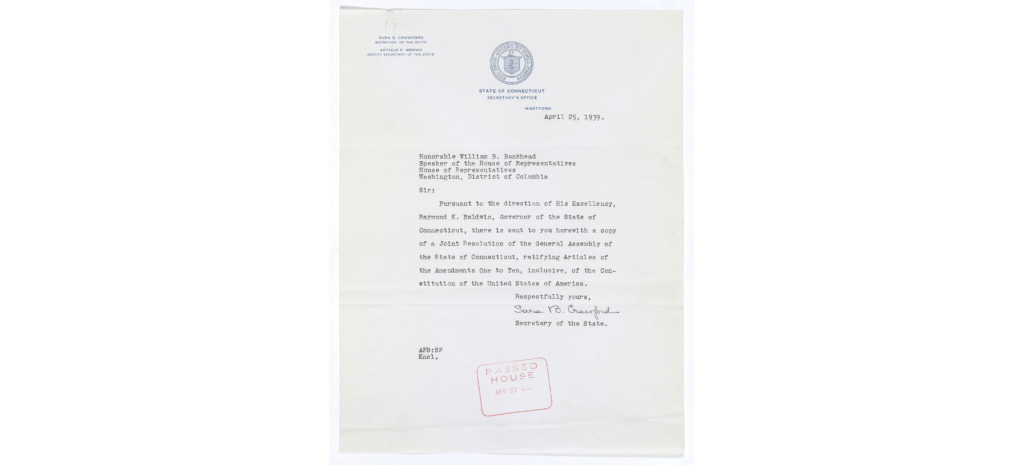
Connecticut became the last state in the the union (which consisted of 48 states at the time) to ratify the US Constitution’s Bill of Rights — 150 years after the list of amendments were first proposed.
Why the delay? It certainly wasn’t because Connecticans didn’t place a high value on securing individual rights — on the contrary, Connecticut’s colonial government had codified one of the earliest set of individual rights in American history in 1650, which included protections against murder, slander, forgery, and theft.
In fact, the Connecticut General Assembly had actually voted in favor of ratifying the ten amendments back in 1789, but a procedural inconsistency between the upper and lower houses of the state legislature had prevented the vote from becoming official. Thankfully, the General Assembly’s technical error didn’t jeopardize the adoption of the Bill of Rights. According to the Constitution, 3/4 of the states had to approve of the amendments in order for them to become law, and that threshold had already been met by the time Connecticut would have registered its formal approval.
On April 19, 1939, as the nation celebrated the 150th anniversary of the Bill of Rights, Connecticut followed the example of Massachusetts and Georgia (the only two other states who had failed to officially ratify the Bill of Rights in the 18th century) and held a symbolic vote to ratify the amendments. Both houses of the General Assembly unanimously approved the measure, and thus Connecticut became the last state in the union to ratify the U.S. Bill of Rights — today in Connecticut history.
Resource: todayincthistory.com


 Be a Seed for Change
You must be logged in to post a comment.