1924 – Immigration Act


President Calvin Coolidge signs into law the Immigration Act of 1924, the most stringent U.S. immigration policy up to that time in the nation’s history.

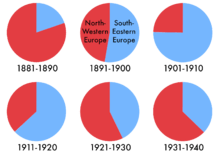
The new law reflected the desire of Americans to isolate themselves from the world after fighting World War I in Europe, which exacerbated growing fears of the spread of communist ideas. It also reflected the pervasiveness of racial discrimination in American society at the time. Many Americans saw the enormous influx of largely unskilled, uneducated immigrants during the early 1900s as causing unfair competition for jobs and land.

Under the new law, immigration remained open to those with a college education and/or special skills, but entry was denied to Mexicans, and disproportionately to Eastern and Southern Europeans and Japanese. At the same time, the legislation allowed for more immigration from Northern European nations such as Britain, Ireland and Scandinavian countries.

A quota was set that limited immigration to two percent of any given nation’s residents already in the U.S. as of 1890, a provision designed to maintain America’s largely Northern European racial composition. In 1927, the “two percent rule” was eliminated and a cap of 150,000 total immigrants annually was established.

Source: history.com

history… may 26


0017 – Germanicus of Rome celebrated his victory over the Germans.

1328 – William of Ockham was forced to flee from Avignon by Pope John XXII.

1521 – Martin Luther was banned by the Edict of Worms because of his religious beliefs and writings.

1647 – A new law banned Catholic priests from the colony of Massachusetts. The penalty was banishment or death for a second offense.

1660 – King Charles II of England landed at Dover after being exiled for nine years.

1670 – A treaty was signed in secret in Dover, England, between Charles II and Louis XIV ending the hostilities between them.

1691 – Jacob Leiser, leader of the popular uprising in support of William and Mary’s accession to the English throne, was executed for treason.

1736 – The British and Chickasaw Indians defeated the French at the Battle of Ackia.

1791 – The French Assembly forced King Louis XVI to hand over the crown and state assets.

1805 – Napoleon Bonaparte was crowned King of Italy in Milan Cathedral.

1831 – Russians defeated the Poles at battle of Ostrolenska.

1835 – A resolution was passed in the U.S. Congress stating that Congress has no authority over state slavery laws.

1836 – The U.S. House of Representatives adopted what has been called the Gag Rule.

1864 – The Territory of Montana was organized.

1865 – Arrangements were made in New Orleans for the surrender of Confederate forces west of the Mississippi.

1868 – U.S. President Andrew Johnson was acquitted, by one vote, of all charges in his impeachment trial.

1896 – The Dow Jones Industrial Average appeared for the first time in the “Wall Street Journal.”

1896 – The last czar of Russia, Nicholas II, was crowned.

1908 – In Persia, the first oil strike was made in the Middle East.

1913 – Actors’ Equity Association was organized in New York City.

1926 – In Morocco, rebel leader Abd el Krim surrendered.

1938 – The House Committee on Un-American Activities began its work of searching for subversives in the United States.

1940 – The evacuation of Allied troops from Dunkirk, France, began during World War II.

1946 – A patent was filed in the United States for an H-bomb.

1946 – British Prime Minister Winston Churchill signed a military pact with Russian leader Joseph Stalin. Stalin promised a “close collaboration after the war.”

1948 – The U.S. Congress passed Public Law 557 which permanently established the Civil Air Patrol as the Auxiliary of the new U.S. Air Force.

1956 – The first trailer bank opened for business in Locust Grove, Long Island, NY. The 46-foot-long trailer took in $100,000 in deposits its first day.

1958 – Union Square, San Francisco became a state historical landmark.

1959 – The word “Frisbee” became a registered trademark of Wham-O.

1961 – Civil rights activist group Freedom Ride Coordinating Committee was established in Atlanta, GA.

1961 – A U.S. Air Force bomber flew across the Atlantic in a record time of just over three hours.

1969 – The Apollo 10 astronauts returned to Earth after a successful eight-day dress rehearsal for the first manned moon landing.

1972 – The Strategic Arms Limitation Treaty (SALT I) was signed by the U.S. and USSR. The short-term agreement put a freeze on the testing and deployment of intercontinental and submarine-launched ballistic missiles for a 5-year period.

1973 – Kathy Schmidt set an American women’s javelin record with a throw of 207 feet, 10 inches.

1975 – American stuntman Evel Knievel suffered severe spinal injuries in Britain when he crashed while attempting to jump 13 buses in his car.

1977 – George H. Willig was arrested after he scaled the South Tower of New York’s World Trade Center. It took him 3 1/2 hours.

1978 – The first legal casino in the Eastern U.S. opened in Atlantic City, NJ.

1987 – Sri Lanka launched Operation Liberation. It was an offensive against the Tamil rebellion in Jaffra.

1988 – The Edmonton Oilers won their fourth NHL Stanley Cup in five seasons. They swept the series 4 games to 0 against the Boston Bruins.

1994 – U.S. President Clinton renewed trade privileges for China, and announced that his administration would no longer link China’s trade status with its human rights record.

1998 – The U.S. Supreme Court ruled that Ellis Island was mainly in New Jersey, not New York.

1998 – The U.S. Supreme Court ruled that police officers in high-speed chases are liable for bystander injuries only if their “actions shock the conscience.”

1998 – The Grand Princess cruise ship made its inaugural cruise. The ship measured 109,000 tons and cost approximately $450 million, making it the largest and most expensive cruise ship ever built.

1998 – The United States Senate approved legislation that allowed the U.S. Mint flexibility on how the mandatory inscriptions on the Washington quarter could be placed. H.R. 3301 allowed the mandatory inscriptions to be moved to the front of the quarter for the 50 States Circulating Commemorative Coin Program.

Source: on-this-day.com

May 1787 the Beginning of the Constitutional Convention – 25,28,29th


The last week of May marks the anniversary of the first meeting of the 1787 Constitutional Convention in Philadelphia.  The convention was called to address problems with the Articles of Confederation, which had been drafted in 1777 in order to provide a system for a national government.  By 1779, the Articles had been ratified by all the colonies except Maryland.  Maryland had initially refused to ratify the Articles due to a dispute between the various colonies about claims to the lands west of the colonies.  In 1781, Maryland was finally persuaded to ratify the Articles which then served as the basis for a federal government until 1789.

The Articles of Confederation provided the new emerging country with a name, “The United States of America,” and an unicameral congress.  The Articles, however, had several weaknesses, including an inability to directly raise revenue or enforce economic regulations.  These weaknesses, as well as economic troubles and local uprisings in the 1780s, such as Shay’s Rebellion, contributed to interest in amending the Articles.  The first steps towards amending the Articles were taken at the Annapolis Convention on September 11, 1786.  The Virginia Legislature had called for a convention of all states in Annapolis to discuss interstate commerce issues but when delegates from only five states attended, the delegates decided that such problems could only be dealt with if the Articles of Confederation were revised.  Three days later, on September 14,1786, Alexander Hamilton drafted a report proposing a convention of all states to revise the Articles.  The resolution acknowledged the problems in the current system and proposed a remedy:

That there are important defects in the system of the Federal Government is acknowledged by the Acts of all those States, which have concurred in the present Meeting; That the defects, upon a closer examination, may be found greater and more numerous, than even these acts imply, is at least so far probably, from the embarrassments which characterize the present State of our national affairs, foreign and domestic, as may reasonably be supposed to merit a deliberate and candid discussion, in some mode, which will unite the Sentiments and Councils of all the States. In the choice of the mode, your Commissioners are of opinion, that a Convention of Deputies from the different States, for the special and sole purpose of entering into this investigation, and digesting a plan for supplying such defects as may be discovered to exist, will be entitled to a preference from considerations, which will occur without being particularized.

The Annapolis Report further suggested that Congress direct:

the appointment of Commissioners, to meet at Philadelphia on the second Monday in May next, to take into consideration the situation of the United States, to devise such further provisions as shall appear to them necessary to render the constitution of the Federal Government adequate to the exigencies of the Union; and to report such an Act for that purpose to the United States in Congress assembled, as when agreed to, by them, and afterwards confirmed by the Legislatures of every State, will effectually provide for the same.

This report was transmitted to Congress and in February 1787 the Congress, following the suggestions of the Annapolis Report called for a convention to begin on May 14, 1787 “to render the constitution … adequate to the exigencies of the Union.”

Though the convention was to begin on May 14th, only eight delegates had arrived in Philadelphia, and it was not until May 25th that a sufficient number of delegates were present to begin proceedings.  The convention began with the election of a president, George Washington; a secretary, William Jackson; and the nomination of a three member committee consisting of Messrs. WytheHamilton and C. Pinckney, which was directed to draft the rules for the convention.  A doorkeeper and messengers were also appointed.

On May 28th, Mr. Wythe presented the proposed rules to the Convention and on May 29th the rules, as amended, were adopted.  Also, on May 29th, Edmund Randolphintroduced the Virginia Plan.  Although introduced by Randolph, the plan was largely the work of another delegate, James Madison.  As the work of the convention was officially to amend the Articles of Confederation, the Virginia Plan began with the phrase “Resolved that the Articles of Confederation ought to be so corrected & enlarged as to accomplish the objects proposed by their institution; namely, “common defence, security of liberty and general welfare.”  The plan suggested, among other things, that the Congress be split into two branches, that a national executive and judiciary be established with the national legislature picking the executive.

Convention at Philadelphia, 1787 / Hartford : Published by Huntington & Hopkins, 1823. Library of Congress, Prints & Photographs Division, //hdl.loc.gov/loc.pnp/cph.3b39116

Convention at Philadelphia, 1787 / Hartford : Published by Huntington & Hopkins, 1823. Library of Congress, Prints & Photographs Division, //hdl.loc.gov/loc.pnp/cph.3b39116

Working rapidly, the outline on a three part system of government consisting of a legislature, executive and judiciary was agreed upon by May 30th.  During the next two months, the Convention put forth and debated the general principles of the government.  On July 26th, the Convention adjourned for 10 days while the five member Committee of Detail drafted a constitution based on the Convention’s work.  Returning to work on August 6th, the Convention spent the next month debating and amending the proposed document.  Then on September 17, 1787, the Convention completed its work and the state delegations unanimously agreed to approve the Constitution.  All but three of the members then signed the Constitution, after debating this step, and Convention President Washington, transmitted the document by letter to Congress.  Since the proceedings of the Convention had been secret, Washington had to explain in his letter why the Convention had drafted a document for the institution of a new system of government rather than proposals to amend the existing Articles of Confederation:

The friends of our country have long seen and desired, that the power of making war, peace, and treaties, that of levying money and regulating commerce, and the correspondent executive and judicial authorities should be fully and effectually vested in the general government of the Union: But the impropriety of delegating such extensive trust to one body of men is evident-Hence results the necessity of a different organization. In all our deliberations on this subject we kept steadily in our view, that which appears to us the greatest interest of every true American, the consolidation of our Union, in which is involved our prosperity, felicity, safety, perhaps our national existence … That it will meet the full and entire approbation of every state is not perhaps to be expected; … we hope and believe; that it may promote the lasting welfare of that country so dear to us all, and secure her freedom and happiness, is our most ardent wish.

Although the proceedings of the convention were kept secret at the time, the Convention’s Secretary, William Jackson, gathered up the journals and related papers and delivered them to George Washington, who in turn delivered the papers to the Department of State in 1796.   In 1818, Congress ordered that the journals be printed.  After the publication of the journals in 1819, the next several decades saw publications of notes of the proceedings by various attendees, including Madison’s, which were published in 1840.  Then in 1911, Max Farrand published a four volume set titled The Records of the Federal Convention of 1787.  This compilation brought together the journals of the convention along with Madison’s notes and the notes of various of the other delegates, including those of Rufus King.  The fourth volume of the set included supplemental materials such as letters from the delegates written during the convention.  Farrand’s Records is considered to be one of the best sources of information about the Constitutional Convention as it brings together in one publication the diverse materials which form the record of the Convention

resources: loc, internet