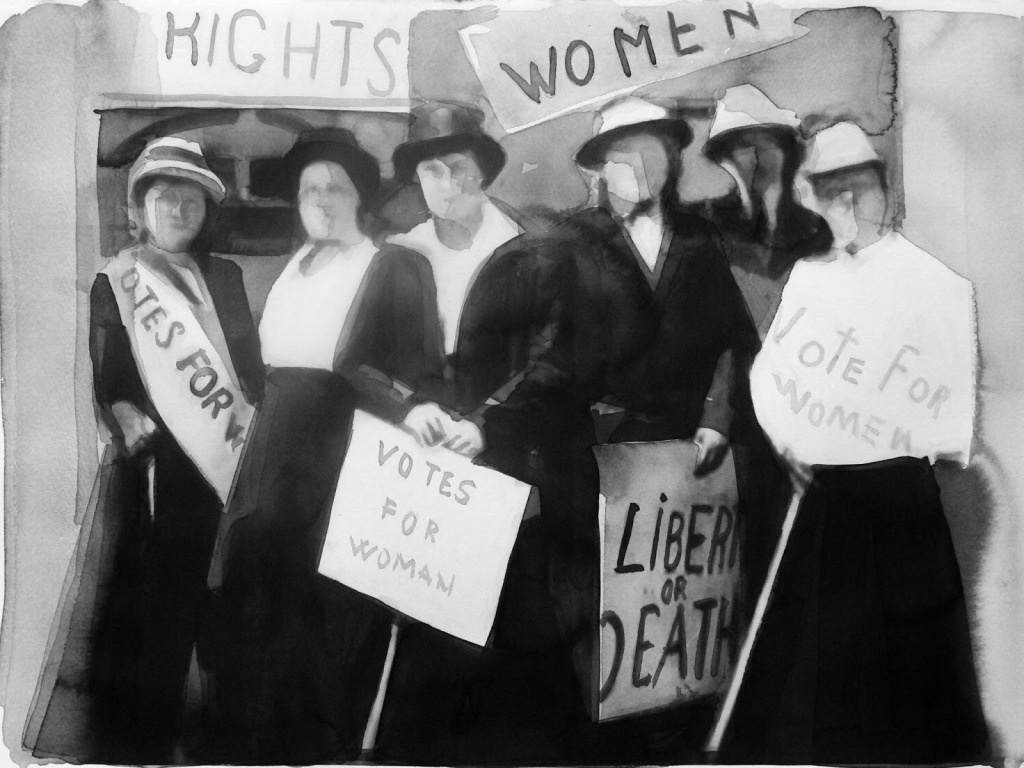
1919 – Congress passes the 19th Amendment, giving Women the right to vote


On May 21, 1919, the House again passes what would become the 19th Amendment, popularly known as the Susan B. Anthony Amendment.

The Senate follows suit on June 4 by a narrow margin (just over the two-thirds requirement), and it goes to the states to be ratified. Ratification requires 36 states, or three-quarters of those in the Union at the time.

The 19th Amendment to the U.S. Constitution, granting women the right to vote, was passed by Congress and sent to the states for ratification.

The women’s suffrage movement was founded in the mid-19th century by women who had become politically active through their work in the abolitionist and temperance movements.

In July 1848, 240 woman suffragists, including Elizabeth Cady Stanton and Lucretia Mott, met in Seneca Falls, New York, to assert the right of women to vote. Female enfranchisement was still largely opposed by most Americans, and the distraction of the North-South conflict and subsequent Civil War precluded further discussion. During the Reconstruction Era, the 15th Amendment was adopted, granting African American men the right to vote, but the Republican-dominated Congress failed to expand its progressive radicalism into the sphere of gender.

Source: history.com

1989 – In memory … Student protestors took over Tiananmen Square in Beijing ~( April – June 4)


See the source image

Six days after the death of Hu Yaobang, the deposed reform-minded leader of the Chinese Communist Party, some 100,000 students gather at Beijing’s Tiananmen Square to commemorate Hu and voice their discontent with China’s authoritative communist government. The next day, an official memorial service for Hu Yaobang was held in Tiananmen’s Great Hall of the People, and student representatives carried a petition to the steps of the Great Hall, demanding to meet with Premier Li Peng. The Chinese government refused such a meeting, leading to a general boycott of Chinese universities across the country and widespread calls for democratic reforms.

Ignoring government warnings of violent suppression of any mass demonstration, students from more than 40 universities began a march to Tiananmen on April 27. The students were joined by workers, intellectuals, and civil servants, and by mid-May more than a million people filled the square, the site of communist leader’s Mao Zedong’s proclamation of the People’s Republic of China in 1949. On May 20, the government formally declared martial law in Beijing, and troops and tanks were called in to disperse the dissidents. However, large numbers of students and citizens blocked the army’s advance, and by May 23 government forces had pulled back to the outskirts of Beijing.

On June 3, with negotiations to end the protests stalled and calls for democratic reforms escalating, the troops received orders from the Chinese government to reclaim Tiananmen at all costs. By the end of the next day, Chinese troops had forcibly cleared Tiananmen Square and Beijing’s streets, killing hundreds of demonstrators and arresting thousands of protesters and other suspected dissidents. In the weeks after the government crackdown, an unknown number of dissidents were executed, and communist hard-liners took firm control of the country.

The international community was outraged at the incident, and economic sanctions imposed by the United States and other countries sent China’s economy into decline. However, by late 1990, international trade had resumed, thanks in part to China’s release of several hundred imprisoned dissidents.

Citation Information
Article Title
Chinese students begin protests at Tiananmen Square
Author
History.com Editors
Website Name
HISTORY

On June 4, 1989, however, Chinese troops and security police stormed through Tiananmen Square, firing indiscriminately into the crowds of protesters. Turmoil ensued, as tens of thousands of the young students tried to escape the rampaging Chinese forces. Other protesters fought back, stoning the attacking troops and overturning and setting fire to military vehicles. Reporters and Western diplomats on the scene estimated that at least 300, and perhaps thousands, of the protesters had been killed and as many as 10,000 were arrested.

The savagery of the Chinese government’s attack shocked both its allies and Cold War enemies. Soviet leader Mikhail Gorbachev declared that he was saddened by the events in China. He said he hoped that the government would adopt his own domestic reform program and begin to democratize the Chinese political system.

history.com

The Senate Passes the Woman Suffrage Amendment


Maud Younger

June 4, 1919

Throughout its history the Senate has cast many crucial votes that have broken a deadlock to bring about legislative success. On June 4, 1919, the Senate cast one such vote when it approved the Woman Suffrage Amendment, clearing the way for state ratification of the Nineteenth Amendment. That success did not come easily. It took years of activism by suffragists, and some brilliant maneuvering by one particular female lobbyist, to gain Senate support for a woman’s right to vote.

One of the suffragists’ first campaigns in the Senate came in 1913. The so-called “Siege of the Senate” brought to Washington hundreds of female activists who arrived in a parade of automobiles and carried petitions for voting rights signed by more than 200,000 women. “We want action now,” chanted the suffragists as they marched into the Capitol. Opponents called the siege a cheap advertising trick, but as the women filled halls and committee rooms, armed with banners, picket signs, and lengthy petitions, senators paid attention.

Senators who supported suffrage rights quickly took the floor and introduced petitions for women of their home states. Giving women the vote, Reed Smoot of Utah observed reassuringly, “has made no daughter less beautiful, no wife less devoted, no mother less inspiring.” Senators opposed to female suffrage, feeling pressure from the lady lobbyists, also participated. “I wish to say that I am opposed to the passage of the amendment,” explained John Thornton of Louisiana, before obediently submitting a petition. Joseph Johnston of Alabama explained that his petition came “at the request of one lady,” then left to speculation the identity of that singular suffragist. “Whatever may be my personal view on this matter,” James Martine of New Jersey confessed, “I would be a veritable coward [should] I not present this petition.”

As years passed, and the Senate remained a barrier to reform, the activists intensified their efforts. Leading the way was a savvy operator named Maud Younger. Although Younger employed a variety of tactics, her most effective strategy was the use of a “congressional card index,” a voluminous collection of index cards on which she recorded every detail, public and private, that she learned about each member of Congress. No detail was overlooked. If the cards noted that a senator always arrived at his office at 7:30 a.m., Younger had a suffragist there at 7:29. If a senator smoked cigars, she sought support among his state’s cigar-makers, or his lodge members, or the family doctor, or anyone else who might influence his vote. She found it especially useful to collect information about the senators’ mothers. Some men, she explained, “listen to their mothers more than to their wives.” By 1919 the tide of Senate opinion was shifting, prompting Maud Younger to boast: “Twenty-two senators have changed their position since I came to Washington.”

On June 4, 1919, 37 Republican senators joined 19 Democrats to pass the amendment. In quick succession, states then ratified the amendment, with Tennessee becoming the necessary 36th state to approve on August 18, 1920. Once again, a Senate vote had provided the crucial bridge to success. In reviewing the tactics that helped bring about that successful Senate vote, the New York Times paid special tribute to Maud Younger and her sister lobbyists. “In the hands of determined women,” concluded the Times, “a full card index is even mightier than pen or sword.”

1989~June 4 ~ Tiananmen Square


June 4, 1989 – The Chinese government ordered its troops to open fire on unarmed protesters in Tiananmen Square in Beijing. The protest had started on April 16 as about 1,000 students marched to mourn the death of Hu Yaobang, a pro-reform leader within the Chinese government. Despite government warnings, pro-reform and pro-democracy demonstrations continued for a month drawing ever-larger crowds of young people, eventually totaling over a million persons. On May 13, three thousand students began an eight-day hunger strike. The government imposed martial law on May 20 and brought in troops. On June 2, in their first clash with the People’s Army, demonstrators turned back an advance of unarmed troops. However, in the pre-dawn hours of June 4, the People’s Army, using tanks, machine-guns, clubs and tear gas, opened fire on the unarmed protesters. Armored personnel carriers then rolled into the square crushing students still sleeping in their tents. The Chinese government later claimed only 300 died in the attack. U.S. estimates put the toll at over 3,000. Following the massacre, over 1,600 demonstrators were rounded up and jailed, with 27 being executed.