1866 – 14th Amendment


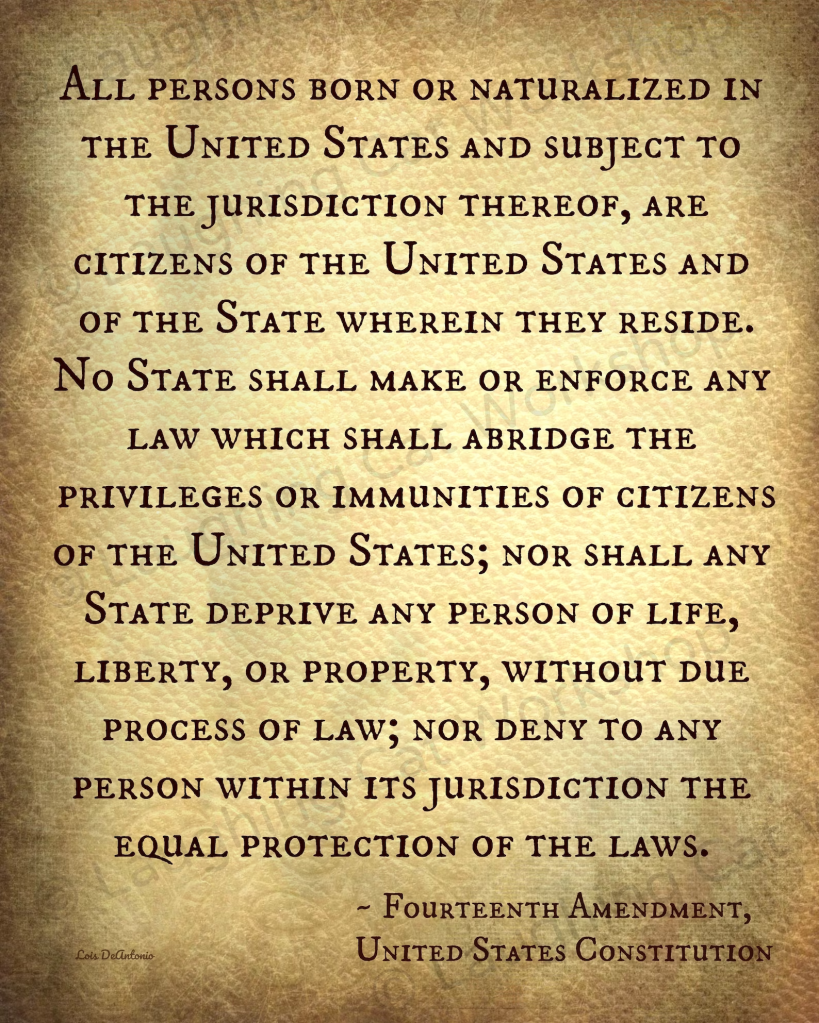
1866 – The 14th Amendment to the U.S. Constitution was passed by the U.S. Congress. It was ratified on July 9, 1868. The amendment was designed to grant citizenship to and protect the civil liberties of recently freed slaves. It did this by prohibiting states from denying or abridging the privileges or immunities of citizens of the United States, depriving any person of his life, liberty, or property without due process of law, or denying to any person within their jurisdiction the equal protection of the laws.

Happy Dad’s Day – Began on June 19, 1910, and a history of the Art of Manliness


Father’s Day is coming up, so in honor of dear old Dad, the Art of Manliness is presenting a series of father-themed posts. Today we look into the history of Father’s Day. Sadly, retailers and marketers, in an effort to make a quick buck, have bastardized the original meaning of Father’s Day. A holiday that was supposed to honor Dad and enumerate his special qualities now is used to sell chili pepper ties and shop vacs. Hopefully, by understanding why the concept of Father’s Day was created, we can better celebrate and honor the fathers who raised us into men.

The History of Father’s Day in the United States

There are two stories of when the first Father’s Day was celebrated.

According to some accounts, the first Father’s Day was celebrated in Washington State on June 19, 1910.

A woman by the name of Sonora Smart Dodd came up with the idea of honoring and celebrating her father while listening to a Mother’s Day sermon at church in 1909. She felt as though mothers were getting all the acclaim, while fathers were equally deserving of a day of praise (She would probably be displeased that Mother’s Day still gets the lion’s share of attention).

Sonora’s dad was quite a man. William Smart, a veteran of the Civil War, was left a widower when his wife died while giving birth to their sixth child. He went on to raise the six children by himself on their small farm in Washington. To show her appreciation for all the hard work and love William gave to her and her siblings, Sonora thought there should be a day to pay homage to him and other dads like him. She initially suggested June 5th, the anniversary of her father’s death to be the designated day to celebrate Father’s Day, but due to some bad planning, the celebration in Spokane, Washington was deferred to the third Sunday in June.

The other story of the first Father’s Day in America happened all the way on the other side of the country in Fairmont, West Virginia on July 5, 1908. Grace Golden Clayton suggested to the minister of the local Methodist church that they hold services to celebrate fathers after a deadly mine explosion killed 361 men.

While Father’s Day was celebrated locally in several communities across the country, unofficial support to make the celebration a national holiday began almost immediately. William Jennings Bryant was one of its staunchest proponents. In 1924, President Calvin “Silent Cal” Coolidge recommended that Father’s Day become a national holiday. But no official action was taken.

In 1966, Lyndon B. Johnson, through an executive order, designated the third Sunday in June as the official day to celebrate Father’s Day. However, it wasn’t until 1972, during the Nixon administration, that Father’s Day was officially recognized as a national holiday.

Father’s Day Around The World

Other countries also picked up on the idea of Father’s Day. While many followed suit by celebrating it on the third Sunday in June, some decided to honor Dad on different dates. So, to make sure you know when to pay your respects to dear old dad wherever you may be, here’s a list of the dates

Father’s Day is celebrated across the world.

  • March 14– Iran
  • March 19– Bolivia, Honduras, Italy, Lichtenstein, Portugal, Spain
  • May 8– South Korea
  • First Sunday in June– Lithuania
  • Second Sunday in June– Austria, Ecuador, Belgium
  • Third Sunday in June– Antigua, Bahamas, Bangladesh, Bulgaria, Canada, Chile, Columbia, Costa Rica, Cuba, Cyprus, Czech Republic, France, Greece, Guyana, Hong Kong, India, Ireland, Jamaica, Japan, Malaysia, Malta, Mauritius, Mexico, Netherlands, Pakistan, Panama, Paraguay, Peru, Philippines, Puerto Rico, Saint Vincent, Singapore, Slovakia, South Africa, Sri Lanka, Switzerland, Trinidad, Turkey, United Kingdom, Venezuela, Zimbabwe
  • June 17– El Salvador, Guatemala
  • June 23– Nicaragua, Poland, Uganda
  • Second Sunday in July– Uruguay
  • Last Sunday in July– Dominican Republic
  • Second Sunday in August– Brazil
  • August 8– Taiwan, China
  • August 24– Argentina
  • First Sunday in September– Australia, New Zealand
  • New Moon of September– Nepal
  • First Sunday in October– Luxembourg
  • Second Sunday in November– Estonia, Finland, Norway, Sweden
  • December 5– Thailand

This Father’s Day, don’t just buy your Pops a crappy “World’s Best Dad” mug. Write him a card expressing some of the things you love and admire about him. Nothing mushy. Just tell him that you’re glad to be his son.

History… 6/13


1415 – Henry the Navigator, the prince of Portugal, embarked on an expedition to Africa.

1777 – The Marquis de Lafayette arrived in the American colonies to help with their rebellion against the British.

1789 – Ice cream was served to General George Washington by Mrs. Alexander Hamilton.

1825 – Walter Hunt patented the safety pin. Hunt then then sold the rights for $400.

1866 – The 14th Amendment to the U.S. Constitution was passed by the U.S. Congress. It was ratified on July 9, 1868. The amendment was designed to grant citizenship to and protect the civil liberties of recently freed slaves. It did this by prohibiting states from denying or abridging the privileges or immunities of citizens of the United States, depriving any person of his life, liberty, or property without due process of law, or denying to any person within their jurisdiction the equal protection of the laws.

1888 – The U.S. Congress created the Department of Labor.

1898 – The Canadian Yukon Territory was organized.

1900 – China’s Boxer Rebellion against foreigners and Chinese Christians erupted into violence.

1912 – Captain Albert Berry made the first successful parachute jump from an airplane in Jefferson, Mississippi.

1920 – The U.S. Post Office Department ruled that children may not be sent by parcel post.

1922 – Charlie Osborne started the longest attack on hiccups. He hiccuped over 435 million times before stopping. He died in 1991, 11 months after his hiccups ended.

1923 – The French set a trade barrier between the occupied Ruhr and the rest of Germany.

1927 – Charles Lindbergh was honored with a ticker-tape parade in New York City.

1927 – For the first time, an American Flag was displayed from the right hand of the Statue of Liberty.

1940 – Paris was evacuated before the German advance on the city.

1943 – German spies landed on Long Island, New York. They were soon captured.

1944 – Germany launched 10 of its new V1 rockets against Britain from a position near the Channel coast. Of the 10 rockets only 5 landed in Britain and only one managed to kill (6 people in London).

1944 – Marvin Camras patented the wire recorder.

1949 – Bao Dai entered Saigon to rule Vietnam. He had been installed by the French.

1951 – U.N. troops seized Pyongyang, North Korea.

1966 – The landmark “Miranda v. Arizona” decision was issued by the U.S. Supreme Court. The decision ruled that criminal suspects had to be informed of their constitutional rights before being questioned by police.

1967 – Solicitor General Thurgood Marshall was nominated by President Lyndon B. Johnson to become the first black justice on the U.S. Supreme Court.

1971 – The New York Times began publishing the “Pentagon Papers”. The articles were a secret study of America’s involvement in Vietnam.

1978 – Israelis withdrew the last of their invading forces from Lebanon.

1979 – Sioux Indians were awarded $105 million in compensation for the U.S. seizure in 1877 of their Black Hills in South Dakota.

1983 – The unmanned U.S. space probe Pioneer 10 became the first spacecraft to leave the solar system. It was launched in March 1972. The first up-close images of the planet Jupiter were provided by Pioneer 10.

1988 – The Liggett Group, a cigarette manufacturer, was found liable for a lung-cancer death. They were, however, found innocent by the federal jury of misrepresenting the risks of smoking.

1989 – The Detroit Pistons won their first National Basketball Association title. They beat the L.A. Lakers in four games.

1989 – U.S. President George H.W. Bush exercised his first Presidential veto on a bill dealing with minimum wage.

1992 – Future U.S. President Bill Clinton criticized rap singer Sister Souljah for making remarks “filled with hatred” towards whites.

1994 – A jury in Anchorage, Alaska, found Exxon Corp. and Captain Joseph Hazelwood to be reckless in the Exxon Valdez oil spill.

1995 – France announced that they would conduct eight more nuclear tests in the South Pacific.

2000 – In Pyongyang, North Korea’s leader Kim Jong Il welcomed South Korea’s President Kim Dae for a three-day summit. It was the first such meeting between the leaders of North and South Korea.

on-this-day.com

1966 The Miranda rights are established


June 13, 1966 – The U.S. Supreme Court ruled (5-4) in the case of Miranda v. Arizona that an accused person must be apprised of certain rights before police questioning, including the right to remain silent, the right to know that anything said can be used against the individual in court, and the right to have a defense attorney present during interrogation. American police officers now routinely read prisoners their ‘Miranda’ (constitutional) rights before questioning.

Source: The History Place