
 1775 – The Continental Army was founded by the Second Continental Congress for purposes of common defense. This event is considered to be the birth of the United States Army. On June 15, George Washington was appointed commander-in-chief.
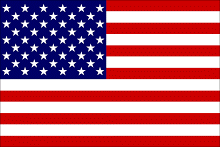
1777 – The Continental Congress in Philadelphia adopted the “Stars and Stripes” as the national flag of the United States. The Flag Resolution stated “Resolved: that the flag of the United States be made of thirteen stripes, alternate red and white; that the union be thirteen stars, white in a blue field, representing a new Constellation.” On May 20, 1916, President Woodrow Wilson officially proclaimed June 14 “Flag Day” as a commemoration of the “Stars and Stripes.”
1789 – Captain William Bligh of the HMS Bounty arrived in Timor in a small boat.
1834 – Cyrus Hall McCormick received a patent for his reaping machine.
1834 – Isaac Fischer Jr. patented sandpaper.
1841 – The first Canadian parliament opened in Kingston.
1846 – A group of U.S. settlers in Sonoma proclaimed the Republic of California.
1893 – Philadelphia observed the first Flag Day.
1900 – Hawaii became a U.S. territory.
1907 – Women in Norway won the right to vote.
1917 – General John Pershing arrived in Paris during World War I.
1919 – The first non-stop trans-Atlantic flight began. Captain John Alcot and Lt. Arthur Brown flew from Newfoundland to Ireland.
1922 – Warren G. Harding became the first U.S. president to be heard on radio. The event was the dedication of the Francis Scott Key memorial at Fort McHenry.
1927 – Nicaraguan President Adolfo Diaz signed a treaty with the U.S. allowing American intervention in his country.
1940 – The Nazis opened their concentration camp at Auschwitz in German-occupied Poland.
1940 – German troops entered Paris. As Paris became occupied loud speakers announced the implementation of a curfew being imposed for 8 p.m.
1943 – The U.S. Supreme Court ruled that schoolchildren could not be made to salute the U.S. flag if doing so conflicted with their religious beliefs.
1944 – Sixty U.S. B-29 Superfortress’ attacked an iron and steel works factory on Honshu Island.
1945 – Burma was liberated by Britain.
1949 – The state of Vietnam was formed.
1951 – “Univac I” was unveiled. It was a computer designed for the U.S. Census Bureau and billed as the world’s first commercial computer.
1952 – The Nautilus was dedicated. It was the first nuclear powered submarine.
1954 – U.S. President Dwight D. Eisenhower signed an order adding the words “under God” to the Pledge of Allegiance.
1954 – Americans took part in the first nation-wide civil defense test against atomic attack.
1965 – A military triumvirate took control in Saigon, South Vietnam.
1967 – Mariner 5 was launched from Cape Kennedy, FL. The space probe’s flight took it past Venus.
1982 – Argentine forces surrendered to British troops on the Falkland Islands.
1987 – The Los Angeles Lakers won the NBA title by defeating the defending Boston Celtics.
1989 – Former U.S. President Reagan received an honorary knighthood from Britain’s Queen Elizabeth II.
1990 – The U.S. Supreme Court upheld police checkpoints that are used to examine drivers for signs of intoxication.
1994 – The New York Rangers won the Stanley Cup by defeating the Vancouver Canucks. It was the first time the Rangers had won the cup in 54 years.
2002 – Actor Kirk Douglas received the UCLA Medal. The award is presented to people for cultural, political and humanitarian achievements.






 Be a Seed for Change
You must be logged in to post a comment.