Happy Dad’s Day – Began on June 19, 1910, and a history of the Art of Manliness


Father’s Day is coming up, so in honor of dear old Dad, the Art of Manliness is presenting a series of father-themed posts. Today we look into the history of Father’s Day. Sadly, retailers and marketers, in an effort to make a quick buck, have bastardized the original meaning of Father’s Day. A holiday that was supposed to honor Dad and enumerate his special qualities now is used to sell chili pepper ties and shop vacs. Hopefully, by understanding why the concept of Father’s Day was created, we can better celebrate and honor the fathers who raised us into men.

The History of Father’s Day in the United States

There are two stories of when the first Father’s Day was celebrated.

According to some accounts, the first Father’s Day was celebrated in Washington State on June 19, 1910.

A woman by the name of Sonora Smart Dodd came up with the idea of honoring and celebrating her father while listening to a Mother’s Day sermon at church in 1909. She felt as though mothers were getting all the acclaim, while fathers were equally deserving of a day of praise (She would probably be displeased that Mother’s Day still gets the lion’s share of attention).

Sonora’s dad was quite a man. William Smart, a veteran of the Civil War, was left a widower when his wife died while giving birth to their sixth child. He went on to raise the six children by himself on their small farm in Washington. To show her appreciation for all the hard work and love William gave to her and her siblings, Sonora thought there should be a day to pay homage to him and other dads like him. She initially suggested June 5th, the anniversary of her father’s death to be the designated day to celebrate Father’s Day, but due to some bad planning, the celebration in Spokane, Washington was deferred to the third Sunday in June.

The other story of the first Father’s Day in America happened all the way on the other side of the country in Fairmont, West Virginia on July 5, 1908. Grace Golden Clayton suggested to the minister of the local Methodist church that they hold services to celebrate fathers after a deadly mine explosion killed 361 men.

While Father’s Day was celebrated locally in several communities across the country, unofficial support to make the celebration a national holiday began almost immediately. William Jennings Bryant was one of its staunchest proponents. In 1924, President Calvin “Silent Cal” Coolidge recommended that Father’s Day become a national holiday. But no official action was taken.

In 1966, Lyndon B. Johnson, through an executive order, designated the third Sunday in June as the official day to celebrate Father’s Day. However, it wasn’t until 1972, during the Nixon administration, that Father’s Day was officially recognized as a national holiday.

Father’s Day Around The World

Other countries also picked up on the idea of Father’s Day. While many followed suit by celebrating it on the third Sunday in June, some decided to honor Dad on different dates. So, to make sure you know when to pay your respects to dear old dad wherever you may be, here’s a list of the dates

Father’s Day is celebrated across the world.

  • March 14– Iran
  • March 19– Bolivia, Honduras, Italy, Lichtenstein, Portugal, Spain
  • May 8– South Korea
  • First Sunday in June– Lithuania
  • Second Sunday in June– Austria, Ecuador, Belgium
  • Third Sunday in June– Antigua, Bahamas, Bangladesh, Bulgaria, Canada, Chile, Columbia, Costa Rica, Cuba, Cyprus, Czech Republic, France, Greece, Guyana, Hong Kong, India, Ireland, Jamaica, Japan, Malaysia, Malta, Mauritius, Mexico, Netherlands, Pakistan, Panama, Paraguay, Peru, Philippines, Puerto Rico, Saint Vincent, Singapore, Slovakia, South Africa, Sri Lanka, Switzerland, Trinidad, Turkey, United Kingdom, Venezuela, Zimbabwe
  • June 17– El Salvador, Guatemala
  • June 23– Nicaragua, Poland, Uganda
  • Second Sunday in July– Uruguay
  • Last Sunday in July– Dominican Republic
  • Second Sunday in August– Brazil
  • August 8– Taiwan, China
  • August 24– Argentina
  • First Sunday in September– Australia, New Zealand
  • New Moon of September– Nepal
  • First Sunday in October– Luxembourg
  • Second Sunday in November– Estonia, Finland, Norway, Sweden
  • December 5– Thailand

This Father’s Day, don’t just buy your Pops a crappy “World’s Best Dad” mug. Write him a card expressing some of the things you love and admire about him. Nothing mushy. Just tell him that you’re glad to be his son.

History… 6/13


1415 – Henry the Navigator, the prince of Portugal, embarked on an expedition to Africa.

1777 – The Marquis de Lafayette arrived in the American colonies to help with their rebellion against the British.

1789 – Ice cream was served to General George Washington by Mrs. Alexander Hamilton.

1825 – Walter Hunt patented the safety pin. Hunt then then sold the rights for $400.

1866 – The 14th Amendment to the U.S. Constitution was passed by the U.S. Congress. It was ratified on July 9, 1868. The amendment was designed to grant citizenship to and protect the civil liberties of recently freed slaves. It did this by prohibiting states from denying or abridging the privileges or immunities of citizens of the United States, depriving any person of his life, liberty, or property without due process of law, or denying to any person within their jurisdiction the equal protection of the laws.

1888 – The U.S. Congress created the Department of Labor.

1898 – The Canadian Yukon Territory was organized.

1900 – China’s Boxer Rebellion against foreigners and Chinese Christians erupted into violence.

1912 – Captain Albert Berry made the first successful parachute jump from an airplane in Jefferson, Mississippi.

1920 – The U.S. Post Office Department ruled that children may not be sent by parcel post.

1922 – Charlie Osborne started the longest attack on hiccups. He hiccuped over 435 million times before stopping. He died in 1991, 11 months after his hiccups ended.

1923 – The French set a trade barrier between the occupied Ruhr and the rest of Germany.

1927 – Charles Lindbergh was honored with a ticker-tape parade in New York City.

1927 – For the first time, an American Flag was displayed from the right hand of the Statue of Liberty.

1940 – Paris was evacuated before the German advance on the city.

1943 – German spies landed on Long Island, New York. They were soon captured.

1944 – Germany launched 10 of its new V1 rockets against Britain from a position near the Channel coast. Of the 10 rockets only 5 landed in Britain and only one managed to kill (6 people in London).

1944 – Marvin Camras patented the wire recorder.

1949 – Bao Dai entered Saigon to rule Vietnam. He had been installed by the French.

1951 – U.N. troops seized Pyongyang, North Korea.

1966 – The landmark “Miranda v. Arizona” decision was issued by the U.S. Supreme Court. The decision ruled that criminal suspects had to be informed of their constitutional rights before being questioned by police.

1967 – Solicitor General Thurgood Marshall was nominated by President Lyndon B. Johnson to become the first black justice on the U.S. Supreme Court.

1971 – The New York Times began publishing the “Pentagon Papers”. The articles were a secret study of America’s involvement in Vietnam.

1978 – Israelis withdrew the last of their invading forces from Lebanon.

1979 – Sioux Indians were awarded $105 million in compensation for the U.S. seizure in 1877 of their Black Hills in South Dakota.

1983 – The unmanned U.S. space probe Pioneer 10 became the first spacecraft to leave the solar system. It was launched in March 1972. The first up-close images of the planet Jupiter were provided by Pioneer 10.

1988 – The Liggett Group, a cigarette manufacturer, was found liable for a lung-cancer death. They were, however, found innocent by the federal jury of misrepresenting the risks of smoking.

1989 – The Detroit Pistons won their first National Basketball Association title. They beat the L.A. Lakers in four games.

1989 – U.S. President George H.W. Bush exercised his first Presidential veto on a bill dealing with minimum wage.

1992 – Future U.S. President Bill Clinton criticized rap singer Sister Souljah for making remarks “filled with hatred” towards whites.

1994 – A jury in Anchorage, Alaska, found Exxon Corp. and Captain Joseph Hazelwood to be reckless in the Exxon Valdez oil spill.

1995 – France announced that they would conduct eight more nuclear tests in the South Pacific.

2000 – In Pyongyang, North Korea’s leader Kim Jong Il welcomed South Korea’s President Kim Dae for a three-day summit. It was the first such meeting between the leaders of North and South Korea.

on-this-day.com

1966 The Miranda rights are established


June 13, 1966 – The U.S. Supreme Court ruled (5-4) in the case of Miranda v. Arizona that an accused person must be apprised of certain rights before police questioning, including the right to remain silent, the right to know that anything said can be used against the individual in court, and the right to have a defense attorney present during interrogation. American police officers now routinely read prisoners their ‘Miranda’ (constitutional) rights before questioning.

Source: The History Place

Friday the 13th ~ History


Long considered a harbinger of bad luck, Friday the 13th has inspired a late 19th-century secret society, an early 20th-century novel, a horror film franchise and not one but two unwieldy terms—paraskavedekatriaphobia and friggatriskaidekaphobia—that describe the fear of this supposedly unlucky day.

Just like walking under a ladder, crossing paths with a black cat or breaking a mirror, many people hold fast to the belief that Friday the 13th brings bad luck. Though it’s uncertain exactly when this particular tradition began, negative superstitions have swirled around the number 13 for centuries.

While Western cultures have historically associated the number 12 with completeness (there are 12 days of Christmas, 12 months and zodiac signs, 12 labors of Hercules, 12 gods of Olympus and 12 tribes of Israel, just to name a few examples), its successor 13 has a long history as a sign of bad luck.

The ancient Code of Hammurabi, for example, reportedly omitted a 13th law from its list of legal rules. Though this was probably a clerical error, superstitious people sometimes point to this as proof of 13’s longstanding negative associations.

Fear of the number 13 has even earned a psychological term: triskaidekaphobia.

According to biblical tradition, 13 guests attended the Last Supper, held on Maundy Thursday, including Jesus and his 12 apostles (one of whom, Judas, betrayed him). The next day, of course, was Good Friday, the day of Jesus’ crucifixion.

The seating arrangement at the Last Supper is believed to have given rise to a longstanding Christian superstition that having 13 guests at a table was a bad omen—specifically, that it was courting death.

Though Friday’s negative associations are weaker, some have suggested they also have roots in Christian tradition: Just as Jesus was crucified on a Friday, Friday was also said to be the day Eve gave Adam the fateful apple from the Tree of Knowledge, as well as the day Cain killed his brother, Abel.

In the late-19th century, a New Yorker named Captain William Fowler (1827-1897) sought to remove the enduring stigma surrounding the number 13—and particularly the unwritten rule about not having 13 guests at a dinner table—by founding an exclusive society called the Thirteen Club.

The group dined regularly on the 13th day of the month in room 13 of the Knickerbocker Cottage, a popular watering hole Fowler owned from 1863 to 1883. Before sitting down for a 13-course dinner, members would pass beneath a ladder and a banner reading “Morituri te Salutamus,” Latin for “Those of us who are about to die salute you.”

Four former U.S. presidents (Chester A. ArthurGrover ClevelandBenjamin Harrison and Theodore Roosevelt) would join the Thirteen Club’s ranks at one time or another.

An important milestone in the history of the Friday the 13th legend in particular (not just the number 13) occurred in 1907, with the publication of the novel Friday, the Thirteenth written by Thomas William Lawson.

The book told the story of a New York City stockbroker who plays on superstitions about the date to create chaos on Wall Street, and make a killing on the market.

The horror movie Friday the 13th, released in 1980, introduced the world to a hockey mask-wearing killer named Jason, and is perhaps the best-known example of the famous superstition in pop culture history. The movie spawned multiple sequels, as well as comic books, novellas, video games, related merchandise and countless terrifying Halloween costumes.

On Friday, October 13, 1307, officers of King Philip IV of France arrested hundreds of the Knights Templar, a powerful religious and military order formed in the 12th century for the defense of the Holy Land.

Imprisoned on charges of various illegal behaviors (but really because the king wanted access to their financial resources), many Templars were later executed. Some cite the link with the Templars as the origin of the Friday the 13th superstition, but like many legends involving the Templars and their history, the truth remains murky.

In more recent times, a number of traumatic events have occurred on Friday the 13th, including the German bombing of Buckingham Palace (September 1940); the murder of Kitty Genovese in Queens, New York (March 1964); a cyclone that killed more than 300,000 people in Bangladesh (November 1970); the disappearance of a Chilean Air Force plane in the Andes (October 1972); the death of rapper Tupac Shakur (September 1996) and the crash of the Costa Concordia cruise ship off the coast of Italy, which killed 30 people (January 2012).

“The Origins of Unlucky Friday the 13th,” Live Science.
“Friday the 13th: why is it unlucky and other facts about the worst day in the calendar,” The Telegraph.
“13 Freaky Things That Happened on Friday the 13th,” Live Science.
“Here’s Why Friday the 13th is Considered Unlucky,” Time.
“Friggatriskaidekaphobes Need Not Apply,” New-York Historical Society.

history.com

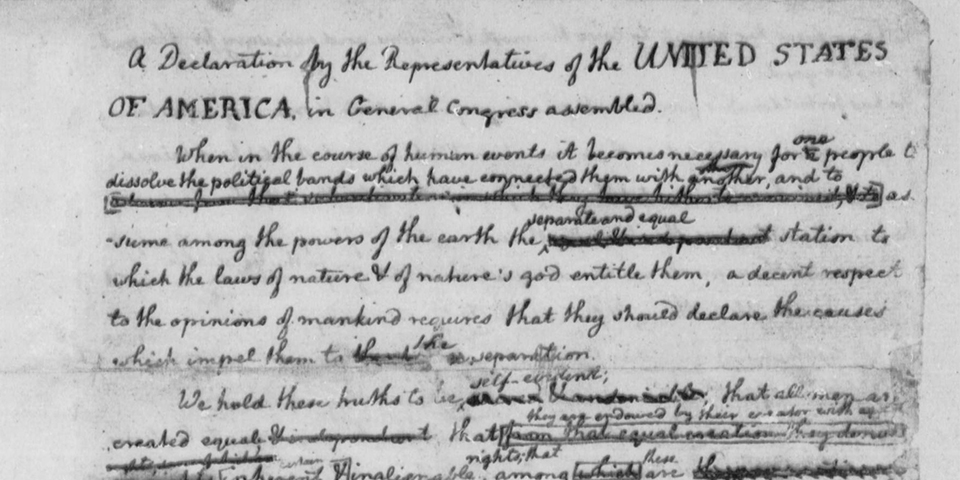
1776 – Congress appoints Committee of Five to draft the Declaration of Independence


On June 11, 1776, the Continental Congress selects Thomas Jefferson of VirginiaJohn Adams of MassachusettsBenjamin Franklin of Pennsylvania, Roger Sherman of Connecticut and Robert R. Livingston of New York to draft a declaration of independence.

Knowing Jefferson’s prowess with a pen, Adams urged him to author the first draft of the document, which was then carefully revised by Adams and Franklin before being given to Congress for review on June 28.

The revolutionary treatise began with reverberating prose:

“When, in the Course of human Events, it becomes necessary for one People to dissolve the Political Bands which have connected them with another, and to assume, among the Powers of the Earth, the separate and equal Station to which the Laws of Nature and of Nature’s God entitle them, a decent Respect to the Opinions of Mankind requires that they should declare the Causes which impel them to the Separation.

For the complete article, go to: history.com