
February 1839: The Amistad abducted 53 slaves on June 28 1839 ~ on July 1 ,35 Slaves organized a Mutiny On Nov 26,1841 three yrs later& only 23 slaves made it back – a repost


by Jenny Ashcraft  
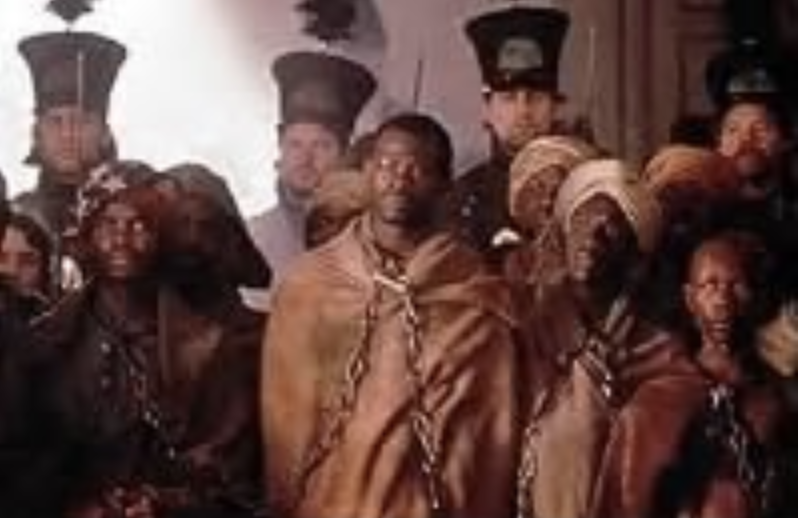
In February 1839, slave hunters abducted a group of Africans from Sierra Leone and shipped them to Havana, Cuba to be sold as slaves. Their kidnappings violated all treaties then in existence. When they arrived in Cuba, two Spanish plantation owners, Pedro Montes and Jose Ruiz, purchased 53 slaves to work their Caribbean plantation. They loaded the slaves aboard the Cuban schooner Amistad. On July 1, while sailing through the Caribbean, the captured slaves organized a mutiny. One of the slaves, Sengbe Pieh (also known as Joseph Cinque), freed himself and loosed others. They killed the captain and the ship’s cook, seized the ship, and ordered Montes and Ruiz to sail to Africa. Early in the morning of July 2, in the midst of a storm, the enslaved people rose up against their captors and, using sugar-cane knives found in the hold, killed the captain of the vessel and a crewmember. Two other crewmembers were either thrown overboard or escaped, and Jose Ruiz and Pedro Montes, the two Cubans who had purchased the enslaved people, were captured. Cinque ordered the Cubans to sail the Amistad east back to Africa. During the day, Ruiz and Montes complied, but at night they would turn the vessel in a northerly direction, toward U.S. waters. After almost nearly two difficult months at sea, during which time more than a dozen Africans perished, what became known as the “black schooner” was first spotted by American vessels.

Under the guise of heading towards Africa, Montes and Ruiz sailed the ship north instead. The Amistad zigzagged up the east coast for nearly two months.

On August 26, 1839, it dropped anchor off the tip of Long Island and a few of the men went ashore for fresh water. Soon, the US Navy brig Washington sailed into view. Thomas R. Gedney, commanding officer of the Washington, assumed those on board were pirates. He ordered his men to disarm the Africans and capture everyone including those who had gone ashore for water. They were all transported to Connecticut where officials freed the Spaniards but charged the Africans with murder upon the high seas.

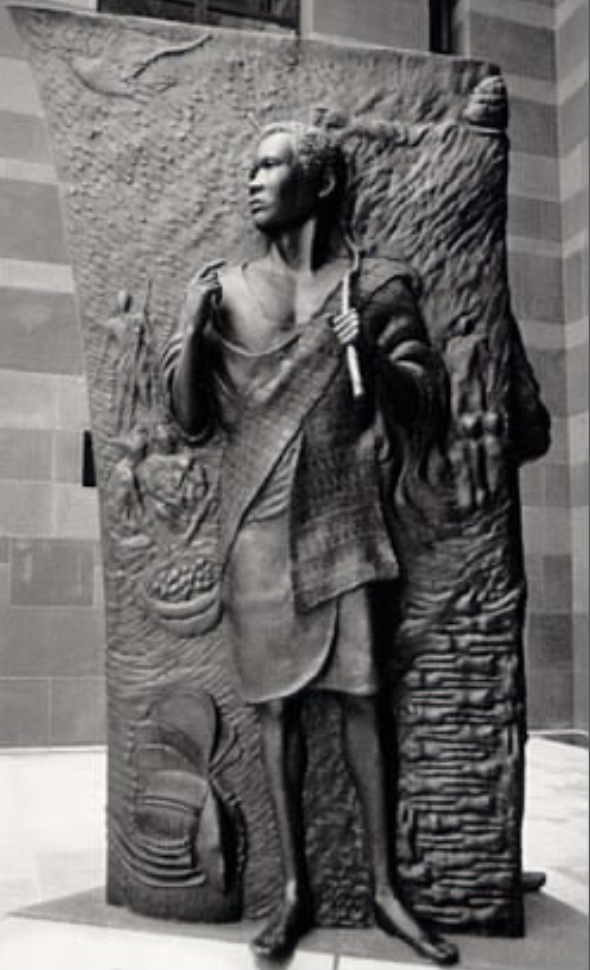
Amistad Memorial
New Haven, Connecticut 
The murder charges were eventually dismissed, but the Africans remained imprisoned and their case sent to Federal District Court in Connecticut. The plantation owners, the government of Spain, and Gedney all claimed some sort of compensation. The plantation owners wanted their slaves back, the Spanish government wanted the slaves returned to Cuba where they would likely be put to death, and Thomas Gedney felt he was entitled to compensation under maritime law that allowed salvage rights when saving a ship or its cargo from impending loss.
The district court ruled that the case fell within Federal jurisdiction. The ruling was appealed, and the case sent to the Supreme Court. Former president John Quincy Adams argued on behalf of the Africans. He said they were innocent because international laws found the slave trade was illegal. Thus, anyone who escaped should be considered free under American law.

The Supreme Court ruled in favor of the Africans and ordered their immediate release. Abolitionists who had supported their cause raised funds to return them to Africa.

On November 26, 1841, nearly three years after their abduction, the Africans departed New York City bound for home. Only 35 of them made it back. The others died at sea or while in custody.
The original 19th-century manuscripts from the Amistad case and our entire Black History collection are available to search for free this month on Fold3!

LBJ Remarks on Signing the Civil Rights Act


Civil Rights Act of 1964 Facts ~ taught in some schools


Civil Rights Act of 1964 Facts

The Civil Rights Act of 1964 was a far-ranging law that was passed by Congress and signed into law by President Lyndon Johnson.

The Act essentially outlawed racial and gender discrimination in the workplace and outlawed most forms of racial segregation.

The bill was originally the idea of President John F. Kennedy, who was viewed by many in the Civil Rights movement as apathetic at best to their plight. Kennedy said he was influenced by sights of civil rights marchers being beaten by the police in Alabama, so he put forward the legislation in June 1963. The bill probably had the votes to pass, but was stopped in committee by Representative Howard Smith of Virginia, who was a segregationist.

After Kennedy was assassinated on November 22, 1963, the Congress and the general public were much more sympathetic to the bill.

The bill was passed 289-126 in the House of Representatives and a modified compromise version by the Senate 73-27 on June 19, 1964.

President Johnson signed the bill into law on July 2, 1964.


CivilRightsactsigned

Interesting Civil Rights Act of 1964 Facts:
  • Opposition to the bill was more along geographic than political lines with a majority of both southern Democrats and Republicans voting “nay.”
  • Representative Emanuel Cellar (D-NY) was one of the bill’s early advocates. He was also instrumental in passing the Immigration Act of 1965.
  • Southern Democrats filibustered for fifty-four days to prevent the passage of the bill before a compromise bill was introduced that lessened the power of the government to regulate private business.
  • Civil rights organizations, such as the NAACP, and leaders, like Martin Luther King Jr., lobbied congressmen and both presidents to pass the bill.
  • Title VII of the Act expressly prohibits workplace discrimination on the basis of race, color, religion, sex, or national origin.
  • The Equal Employment Opportunity Commission (EEOC), oversees enforcement of Title VII of the Civil Rights Act of 1964.
  • Among the more interesting of the congressmen who were opposed to the bill were Senators Robert Byrd (D-WV), who became a mentor to the next generation of Democrat politicians, and Albert Gore Sr. (D-TN), who was the father of former vice president and senator, Al Gore.
  • The legality of the Act has been upheld in several Supreme Court decisions, including:

Heart of Atlanta Hotel v. United States, Philips v. Martin Marietta Corp., and Pittsburgh Press Co. v. Pittsburgh Commission on Human Relations.

  • Title IX of the Act made it easier for criminal cases involving civil rights violations to be tried in federal court. This was extremely important as many Klansmen who were acquitted in state courts for crimes ranging from assault and arson to murder were usually convicted for civil rights violations, although the convictions usually carried far less time.
  • The passage of the Civil Rights Act of 1964 paved the way for the Civil Rights Act of 1968, which barred racial discrimination in housing.
Although some aspects of voting problems were addressed in the Civil Rights Act of 1964, most of the barriers to black disenfranchisement in the southern states were dealt with in the Voting Rights Act of 1965.

softschools.com

If you see any errors please feel free to comment… so many opinions on who actually came up with the idea of the Bill

on this day: 1964 – U.S. President Johnson signed the “Civil Rights Act of 1964” into law. The act made it illegal in the U.S. to discriminate against others because of their race. 


1298 – An army under Albert of Austria defeated and killed Adolf of Nassua near Worms, Germany.

1625 – The Spanish army took Breda, Spain, after nearly a year of siege.

1644 – Lord Cromwell crushed the Royalists at the Battle of Marston Moor near York, England.

1747 – Marshall Saxe led the French forces to victory over an Anglo-Dutch force under the Duke of Cumberland at the Battle of Lauffeld.

1776 – Richard Henry Lee’s resolution that the American colonies “are, and of right ought to be, free and independent States” was adopted by the Continental Congress. 

1850 – Prussia agreed to pull out of Schlewig and Holstein, Germany.

1850 – Benjamin Lane patented a gas mask with a breathing apparatus. (Patent US7476 A)

1857 – New York City’s first elevated railroad officially opened for business.

1858 – Czar Alexander II freed the serfs working on imperial lands.

1881 – Charles J. Guiteau fatally wounded U.S. President James A. Garfield in Washington, DC.

1890 – The U.S. Congress passed the Sherman Antitrust Act. 

1926 – The U.S. Congress established the Army Air Corps.

1937 – American aviation pioneer Amelia Earhart disappeared in the Central Pacific during an attempt to fly around the world at the equator.

1939 – At Mount Rushmore, Theodore Roosevelt’s face was dedicated.

1944 – American bombers, as part of Operation Gardening, dropped land mines, leaflets and bombs on German-occupied Budapest.

1947 – An object crashed near Roswell, NM. The U.S. Army Air Force insisted it was a weather balloon, but eyewitness accounts led to speculation that it might have been an alien spacecraft.

1962 – Wal-Mart Discount City opened in Rogers, Arkansas. It was the first Walmart store.

1964 – U.S. President Johnson signed the “Civil Rights Act of 1964” into law. The act made it illegal in the U.S. to discriminate against others because of their race.

1967 – The U.S. Marine Corps launched Operation Buffalo in response to the North Vietnamese Army’s efforts to seize the Marine base at Con Thien.

1976 – The U.S. Supreme Court ruled the death penalty was not inherently cruel or unusual.

1976 – North Vietnam and South Vietnam were reunited.

1979 – The U.S. Mint officially released the Susan B. Anthony coin in Rochester, NY.

1980 – U.S. President Jimmy Carter reinstated draft registration for males 18 years of age.

1981 – Soyuz T-6 returned to Earth.

1982 – Larry Walters (“Lawnchair Larry”) took flight in his homeade airship that consisted of a lawnchair with 45 helium-filled weather balloons attached to it. He stayed in flight for about an hour.

1985 – General Motors announced that it was installing electronic road maps as an option in some of its higher-priced cars.

1995 – “Forbes” magazine reported that Microsoft’s chairman, Bill Gates, was the worth $12.9 billion, making him the world’s richest man.

1998 – Cable News Network (CNN) retracted a story that alleged that U.S. commandos had used nerve gas to kill American defectors during the Vietnam War. 

2000 – In Mexico, Vicente Fox Quesada of the National Action Party (PAN) defeated Francisco Labastida Ochoa of the Institutional Revolutionary Party (PRI) in the presidential election. The PRI had controlled the presidency in Mexico since the party was founded in 1929.

The story of 4th of July


4thofJuly

The Declaration of Independence

We celebrate American Independence Day on the Fourth of July every year. July 4, 1776, represents the Declaration of Independence and the birth of the United States of America as an independent nation.

But July 4, 1776 wasn’t the day that the Continental Congress decided to declare independence (they did that on July 2, 1776).

It wasn’t the day we started the American Revolution, either (that had happened back in April 1775).

And it wasn’t the day Thomas Jefferson wrote the first draft of the Declaration of Independence ( June of 1776). Or the date on which the Declaration was delivered to Great Britain (that didn’t happen until November 1776). Or the date it was signed (that was August 2, 1776).

So what did happen on July 4, 1776?

The Continental Congress approved the final wording of the Declaration of Independence on July 4, 1776. They’d been working on it for a couple of days after the draft was submitted on July 2nd and finally agreed on all of the edits and changes.

July 4, 1776, became the date included on the Declaration of Independence, and the fancy handwritten copy signed in August (the copy now displayed at the National Archives in Washington, D.C.) It’s also the date printed on the Dunlap Broadsides, the original copies of the Declaration that were circulated throughout the new nation. So when people thought of the Declaration of Independence, July 4, 1776 was the date they remembered.

In contrast, we celebrate Constitution Day on September 17th of each year, the anniversary of the date the Constitution was signed, not the anniversary of the date it was approved. If we’d followed this same approach for the Declaration of Independence, we would be celebrating Independence Day on August 2nd of each year, the day the Declaration of Independence was signed!

How did the Fourth of July become a national holiday?

For the first 15 or 20 years after the Declaration was written, people didn’t celebrate it much on any date. It was too new, and too much else was happening in the young nation. By the 1790s, a time of bitter partisan conflicts, the Declaration had become controversial. One party, the Democratic-Republicans, admired Jefferson and the Declaration. The other party, the Federalists, thought the Declaration was too French and anti-British, which went against their current policies.

By 1817, John Adams complained in a letter that America seemed uninterested in its past. But that would soon change.

After the War of 1812, the Federalist party began to come apart and the new parties of the 1820s and 1830s all considered themselves inheritors of Jefferson and the Democratic-Republicans. Printed copies of the Declaration began to circulate again, all with the date July 4, 1776, listed at the top. The deaths of Thomas Jefferson and John Adams on July 4, 1826, may even have helped to promote the idea of July 4 as an important date to be celebrated.

Celebrations of the Fourth of July became more common as the years went by. In 1870, almost a hundred years after the Declaration was written, Congress first declared July 4  a national holiday as part of a bill to officially recognize several holidays, including Christmas. Further legislation about national holidays, including July 4, was passed in 1939 and 1941.