
14th Amendment to the U.S. Constitution: Civil Rights (1868)


Passed by Congress June 13, 1866, and ratified July 9, 1868, the 14th Amendment extended liberties and rights granted by the Bill of Rights to formerly enslaved people.
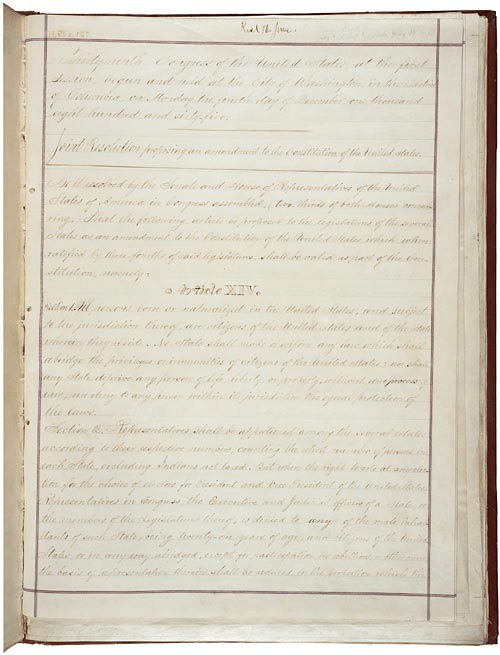
Citation: The House Joint Resolution Proposing the 14th Amendment to the Constitution, June 16, 1866; Enrolled Acts and Resolutions of Congress, 1789-1999; General Records of the United States Government; Record Group 11; National Archives.
View All Pages in the National Archives Catalog
View Transcript

Following the Civil War, Congress submitted to the states three amendments as part of its Reconstruction program to guarantee equal civil and legal rights to Black citizens. A major provision of the 14th Amendment was to grant citizenship to “All persons born or naturalized in the United States,” thereby granting citizenship to formerly enslaved people.

Another equally important provision was the statement that “nor shall any state deprive any person of life, liberty, or property, without due process of law; nor deny to any person within its jurisdiction the equal protection of the laws.” The right to due process of law and equal protection of the law now applied to both the federal and state governments.

On June 16, 1866, the House Joint Resolution proposing the 14th Amendment to the Constitution was submitted to the states. On July 28, 1868, the 14th amendment was declared, in a certificate of the Secretary of State, ratified by the necessary 28 of the 37 States, and became part of the supreme law of the land.

Congressman John A. Bingham of Ohio, the primary author of the first section of the 14th Amendment, intended that the amendment also nationalize the Bill of Rights by making it binding upon the states. When introducing the amendment, Senator Jacob Howard of Michigan specifically stated that the privileges and immunities clause would extend to the states “the personal rights guaranteed and secured by the first eight amendments.” Historians disagree on how widely Bingham’s and Howard’s views were shared at the time in the Congress, or across the country in general. No one in Congress explicitly contradicted their view of the amendment, but only a few members said anything at all about its meaning on this issue. For many years, the Supreme Court ruled that the amendment did not extend the Bill of Rights to the states.

Not only did the 14th Amendment fail to extend the Bill of Rights to the states; it also failed to protect the rights of Black citizens. A legacy of Reconstruction was the determined struggle of Black and White citizens to make the promise of the 14th Amendment a reality. Citizens petitioned and initiated court cases, Congress enacted legislation, and the executive branch attempted to enforce measures that would guard all citizens’ rights. While these citizens did not succeed in empowering the 14th Amendment during Reconstruction, they effectively articulated arguments and offered dissenting opinions that would be the basis for change in the 20th century.

on this day 7/9


0118 – Hadrian, Rome’s new emperor, made his entry into the city.

0455 – Avitus, the Roman military commander in Gaul, became Emperor of the West.

1540 – England’s King Henry VIII had his 6-month-old marriage to his fourth wife, Anne of Cleves, annulled.

1609 – In a letter to the crown, the emperor Rudolf II granted Bohemia freedom of worship.

1755 – General Edward Braddock was mortally wounded when French and Indian troops ambushed his force of British regulars and colonial militia. He died on July 13.

1776 – The American Declaration of Independence was read aloud to Gen. George Washington’s troops in New York.

1789 – In Versailles, the French National Assembly declared itself the Constituent Assembly and began to prepare a French constitution.

1790 – The Swedish navy captured one third of the Russian fleet at the naval battle of Svensksund in the Baltic Sea.

1792 – S.L. Mitchell of Columbia College in New York City became the first Professor of Agriculture.

1808 – The leather-splitting machine was patented by Samuel Parker.

1816 – Argentina declared independence from Spain.

1847 – A 10-hour work day was established for workers in the state of New Hampshire. 

1868 – The 14th Amendment to the U.S. Constitution was ratified. The amendment was designed to grant citizenship to and protect the civil liberties of recently freed slaves. It did this by prohibiting states from denying or abridging the privileges or immunities of citizens of the United States, depriving any person of his life, liberty, or property without due process of law, or denying to any person within their jurisdiction the equal protection of the laws. 

1872 – The doughnut cutter was patented by John F. Blondel.

1877 – Alexander Graham Bell, Gardiner Greene Hubbard, Thomas Sanders and Thomas Watson formed the Bell Telephone Company.

1878 – The corncob pipe was patented by Henry Tibbe.

1900 – The Commonwealth of Australia was established by an act of the British Parliament, uniting the separate colonies under a federal government.

1922 – Johnny Weissmuller became the first person to swim the 100 meters freestyle in less than a minute.

1943 – American and British forces made an amphibious landing on Sicily.

1947 – The engagement of Britain’s Princess Elizabeth to Lt. Philip Mountbatten was announced.

1951 – U.S. President Truman asked Congress to formally end the state of war between the United States and Germany.

1953 – New York Airways began the first commuter passenger service by helicopter. 

1968 – The first All-Star baseball game to be played indoors took place at the Astrodome in Houston, TX.

1971 – The United States turned over complete responsibility of the Demilitarized Zone to South Vietnamese units.

1985 – Joe Namath signed a five-year pact with ABC-TV to provide commentary for “Monday Night Football”.

2015 – The South Carolina House of Representatives approved taking down the Confederate flag from the Capitol grounds. The flag was removed the next day and taken to a state military museum. 

Why Don’t Churches Have To Pay Taxes?


H.R. 1: One Big Beautiful Bill Act


By Party
Selected Caucuses
All VotesRepublicansDemocratsRepublican Study Committee
Aye50%2182180150
No50%21422120

Passed. Simple Majority Required.

Data from the official record at house.gov.

Caucuses are selected based on a statistical analysis of their relevance to the vote outcome. Caucus membership may not be the latest — we are still working on that. Legislators may be a member of multiple caucuses.

Ideology Vote Chart

218 MAGA – 214 DEMs 2 MAGA

The tax-exempt status of churches is rooted in a combination of historical traditions, legal provisions, and constitutional principles. Here are key reasons why churches don’t have to pay taxes:

  1. Constitutional Separation of Church and State: The First Amendment of the United States Constitution prohibits the government from establishing an official religion and ensures the free exercise of religion. Granting tax-exempt status to churches aligns with the principle of separating church and state, preventing government interference in religious affairs.
  2. Recognition of Charitable and Community Contributions: Throughout history, churches have been recognized for their substantial contributions to communities, including charitable activities, education, and social services. Granting tax-exempt status acknowledges and encourages these positive contributions to society.
  3. Internal Revenue Code Section 501(c)(3): The Internal Revenue Code, specifically Section 501(c)(3), outlines the criteria for tax-exempt status for charitable, religious, and educational organizations. Churches qualify for automatic exemption under this section, provided they meet certain requirements.
  4. Preservation of Religious Autonomy: Tax-exempt status allows churches to operate independently and maintain autonomy in matters of doctrine, worship, and internal governance. This preserves the integrity and independence of religious organizations.
  5. Prevention of Government Favoritism: Exempting churches from taxes helps avoid the appearance of government favoritism toward specific religions. By treating all religions equally and not providing financial advantages to any particular faith, the government upholds a neutral stance.
  6. Avoidance of Political Entanglement: Tax-exempt organizations, including churches, are restricted from engaging in substantial political activities. This limitation helps prevent religious institutions from becoming entangled in political affairs, maintaining their focus on spiritual, charitable, and educational missions.
  7. Encouragement of Charitable Giving: Donors to tax-exempt religious organizations can typically deduct their contributions from taxable income. This encourages philanthropy and charitable giving, further supporting the financial well-being of churches.

While churches enjoy tax-exempt status, it is essential to note that this privilege comes with certain limits and conditions. These include adherence to their exclusive religious purpose, avoidance of excessive political activities, and compliance with regulations governing unrelated business income and reporting requirements. The intersection of religious freedom, societal contributions, and fiscal responsibility forms a complex landscape that continues to be shaped by legal, historical, and cultural considerations.

factsontaxes.com