July 5, 1852 – What to the American slave is your Fourth of July? in memory


repost – in memory

NMAAHCLonnie Bunch, museum director, historian, lecturer, and author, is proud to present A Page from Our American Story, a regular on-line series for Museum supporters. It will showcase individuals and events in the African American experience, placing these stories in the context of a larger story — our American story.

A Page From Our American Story

On July 5, 1852 approximately 3.5 million African Americans were enslaved — roughly 14% of the total population of the United States. That was the state of the nation when Frederick Douglass was asked to deliver a keynote address at an Independence Day celebration.

He accepted and, on a day white Americans celebrated their independence and freedom from the oppression of the British crown, Douglass delivered his now-famous speech What to the Slave is the Fourth of July. In it, Douglass offered one of the most thought provoking and powerful testaments to the hypocrisy, bigotry and inhumanity of slavery ever given.

Daguerreotype of Frederick Douglass
(1847-1852) by Samuel J. Miller.
The Art Institute of Chicago

Douglass told the crowd that the arguments against slavery were well understood. What was needed was “fire” not light on the subject; “thunder” not a gentle “shower” of reason. Douglass would tell the audience:

The feeling of the nation must be quickened; the conscience of the nation must be roused; the propriety of the nation must be startled; the hypocrisy of the nation must be exposed; and its crimes against God and man must be denounced.

Frederick Douglass was born into slavery, most likely in February 1818 — birth dates of slaves were rarely recorded. He was put to work full-time at age six, and his life as a young man was a litany of savage beatings and whippings. At age twenty, he successfully escaped to the North. In Massachusetts he became known as a voice against slavery, but that also brought to light his status as an escaped slave. Fearing capture and re-enslavement, Douglass went to England and continued speaking out against slavery.

He eventually raised enough money to buy his freedom and returned to America. He settled in Rochester, New York in 1847 and began to champion equality and freedom for slaves in earnest. By then, his renown extended far beyond America’s boundaries. He had become a man of international stature.

One suspects that Rochester city leaders had Douglass’ fame and reputation as a brilliant orator in mind when they approached him to speak at their Independence Day festivities. But with his opening words, Douglass’ intent became clear — decry the hypocrisy of the day as it played out in the lives of the slaves:

Fellow citizens, pardon me, and allow me to ask, why am I called upon to speak here today? What have I or those I represent to do with your national independence? Are the great principles of political freedom and of natural justice, embodied in that Declaration of Independence, extended to us? And am I, therefore, called upon to bring our humble offering to the national altar, and to confess the benefits, and express devout gratitude for the blessings resulting from your independence to us?

You can easily imagine the wave of unease that settled over his audience. The speech was long, as was the fashion of the day. A link to the entire address can be found at the end of this Our American Story. When you read it you will discover that, to his credit, Douglass was uncompromising and truthful:

This Fourth of July is yours, not mine. You may rejoice, I must mourn … What to the American slave is your Fourth of July? … a day that reveals to him more than all other days of the year, the gross injustice and cruelty to which he is the constant victim. To him your celebration is a sham … your shouts of liberty and equality, hollow mock; your prayers and hymns, your sermons and thanksgivings … hypocrisy — a thin veil to cover up crimes which would disgrace a nation of savages.

US Stamp honoring
Frederick Douglass, 1967.
US Postal Service

Reaction to the speech was strong, but mixed. Some were angered, others appreciative. What I’ve always thought most impressive about Douglass’ speech that day was the discussion it provoked immediately and in the weeks and months that followed.

Certainly much has changed since Douglass’ speech. Yet the opportunity to discuss and debate the important impact of America’s racial history is very much a part of the National Museum of African American History and Culture. Douglass’ words remind us that many have struggled to ensure that the promise of liberty be applied equally to all Americans — regardless of race, gender or ethnicity. And that the struggle for equality is never over.

So, as we gather together at picnics, parades, and fireworks to celebrate the 4th of July, let us remember those, like Frederick Douglass, who fought and sacrificed to help America live up to its ideals of equality, fair play and justice.

Frederick Douglass’ life and words have left us a powerful legacy. His story, and the African American story, is part of us all.

To you and your family, have a joyous and safe Fourth of July and thank you for your interest in the National Museum of African American History and Culture.

All the best,

Lonnie Bunch
Director

P.S. To read the full text Frederick Douglass’ speech of July 5, 1852, click here: http://teachingamericanhistory.org/library/index.asp?document=162

We

hope you will consider making a contribution to the Museum. Thank you for your support.

on this day … 7/10


1609 – The Catholic states in Germany set up a league under the leadership of Maximillian of Bavaria.

1679 – The British crown claimed New Hampshire as a royal colony.

1776 – The statue of King George III was pulled down in New York City.

1778 – In support of the American Revolution, Louis XVI declared war on England.

1821 – U.S. troops took possession of Florida. The territory was sold by Spain.

1832 – U.S. President Andrew Jackson vetoed legislation to re-charter the Second Bank of the United States.

1866 – Edison P. Clark patented his indelible pencil.

1890 – Wyoming became the 44th state to join the United States.
Today in Wyoming History

1900 – ‘His Master’s Voice’, was registered with the U.S. Patent Office. The logo of the Victor Recording Company, and later, RCA Victor, shows the dog, Nipper, looking into the horn of a gramophone machine.

1910 – W.R. Brookins became the first to fly an airplane at an altitude of one mile.

1913 – The highest temperature ever recorded in the U.S. was 134 degrees in Death Valley, CA.

1919 – The Treaty of Versailles was hand delivered to the U.S. Senate by President Wilson.

1925 – The official news agency of the Soviet Union, TASS, was established.

1928 – George Eastman first demonstrated color motion pictures.

1929 – The U.S. government began issuing paper money in the small size.

1938 – Howard Hughes completed a 91 hour flight around the world.

1940 – The 114-day Battle of Britain began during World War II.

1943 – Arthur Ashe, the first African-American inducted into the International Tennis Hall of Fame, was born. He had won 33 career titles.

1947 – Saab introduced the Model 92 prototype as its first automobile.

1949 – The first practical rectangular television was presented. The picture tube measured 12 by 16 and sold for $12.

1951 – Armistice talks aimed at ending the Korean conflict began at Kaesong.

1951 – Sugar Ray Robinson was defeated for only the second time in 133 fights as Randy Turpin took the middleweight crown.

1953 – American forces withdraw from Pork Chop Hill in Korea after heavy fighting.

1962 – The Telstar Communications satellite was launched. The satellite relayed TV and telephone signals between Europe and the U.S.

1962 – Fred Baldasare swam the English Channel underwater. It was a 42 miles and took 18 hours.

1969 – The National League was divided up into two baseball divisions.

1973 – Britain granted the Bahamas their independence after three centuries of British colonial rule.

1984 – Dwight ‘Doc’ Gooden, of the New York Mets, became the youngest player to appear in an All-Star Game as a pitcher. He was 19 years, 7 months, and 24 days old.

1985 – Coca-Cola resumed selling the old formula of Coke, it was renamed “Coca-Cola Classic.” It was also announced that they would continue to sell “New” Coke.

1990 – Mikhail Gorbachev won re-election as the leader of the Soviet Communist Party.

1991 – Boris Yeltsin took the oath of office as the first elected president of the Russian republic.

1991 – U.S. President Bush lifted economic sanctions against South Africa, citing its “profound transformation” toward racial equality.

1993 – Kenyan runner Yobes Ondieki became the first man to run 10,000 meters in less than 27 minutes.

1997 – Scientists in London said DNA from a Neanderthal skeleton supported a theory that all humanity descended from an “African Eve” 100,000 to 200,000 years ago.

1998 – The World Bank approved a $700 million loan to Thailand.

1998 – The U.S. military delivered the remains of Air Force 1st Lt. Michael Blassie to his family in St. Louis. He had been placed in Arlington Cemetery’s Tomb of the Unknown in 1984. His identity had been confirmed with DNA tests.

1999 – The heads of six African nations that had troops in the Democratic Republic of the Congo signed a cease-fire agreement that would end the civil war in that nation.

2002 – Peter Paul Rubens’ painting “The Massacre of the Innocents” sold for $76.2 million at Sotheby’s.

2015 – In South Carolina, the Confederate flag was removed from the Capitol grounds and taken to a state military museum.

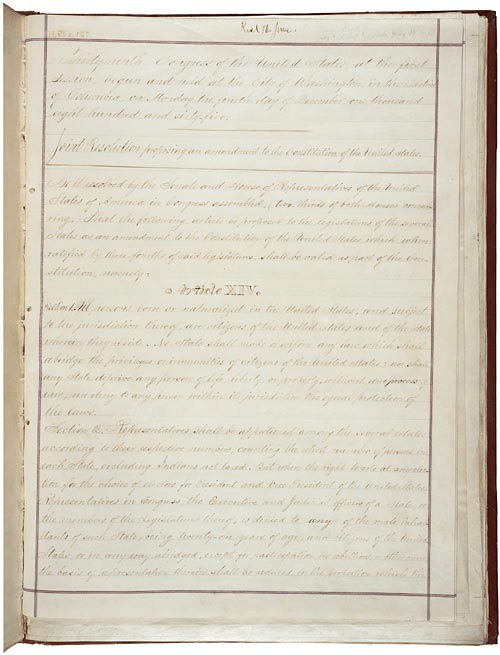
14th Amendment to the U.S. Constitution: Civil Rights (1868)


Passed by Congress June 13, 1866, and ratified July 9, 1868, the 14th Amendment extended liberties and rights granted by the Bill of Rights to formerly enslaved people.

Citation: The House Joint Resolution Proposing the 14th Amendment to the Constitution, June 16, 1866; Enrolled Acts and Resolutions of Congress, 1789-1999; General Records of the United States Government; Record Group 11; National Archives.
View All Pages in the National Archives Catalog
View Transcript

Following the Civil War, Congress submitted to the states three amendments as part of its Reconstruction program to guarantee equal civil and legal rights to Black citizens. A major provision of the 14th Amendment was to grant citizenship to “All persons born or naturalized in the United States,” thereby granting citizenship to formerly enslaved people.

Another equally important provision was the statement that “nor shall any state deprive any person of life, liberty, or property, without due process of law; nor deny to any person within its jurisdiction the equal protection of the laws.” The right to due process of law and equal protection of the law now applied to both the federal and state governments.

On June 16, 1866, the House Joint Resolution proposing the 14th Amendment to the Constitution was submitted to the states. On July 28, 1868, the 14th amendment was declared, in a certificate of the Secretary of State, ratified by the necessary 28 of the 37 States, and became part of the supreme law of the land.

Congressman John A. Bingham of Ohio, the primary author of the first section of the 14th Amendment, intended that the amendment also nationalize the Bill of Rights by making it binding upon the states. When introducing the amendment, Senator Jacob Howard of Michigan specifically stated that the privileges and immunities clause would extend to the states “the personal rights guaranteed and secured by the first eight amendments.” Historians disagree on how widely Bingham’s and Howard’s views were shared at the time in the Congress, or across the country in general. No one in Congress explicitly contradicted their view of the amendment, but only a few members said anything at all about its meaning on this issue. For many years, the Supreme Court ruled that the amendment did not extend the Bill of Rights to the states.

Not only did the 14th Amendment fail to extend the Bill of Rights to the states; it also failed to protect the rights of Black citizens. A legacy of Reconstruction was the determined struggle of Black and White citizens to make the promise of the 14th Amendment a reality. Citizens petitioned and initiated court cases, Congress enacted legislation, and the executive branch attempted to enforce measures that would guard all citizens’ rights. While these citizens did not succeed in empowering the 14th Amendment during Reconstruction, they effectively articulated arguments and offered dissenting opinions that would be the basis for change in the 20th century.

on this day 7/9


0118 – Hadrian, Rome’s new emperor, made his entry into the city.

0455 – Avitus, the Roman military commander in Gaul, became Emperor of the West.

1540 – England’s King Henry VIII had his 6-month-old marriage to his fourth wife, Anne of Cleves, annulled.

1609 – In a letter to the crown, the emperor Rudolf II granted Bohemia freedom of worship.

1755 – General Edward Braddock was mortally wounded when French and Indian troops ambushed his force of British regulars and colonial militia. He died on July 13.

1776 – The American Declaration of Independence was read aloud to Gen. George Washington’s troops in New York.

1789 – In Versailles, the French National Assembly declared itself the Constituent Assembly and began to prepare a French constitution.

1790 – The Swedish navy captured one third of the Russian fleet at the naval battle of Svensksund in the Baltic Sea.

1792 – S.L. Mitchell of Columbia College in New York City became the first Professor of Agriculture.

1808 – The leather-splitting machine was patented by Samuel Parker.

1816 – Argentina declared independence from Spain.

1847 – A 10-hour work day was established for workers in the state of New Hampshire. 

1868 – The 14th Amendment to the U.S. Constitution was ratified. The amendment was designed to grant citizenship to and protect the civil liberties of recently freed slaves. It did this by prohibiting states from denying or abridging the privileges or immunities of citizens of the United States, depriving any person of his life, liberty, or property without due process of law, or denying to any person within their jurisdiction the equal protection of the laws. 

1872 – The doughnut cutter was patented by John F. Blondel.

1877 – Alexander Graham Bell, Gardiner Greene Hubbard, Thomas Sanders and Thomas Watson formed the Bell Telephone Company.

1878 – The corncob pipe was patented by Henry Tibbe.

1900 – The Commonwealth of Australia was established by an act of the British Parliament, uniting the separate colonies under a federal government.

1922 – Johnny Weissmuller became the first person to swim the 100 meters freestyle in less than a minute.

1943 – American and British forces made an amphibious landing on Sicily.

1947 – The engagement of Britain’s Princess Elizabeth to Lt. Philip Mountbatten was announced.

1951 – U.S. President Truman asked Congress to formally end the state of war between the United States and Germany.

1953 – New York Airways began the first commuter passenger service by helicopter. 

1968 – The first All-Star baseball game to be played indoors took place at the Astrodome in Houston, TX.

1971 – The United States turned over complete responsibility of the Demilitarized Zone to South Vietnamese units.

1985 – Joe Namath signed a five-year pact with ABC-TV to provide commentary for “Monday Night Football”.

2015 – The South Carolina House of Representatives approved taking down the Confederate flag from the Capitol grounds. The flag was removed the next day and taken to a state military museum.