Thank you so much for your generous support as a Member of the Director’s Circle of the National Museum of African American History and Culture.
We are pleased to offer a limited number of exclusive Director’s Circle passes to our next community day.
This day-long series of events is inspired by director Ava DuVernay’s cinematic installation, August 28: A Day in the Life of the People, which looks at African American history through the lens of six significant historical events that all transpired years apart on August 28th.
A Day in the Life of a People
1833: Escaping Enslavement
Capture history in this hands-on timeline activity for all ages1955: Because of Emmett Till
Learn from this mixed media presentation1961: Mr. Postman Delivers and Other Hits!
Enjoy DJ music celebrating this landmark Motown album and more1963: Why Do We March?
Create your own sign in this activity for all ages Outside the Museum and thus available without passes2005: When Disaster Strikes
Participate in this group building activity based upon re-building the Lower Ninth Ward after Hurricane Katrina
2008: We Are the Change
Share your thoughts on a message board for everyone in the Museum to read and contemplate
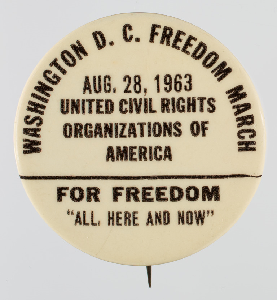
Photo credit: Pin-back button for the 1963 March on Washington for Jobs and Freedom, Collection of the Smithsonian National Museum of African American History and Culture.
On August 28, 1963, one-hundred years after the signing of the Emancipation Proclamation, approximately 200,000 to 250,000 people arrived in Washington, D.C., and peacefully marched down Constitution and Independence Avenues to the Lincoln Memorial, to rectify, in the words of A. Philip Randolph, “old grievances and to help resolve an American crisis.” Precipitating factors included the subjugation of African Americans to Jim Crow segregation and laws in practically every sector in society, a disproportionate level of high unemployment and unequal wages, and other forms of legal, economic, and social inequality.
The marchers, representing rural and urban areas from every corner of the nation, arrived by train, plane, bus, and car. Newspapers reported that the marchers were young and old; black, white, and brown. They were sharecroppers and socialites. The marchers were prayerful, jubilant, and tearful; embraced each other throughout the day and sang traditional spirituals such as “Oh Freedom,” “Ain’t Gon’ Let Nobody Turn Me Round,” and “We Shall Overcome.” These supporters of the March were in Washington to introduce ten levels of demands, of which the first was the demand for comprehensive and effective civil rights legislation that would guarantee all Americans: (1) access to all public accommodations, (2) decent housing, (3) adequate and integrated education, and (4) the right to vote. Other demands included: withholding Federal funds from all programs in which discrimination exists; a massive federal program to train and place all unemployed workers –black and white—on meaningful and dignified jobs with decent wages.
The six primary organizers and organizations for the March were: (1) James Farmer, National Director of the Congress of Racial Equality (CORE), (2) Reverend Martin Luther King, President of the Southern Christian Leadership Conference (SCLC), (3) John Lewis, Chairman of the Student Non-violent Coordinating Committee (SNCC), (4) A. Philip Randolph, President of the Negro American Labor Organization, (5) Roy Wilkins, Executive Secretary of the National Association for the Advancement of Colored People (NAACP), and (6) Whitney Young, Executive Director of the Urban League. These leaders of prominent civil rights organizations came together to commemorate the centennial of the Emancipation Proclamation and to call attention to the atrocities African Americans were still experiencing. The Reverend Dr. Martin Luther King gave his iconic “I Have a Dream”External speech on this occasion.
The 1963 March on Washington for Jobs and Freedom drew attention to the systemic racism and the discrimination which African Americans still experience in education, housing, and jobs. It also called for Federal legislation to guarantee the right to vote for all Americans.
Explore the Rosa Parks Papers to discover additional primary sources about the March on Washington. For example, in a Subject File folder on the March, read the Organizing Manual and other materials created by the organizers.
Listen to A. Philip Randolph, the organizer of the March on Washington for Jobs and Freedom, at the National Press Club two days before the March, where he explains the reasons for the March on Washington (listen to 05.00-14.09), how it serves as a model against racial bias, what it will achieve in motivating people to do something about the problem of abolishing racial violence in America, and its goal to “highlight the idea of the struggle of Negroes in America to achieve the transition from second class citizenship, to first class citizenship,” and…“bring world pressure upon the United States of America to step up the struggle to wipe out race bias.”
Search on the term civil rights leaders in Today in History to read more about the lives of civil rights leaders such as Martin Luther King, Rosa Parks, James Baldwin, Booker T. Washington, and Mary Church Terrell.
Explore the Civil Rights History Project. Included are interviews of several people who participated in the March on Washington as well as many other aspects of the Civil Rights movement to obtain justice, freedom and equality for African Americans. This collection seeks to record and make widely accessible interviews with people who participated in the struggles.
On August 28, 1963, Martin Luther King Jr., delivered a speech to a massive group of civil rights marchers gathered around the Lincoln Memorial in Washington DC. The March on Washington for Jobs and Freedom brought together the nations most prominent civil rights leaders, along with tens of thousands of marchers, to press the United States government for equality. The culmination of this event was the influential and most memorable speech of Dr. King’s career. Popularly known as the “I have a Dream” speech, the words of Martin Luther King, Jr. influenced the Federal government to take more direct actions to more fully realize racial equality.
Mister Maestro, Inc., and Twentieth Century Fox Records Company recorded the speech and offered the recording for sale. Dr. King and his attorneys claimed that the speech was copyrighted and the recording violated that copyright. The court found in favor of Dr. King. Among the papers filed in the case and available at the National Archives at New York City is a deposition given by Martin Luther King, Jr. and signed in his own hand.
Discussion Questions:
What was the official name for the event on August 28th, 1963? What does this title tell us about its focus?
What organizations were involved in the the March on Washington? What does this tell us about the event?
How does Martin Luther King, Jr. describe his writing process?
What are the major issues of this case? In other words, what is Martin Luther King, Jr. disputing?
How does Martin Luther King, Jr. describe his earlier speech on June 23rd in Detroit?
How does Martin Luther King, Jr. compare and contrast the two “I have a dream…” speeches? What are the major similarities and differences?




 On August 28, 1963, Martin Luther King Jr., delivered a speech to a massive group of civil rights marchers gathered around the Lincoln Memorial in Washington DC. The March on Washington for Jobs and Freedom brought together the nations most prominent civil rights leaders, along with tens of thousands of marchers, to press the United States government for equality. The culmination of this event was the influential and most memorable speech of Dr. King’s career. Popularly known as the “I have a Dream” speech, the words of Martin Luther King, Jr. influenced the Federal government to take more direct actions to more fully realize racial equality.
 Be a Seed for Change
You must be logged in to post a comment.