
Civil Rights Under Truman and Eisenhower
As the Cold War raged during the late 1940s and 1950s, great changes occurred in American society, especially concerning civil rights. The civil rights movement gathered strength and momentum during the postwar years.
Truman and Civil Rights 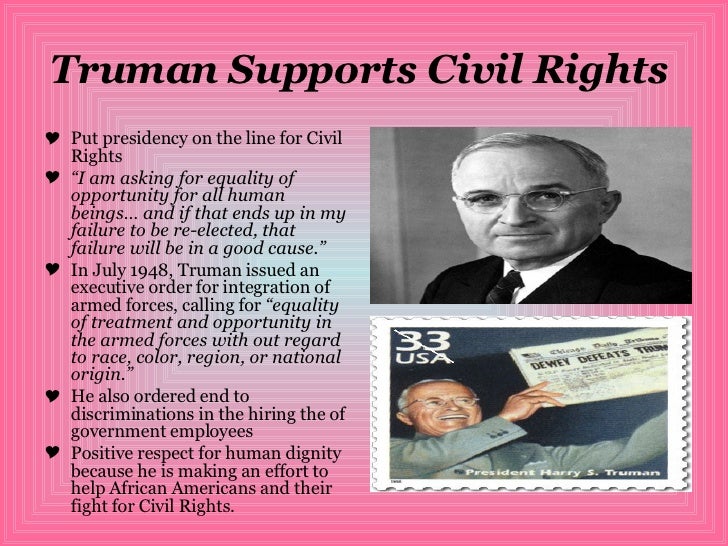
In efforts to preserve the support of southern whites, Truman at first avoided issues of civil rights for blacks. But he could not stay removed for long.
In 1947, the Presidential Committee on Civil Rights, created a year earlier, produced a report, To Secure These Rights, calling for the elimination of segregation.
In 1948, Truman endorsed the findings of the report and called for an end to racial discrimination in federal hiring practices. He also issued an executive order to end segregation in the military, an initiative that would be completed by Eisenhower. Although these moves cost Truman the support of many southern whites, the increased support of black voters made up for the political loss.
Eisenhower and the Civil Rights Acts 
Eisenhower backed the Civil Rights Act of 1957 and the Civil Rights Act of 1960. The former created a permanent Civil Rights Commission, as well as a Civil Rights Division within the Justice Department aimed at combating efforts to deny blacks the vote. The latter granted the federal courts the authority to register black voters.
Brown v. Board of Education
The fight for civil rights took a major leap forward in May 1954, when the Supreme Court, under the leadership of liberal Chief Justice Earl Warren, handed down one of the most famous decisions in American judicial history. In the case of Brown v. Board of Education of Topeka, the Court overturned the 1896 Plessy v. Ferguson decision and ruled that segregation of schools was unconstitutional, arguing that separate schools are inherently unequal. The Court demanded that the states desegregate immediately. Eisenhower ordered the desegregation of Washington, D.C., schools but at first refused to force southern states to comply with the Court’s ruling. Encouraged by this lack of federal backing, southern state governments engaged in “massive resistance” by choosing not to desegregate schools and by denying funding to districts that attempted desegregation. The resistance to integration was so fierce in Arkansas that Eisenhower dispatched federal troops to Little Rock to force desegregation of public schools there.
The Supreme Court’s decision in Brown v. Board of Education overturned the “separate but equal” doctrine established by Plessy v. Ferguson in 1896. In 1957, federal troops were called into Little Rock, Arkansas, to enforce integration of public schools.
The Civil Rights Movement Takes Shape
Amid the conflict over Brown v. Board of Education of Topeka, a strong civil rights movement began taking shape in the South. In December 1955 in Montgomery, Alabama, a black woman named Rosa Parks was arrested for refusing to give her bus seat to a white man. Led by a minister, Martin Luther King Jr., Montgomery blacks organized a boycott of the bus system. Despite violent attacks on black leaders, the boycott continued, reducing bus revenue by over 60 percent. In 1956, the Supreme Court upheld a lower court’s decision outlawing segregation on buses.
The success of the Montgomery bus boycott inspired civil rights leaders to adopt Martin Luther King Jr.’s philosophy of nonviolent civil disobedience. To direct his followers in a campaign against segregation and discrimination, King and other black ministers established the Southern Christian Leadership Conference (SCLC) in 1957. The SCLC soon found an ally in the Student Nonviolent Coordinating Committee (SNCC), which formed after a number of sit-ins at businesses that discriminated against blacks.
The civil rights movement gained strength by employing the doctrine of nonviolent civil disobedience during the 1950s. Led by Martin Luther King Jr. and the Southern Christian Leadership Conference, southern blacks staged direct acts of defiance against segregation.
source: sparknotes.com


 1565 – A Spanish expedition established the first permanent European settlement in North America at present-day St. Augustine,




 Be a Seed for Change
You must be logged in to post a comment.