November Awareness Days


The main days and months you should know about for November are:

November HolidaysTypeDate
Native American Heritage MonthMonthNovember 1
Hunger & Homelessness Awareness WeekWeekNovember 11-18
World Kindness DayDayNovember 12
Giving TuesdayDayNovember 28
Veterans DayDayNovember 11
Trans Day of RemembranceDayNovember 20

Nov. 12 ~ The Story of Ellis Island


On this day in 1954, Ellis Island, the gateway to America, shuts it doors after processing more than 12 million immigrants since opening in 1892. Today, an estimated 40 percent of all Americans can trace their roots through Ellis Island, located in New York Harbor off the New Jersey coast and named for merchant Samuel Ellis, who owned the land in the 1770s.

On January 2, 1892, 15-year-old Annie Moore, from Ireland, became the first person to pass through the newly opened Ellis Island, which President Benjamin Harrison designated as America’s first federal immigration center in 1890.

Before that time, the processing of immigrants had been handled by individual states. Not all immigrants who sailed into New York had to go through Ellis Island. First- and second-class passengers submitted to a brief shipboard inspection and then disembarked at the piers in New York or New Jersey, where they passed through customs. People in third class, though, were transported to Ellis Island, where they underwent medical and legal inspections to ensure they didn’t have a contagious disease or some condition that would make them a burden to the government.

Only two percent of all immigrants were denied entrance into the U.S. Immigration to Ellis Island peaked between 1892 and 1924, during which time the 3.3-acre island was enlarged with landfill and additional buildings were constructed to handle the massive influx of immigrants. During the busiest year of operation, 1907, over 1 million people were processed at Ellis Island.

After 1924, Ellis Island switched from a processing center to serving other purposes, such as a detention and deportation center for illegal immigrants, a hospital for wounded soldiers during World War II and a Coast Guard training center.

In November 1954, the last detainee, a Norwegian merchant seaman, was released and Ellis Island officially closed.

1766 – The Stamp Act … repealed


MPI/GETTY IMAGES
AN ANGRY MOB PROTEST AGAINST THE STAMP ACT BY CARRYING A BANNER READING ‘THE FOLLY OF ENGLAND, THE RUIN OF AMERICA’ THROUGH THE STREETS OF NEW YORK

After four months of widespread protest in America, the British Parliament repeals the Stamp Act, a taxation measure enacted to raise revenues for a standing British army in America.

The Stamp Act was passed on March 22, 1765, leading to an uproar in the colonies over an issue that was to be a major cause of the Revolution: taxation without representation.

Enacted in November 1765, the controversial act forced colonists to buy a British stamp for every official document they obtained. The stamp itself displayed an image of a Tudor rose framed by the word “America” and the French phrase Honi soit qui mal y pense–“Shame to him who thinks evil of it.”

The colonists, who had convened the Stamp Act Congress in October 1765 to vocalize their opposition to the impending enactment, greeted the arrival of the stamps with outrage and violence.

Most Americans called for a boycott of British goods, and some organized attacks on the custom houses and homes of tax collectors. After months of protest, and an appeal by Benjamin Franklin before the British House of Commons, Parliament voted to repeal the Stamp Act in March 1766.

However, the same day, Parliament passed the Declaratory Acts, asserting that the British government had free and total legislative power over the colonies.

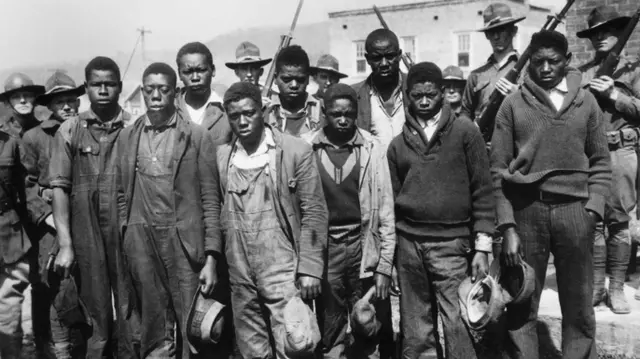
1932 ~ Supreme Court overturns Scottsboro convictions


Why the Communist Party Defended the Scottsboro Boys
As a group of black teenagers awaited execution, the Communist Party and the NAACP bickered over their legal defense.

On November 7, 1932, the Supreme Court hands down its decision in the matter of Powell v. Alabama. The case arose out of the infamous Scottsboro case. Nine young Black men were arrested and accused of raping two white women on train in Alabama. The boys were fortunate to barely have escaped a lynch mob sent to kill them, but were railroaded into convictions and death sentences. The Supreme Court overturned the convictions on the basis that they did not have effective representation.

Victoria Price and Ruby Bates, the alleged victims, had concocted the charges out of thin air. Bates eventually recanted her testimony. The accused boys were not given lawyers until the morning of the trial and these attorneys made almost no effort to defend their clients. On the same day that the case began, the defendants were convicted and received death sentences.

The blatant unfairness of the case attracted the attention of liberals across the country. The transcript of the trial left the Supreme Court with no other choice but to throw out the convictions. Still, Alabama insisted on retrying the defendants. This time, Samuel Leibowitz, one of the premier defense attorneys of the day, came to represent the Scottsboro nine. It didn’t matter.

The jury, all white men because Black men were systematically excluded, convicted once again. In fact, there would be many more trials of the Scottsboro defendants over the years and each time the jury convicted and was later reversed on appeal. When the saga finally ended, all of the defendants were finally released. But not until after they had served an average of ten years for the phantom crime.

Source: history.com