
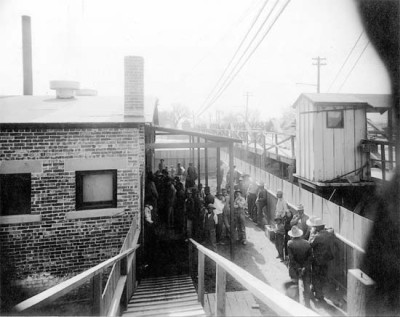
On Jan. 28, 1917, 17-year-old Carmelita Torres, who crossed the border daily from Juarez to clean houses in El Paso, refused to take a toxic disinfectant bath. Press accounts estimated that, by noon, she was joined by several thousand demonstrators at the border bridge. The protest became known as the “Bath Riots.”
By David Dorado Romo
Mexican border crossers were not considered illegal in the United States until 1917, when a new law imposed formidable barriers to entry: a literacy test, a head tax and a prohibition against contract labor. Mexican nationals for the first time needed a passport to enter the United States. That’s also the year that the U.S. entered World War I.
The war stirred deep feelings of paranoia and anti-foreigner patriotism in this country. Americans were afraid that Germans would launch bombing raids from Mexico. As a protest against Germany, Americans changed the name of frankfurters to hot dogs and sauerkraut to “liberty cabbage.” And to protect the country from the threat of typhus, U.S. Customs agents began the mandatory delousing of Mexican border crossers at the El Paso-Juarez international bridge; 127,000 people were subjected to this procedure in 1917 alone.
All immigrants from the interior of Mexico, and those whom U.S. Customs officials deemed “second-class” residents of Juarez, were required to strip completely, turn in their clothes to be sterilized in a steam dryer and fumigated with hydrocyanic acid, and stand naked before a Customs inspector who would check his or her “hairy parts” — scalp, armpits, chest, genital area — for lice. Those found to have lice would be required to shave their heads and body hair with clippers and bathe with kerosene and vinegar.
My great-aunt, Adela Dorado, would tell our family about the humiliation of having to go through the delousing every eight days just to clean American homes in El Paso. She recalled how on one occasion the U.S. Customs officials put her clothes and shoes through the steam dryer and her shoes melted
Source: zinnedproject.org

 Be a Seed for Change
You must be logged in to post a comment.