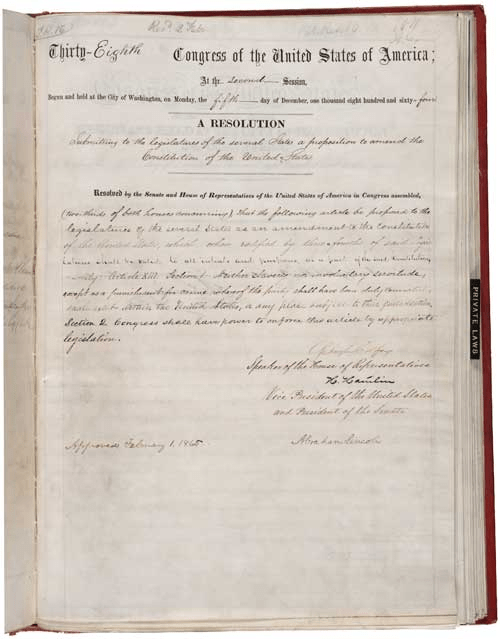
1865 ~The 13th Amendment to the U.S. Constitution was passed by the U.S. House of Representatives.


1865 – The 13th Amendment to the U.S. Constitution was passed by the U.S. House of Representatives. It was ratified by the necessary number of states on December 6, 1865. The amendment abolished slavery in the United States.

 On January 31, 1865, the U.S. House of Representatives passes the 13th Amendment to the Constitution, abolishing slavery in America. The amendment read, “Neither slavery nor involuntary servitude…shall exist within the United States, or any place subject to their jurisdiction.”

When the Civil War began, President Abraham Lincoln’s professed goal was the restoration of the Union. But early in the war, the Union began keeping escaped enslaved people rather than returning them to their owners, so slavery essentially ended wherever the Union army was victorious. In September 1862, Lincoln issued the Emancipation Proclamation, freeing all enslaved people in areas that were still in rebellion against the Union. This measure opened the issue of what to do about slavery in border states that had not seceded or in areas that had been captured by the Union before the proclamation.

history.com for the complete article

on this day 1/31


1606 – Guy Fawkes was executed after being convicted for his role in the “Gunpowder Plot” against the English Parliament and King James I.

1747 – The first clinic specializing in the treatment of venereal diseases was opened at London Dock Hospital.

1858 – The Great Eastern, the five-funnelled steamship designed by Brunel, was launched at Millwall.

1865 – In America, General Robert E. Lee was named general-in-chief of the Confederate armies.

1865 – The 13th Amendment to the U.S. Constitution was passed by the U.S. House of Representatives. It was ratified by the necessary number of states on December 6, 1865. The amendment abolished slavery in the United States. 

1876 – All Natives were ordered to move into reservations.  
1893 – The trademark “Coca-Cola” was first registered in the United States Patent Office.

1936 – The radio show “The Green Hornet” debuted.

1940 –  The first Social Security check was issued by the U.S. Government.

1944 – During World War II, U.S. forces invaded Kwajalein Atoll and other areas of the Japanese-held Marshall Islands.

1945 – Private Eddie Slovik became the only U.S. soldier since the U.S. Civil War to be executed for desertion.

1950 – U.S. President Truman announced that he had ordered development of the hydrogen bomb.

1958 – Explorer I was put into orbit around the earth. It was the first U.S. earth satellite.

1971 – Astronauts Alan B. Shepard Jr., Edgar D. Mitchell and Stuart A. Roosa blasted off aboard Apollo 14 on a mission to the moon.

1971 – Telephone service between East and West Berlin was re-established after 19 years.

1982 – Sandy Duncan gave her final performance as “Peter Pan” in Los Angeles, CA. She completed 956 performances without missing a show.

1983 – The wearing of seat belts in cars became compulsory in Britain.

1985 – The final Jeep rolled off the assembly line at the AMC plant in Toledo, OH.

1996 – In Columbo, Sri Lanka, a truck was rammed into the gates of the Central Bank. The truck filled with explosives killed at least 86 and injured 1,400.

2000 – John Rocker (Atlanta Braves) was suspended from major league baseball for disparaging foreigners, homosexuals and minorities in an interview published by Sports Illustrated.

2000 – An Alaska Airlines jet crashed into the ocean off Southern California. All 88 people on board were killed.

2001 – A Scottish court in the Netherlands convicted one Libyan and acquitted a second in the bombing of Pan Am Flight 103 over Lockerbie, Scotland, that occurred in 1988.

on-this-day.com 

1876-The US orders all Native Americans to move into reservations


by CHARLES-FEIGELSTOCK

Since the beginning of European colonists’ arrival on American shores, the native Indians were pushed back.  President Andrew Jackson signed the Indian Removal Act, which created a nightmare for many Native Americans, and to fix the situation, the U.S. created Indian reservations.

On this day January 31st, in 1876, the U.S. ordered for Native Americans to move into reservations. The hope of creating these reservations was to reduce clashes between the white settlers and the Natives.  At first the Native American tribes were given land that they could use for agriculture, but eventually even this diminished as white settlers set their eyes on land that the Natives had received for reservations.

For the most part, reservations are self-governing and neither local nor federal jurisdiction is enforced. This is why casinos have become a major source of revenue for reservations, as President Ronald Reagan suggested. But don’t be fooled, most Native Americans who live on reservations live in squalor. However there are many tribes which currently sit on natural resources in addition to casinos; these factions have come out financially successful. There are over 300 reservations, but more than 500 tribes, meaning some don’t have their own reservation, having to share land with other tribes.

famousdaily.com/history

1940 – The first Social Security check was issued by the U.S. Government


by CHRISTOPHER KLEIN

Little did Ida May Fuller know she would find a piece of history inside her mailbox when she opened it on a February day in 1940. When the 65-year-old retiree and lifelong Republican lifted the lid of the mailbox outside the front door of her Ludlow, Vermont, house, she found a check for $22.54 from the U.S. government.

That check dated January 31, 1940, was the first payout from the Social Security program that had been enacted five years earlier by the federal government during the Great Depression.

Social Security Checks

The Social Security program is one of the most enduring legacies of President Franklin D. Roosevelt’s New Deal. The measure provided for compensation to the unemployed and payments to retirees over the age of 65 who contributed payroll tax deductions during their working years. “The civilization of the past hundred years, with its startling industrial changes, has tended more and more to make life insecure. Young people have come to wonder what would be their lot when they came to old age,” Roosevelt said when he signed the Social Security Act into law on August 14, 1935.

A descendant of Mayflower passengers, Fuller was born in 1874 on a farm outside Ludlow. After working as a school teacher for a dozen years, she attended business school and then worked as a legal secretary at a Ludlow law firm for 24 years before her retirement in November 1939.

For the complete article

Source: History.com