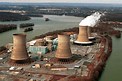
At 4 a.m. on March 28, 1979, the worst accident in the history of the U.S. nuclear power industry begins when a pressure valve in the Unit-2 reactor at Three Mile Island fails to close. Cooling water, contaminated with radiation, drained from the open valve into adjoining buildings, and the core began to dangerously overheat.
The Three Mile Island nuclear power plant was built in 1974 on a sandbar on Pennsylvania’s Susquehanna River, just 10 miles downstream from the state capitol in Harrisburg. In 1978, a second state-of-the-art reactor began operating on Three Mile Island, which was lauded for generating affordable and reliable energy in a time of energy crises.
After the cooling water began to drain out of the broken pressure valve on the morning of March 28, 1979, emergency cooling pumps automatically went into operation. Left alone, these safety devices would have prevented the development of a larger crisis. However, human operators in the control room misread confusing and contradictory readings and shut off the emergency water system. The reactor was also shut down, but residual heat from the fission process was still being released. By early morning, the core had heated to over 4,000 degrees, just 1,000 degrees short of meltdown. In the meltdown scenario, the core melts, and deadly radiation drifts across the countryside, fatally sickening a potentially great number of people.
As the plant operators struggled to understand what had happened, the contaminated water was releasing radioactive gases throughout the plant. The radiation levels, though not immediately life-threatening, were dangerous, and the core cooked further as the contaminated water was contained and precautions were taken to protect the operators. Shortly after 8 a.m., word of the accident leaked to the outside world. The plant’s parent company, Metropolitan Edison, downplayed the crisis and claimed that no radiation had been detected off plant grounds, but the same day inspectors detected slightly increased levels of radiation nearby as a result of the contaminated water leak. Pennsylvania Governor Dick Thornburgh considered calling an evacuation.
Finally, at about 8 p.m., plant operators realized they needed to get water moving through the core again and restarted the pumps. The temperature began to drop, and pressure in the reactor was reduced. The reactor had come within less than an hour of a complete meltdown. More than half the core was destroyed or molten, but it had not broken its protective shell, and no radiation was escaping. The crisis was apparently over.
Two days later, however, on March 30, a bubble of highly flammable hydrogen gas was discovered within the reactor building. The bubble of gas was created two days before when exposed core materials reacted with super-heated steam. On March 28, some of this gas had exploded, releasing a small amount of radiation into the atmosphere. At that time, plant operators had not registered the explosion, which sounded like a ventilation door closing. After the radiation leak was discovered on March 30, residents were advised to stay indoors. Experts were uncertain if the hydrogen bubble would create further meltdown or possibly a giant explosion, and as a precaution Governor Thornburgh advised “pregnant women and pre-school age children to leave the area within a five-mile radius of the Three Mile Island facility until further notice.” This led to the panic the governor had hoped to avoid; within days, more than 100,000 people had fled surrounding towns.
On April 1, President Jimmy Carter arrived at Three Mile Island to inspect the plant. Carter, a trained nuclear engineer, had helped dismantle a damaged Canadian nuclear reactor while serving in the U.S. Navy. His visit achieved its aim of calming local residents and the nation. That afternoon, experts agreed that the hydrogen bubble was not in danger of exploding. Slowly, the hydrogen was bled from the system as the reactor cooled.
At the height of the crisis, plant workers were exposed to unhealthy levels of radiation, but no one outside Three Mile Island had their health adversely affected by the accident. Nonetheless, the incident greatly eroded the public’s faith in nuclear power. The unharmed Unit-1 reactor at Three Mile Island, which was shut down during the crisis, did not resume operation until 1985. Cleanup continued on Unit-2 until 1990, but it was too damaged to be rendered usable again. In the four decades since the accident at Three Mile Island, not a single new nuclear power plant has been ordered in the United States.
Citation Information
Article Title
Nuclear disaster at Three Mile Island
Author
History.com Editors
Website Name
HISTORY
URL
https://www.history.com/this-day-in-history/nuclear-accident-at-three-mile-island
Access Date
{{$root.currentTime | date:’MMMM d, yyyy’}}
Publisher
A&E Television Networks
Last Updated
March 25, 2019
Original Published Date
November 24, 2009
By History.com Editors
At the height of the crisis, plant workers were exposed to unhealthy levels of radiation, but no one outside Three Mile Island had their health adversely affected by the accident. Nonetheless, the incident greatly eroded the public’s faith in nuclear power. The unharmed Unit-1 reactor at Three Mile Island, which was shut down during the crisis, did not resume operation until 1985. Cleanup continued on Unit-2 until 1990, but it was too damaged to be rendered usable again. In the four decades since the accident at Three Mile Island, not a single new nuclear power plant has been ordered in the United States.





 Be a Seed for Change
You must be logged in to post a comment.