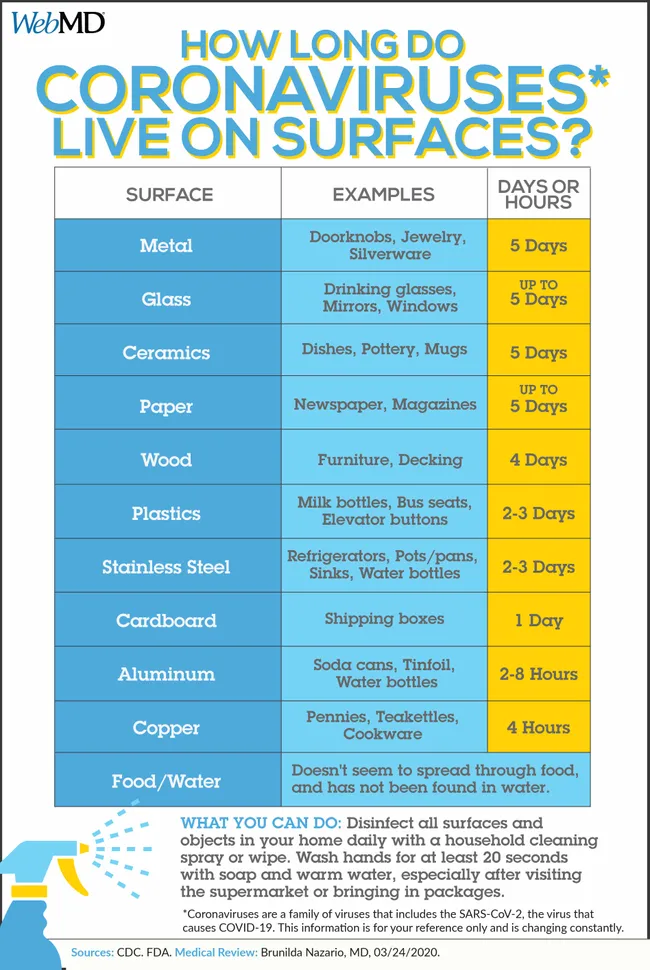
Coronavirus on Surfaces: What You Should Know


April 1, 2020 — Many emergency room workers remove their clothes as soon as they get home — some before they even enter. Does that mean you should worry about COVID-19 transmission from your own clothing, towels, and other textiles?

While researchers found that the virus can remain on some surfaces for up to 72 hours, the study didn’t include fabric. “So far, evidence suggests that it’s harder to catch the virus from a soft surface (such as fabric) than it is from frequently touched hard surfaces like elevator buttons or door handles,” wrote Lisa Maragakis, MD, senior director of infection prevention at the Johns Hopkins Health System.

for the complete article:  webmd.com/lung/news/20200401

It is an incredible eye-opening article

Sign up for the latest coronavirus news.

The problem with Data Centers


I went through old posts and found hints of an increase in data centers, at least in the early 2000s. This company tried to tell a story of why we need them and created a mural project; they also bought a 1960s power plant. In

In 2010, Greenpeace posted a warning and petition re:

The Internet is how we connect, learn new things, and share what we love. But right now, much of our Internet is also dirty, no matter how we use it.

Data centers are where Internet companies store our photos, messages, and music, and many are powered by coal and dirty energy sources that pollute our environment and harm our climate.

What’s worse — the Internet’s demand for energy is only growing bigger. If the Internet were a country, its electricity use would already rank sixth in the world.

I have to say that this is embarrassing to know that the warnings were there, just not given a decent amount of airtime or a good platform to inform the public, now, here we are in 2026, some parts of our country is suffering from droughts, others have had their land squandered by DataCenters, which we all now know use an enormous amount of Energy … and Water!

Logan Act … and why it was created


Dr. George Logan of Pennsylvania attempted to normalize relations with France. He entered into negotiations with France, without authorization, in the hopes of resuming normal relations. In 1799, Congress passed legislation outlawing such contacts between foreign governments and private individuals. The law remains in the books to this day.


In early 1807, a British squadron was stationed off the coast of Virginia. They were there primarily to intercept French frigates, which had taken refuge in Annapolis, Maryland. From time to time, the British vessels made use of American port facilities. British sailors were constantly deserting their ships. This became a major irritant to the British. Three deserters were said to have enlisted on the American naval frigate “Chesapeake.” The British protested, and the Secretary of Navy ordered an inquiry. This inquiry confirmed that three deserters from the “Melampus” had indeed enlisted on the “Chesapeake,” but it was determined that the sailors were Americans who had been illegally impressed. This was transmitted to the British, and the matter seemed to be at an end.

Nevertheless, the British commander in charge of the North Atlantic issued an order to search the “Chesapeake” for deserters, if the ship were encountered at sea. The “Chesapeake” was commanded by Captain Charles Gordon, and had Commodore Barron on board. On June 22, the ship departed from Hampton Roads, headed for the Mediterranean Sea. At 3:30 p.m., the British frigate the “Leopard” came down before the wind. The crew hailed the “Chesapeake,” stating that it had dispatches for the Commodore Barron. Barron replied “We will heave to and you can send your boat on board of us.” At 3:45 p.m., the “Leopard’s” Lieutenant Meade arrived with the following note demanding that the British deserters be turned over.

Since the deserters from the Melampus were not on the list submitted, Captain Gordon believed that his assurance would suffice, and sent back a stern reply to the British.

After the British officer had departed, Barron showed the notes to his other officers. While he felt that the matters was closed, he realized that some show of strength was appropriate. Therefore, Barron ordered Gordon to clear the gun deck. Unfortunately, it took 30 minutes to prepare the “Chesapeake” for battle, and the British officer returned to the ship only five minutes later. Barron was hailed. Trying to obtain more time for his crew, Barron replied that he did not understand. The “Leopard” then fired two shots across the “Chesapeake’s” bow, followed by whole broadside at nearly point blank range. The “Leopard then poured two more broadsides into the “Chesapeake,” while it was still unready to respond. Commodore Barron then ordered the flag to be struck. Several British officers then came aboard and seized the three Americans deserters from the Melampus. They also found a true British deserter, named Jenkin Ratford, who was serving under an assumed name. Ratford was later hanged.

The attack on the “Chesapeake” stirred America into a war fervor. If anyone but Jefferson had been President, this incident would probably have been enough to begin a war.

About

American history and world history can be found at historycental- History’s home on the web. Explore our complete time lines of major events in American history as well as World History. Research our special sections on diverse subjects ranging from presidential elections to naval history.

Whatever aspect of history you wish learn about, you will find it at

Source: Historycentral.com

1972 – Watergate


Following a seemingly routine burglary, five men were arrested at the National Democratic Headquarters in the Watergate complex in Washington, D.C.

However, subsequent investigations revealed the burglars were actually agents hired by the Committee for the Re-election of President Richard Nixon.

A long chain of events then followed in which the president and top aides became involved in an extensive cover-up of this and other White House-sanctioned illegal activities, eventually leading to the resignation of President Nixon on August 9, 1974.

Sources: britannica.com, wiki

1858 ~ Lincoln warns that America is becoming a “house divided”


On June 16, 1858, newly nominated senatorial candidate Abraham Lincoln addresses the Illinois Republican Convention in Springfield and warns that the nation faces a crisis that could destroy the Union. Speaking to more than 1,000 delegates in an ominous tone, Lincoln paraphrased a passage from the New Testament: “a house divided against itself cannot stand.”

The issue dividing the nation was slavery’s place in the growing western territories and the extent of federal power over individual states’ rights. Lincoln declared that only the federal government had the power to end slavery. While the southern states relied on an economy and lifestyle dependent upon the labor provided by enslaved African Americans, the North opposed slavery. The northern states also considered industrialization and manufacturing the key to America’s economic future, not farming.

Source: complete article history.com

“A house divided against itself cannot stand.” – Abraham Lincoln, 1858

Abraham Lincoln delivered his famous “House Divided” speech on June 16, 1858, at the Illinois Republican State Convention in Springfield, Illinois, upon accepting the Republican nomination for U.S. Senate against Stephen A. Douglas. The speech opens with the iconic line: “A house divided against itself cannot stand. I believe this government cannot endure, permanently half slave and half free. I do not expect the Union to be dissolved—I do not expect the house to fall—but I do expect it will cease to be divided. It will become all one thing, or all the other.”

abrahamlincolnonline.org

politics,pollution,petitions,pop culture & purses