Madam C. J. Walker—entrepreneur, philanthropist, activist, patron of the arts—was born Sarah Breedlove in 1867 on the same Delta, Louisiana plantation where her parents had been enslaved. Orphaned at seven, married at 14 and widowed at 20 with a two-year-old daughter, she moved to St. Louis where three older brothers owned a barbershop. Throughout the 1890s—in the neighborhood where ragtime music was born—she worked as a laundress, sang in her church choir and began to aspire to a better life as she observed the educated, civic-minded women at St. Paul African Methodist Episcopal Church.
African American journalist and anti-lynching crusader Ida B. Wells (1862-1931) was born to slaves at Holly Springs, Missouri. Following the Civil War, as lynchings became prevalent, Wells traveled extensively, founding anti-lynching societies and black women’s clubs.
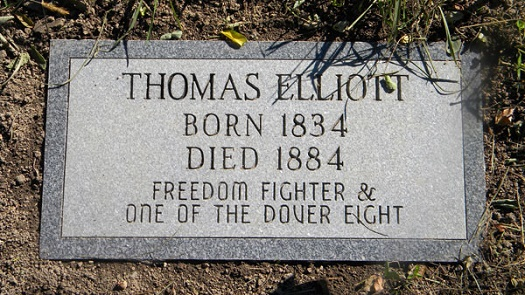
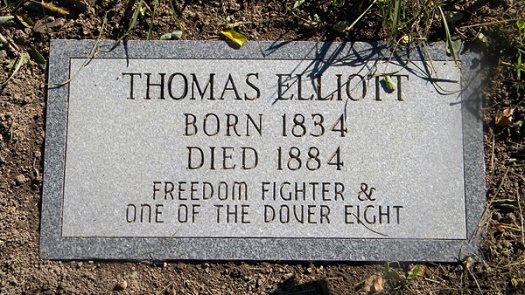
In March 1857, eight slaves from Dorchester County, Maryland, escaped following a route provided by Harriet Tubman, who also previously escaped from Dorchester County.
Tubman had told the fugitives to contact Thomas Otwell, a free black man and underground railroad conductor in Dover, Delaware. Unfortunately, instead of guiding them North to the next step of the railroad, Otwell led them to the Dover jail in expectation of collecting a $3,000 reward. However, despite the betrayal, the “Dover Eight” were able to escape the jail. All of them eventually made their way to freedom.
The slaves were discovered when a man approached Sheriff Green with the information about eight runaway slaves. The man arranged to have the slaves with him in Dover that night.
At about 4 o’clock on a Tuesday morning, the man along with the slaves appeared at the jail. While the sheriff was getting dressed, they all entered the jail and went upstairs. The eight slaves found an open room. The sheriff, knowing the group was upstairs, headed up there to dead bolt the room and seize them.
However, the sheriff found them in the entry way. He turned around and went back to retrieve his revolver, but the slaves followed him down to his room. The slaves entered the room where the sheriff’s wife and children were sleeping before he could seize his revolver.
One of the slaves reportedly became suspicious of the sheriff. The law enforcement officer quickly seized the man and, while in a struggle, the other slaves burst through a window and escaped. They made a fire scatter across the floor, which resulted in awakening the sheriff’s family. The sheriff released the slave for a split second, which allowed him to escape as well.
Six of the eight slaves were later tracked down to a house in Camden, but the officers could not enter the home because they did not have a proper warrant. Later, the six men were moved through the country by the forest woods, which was later known as the “underground railroad.” The other two escaped slaves were seen heading north right after they escaped.
As a teenager, she made history, but it took decades for her to become recognized for her courage and achievements.
source: biography.com
first posted 2015
A full nine months before Rosa Parks‘s famous act of civil disobedience, 15-year-old Claudette Colvin is arrested on March 2, 1955 for refusing to give up her seat on a segregated Montgomery, Alabama bus.
Colvin was traveling home from school when the bus’ driver ordered her, along with three fellow Black students, to give up their row of seats to a white passenger. Colvin’s friends obliged, but she refused to move. At school, she had recently learned about abolitionists, and later recalled that “it felt like Sojourner Truth was on one side pushing me down, and Harriet Tubman was on the other side of me pushing me down. I couldn’t get up.”
On the evening of December 1, 1955, Rosa Parks, an African American, was arrested for disobeying an Alabama law requiring black passengers to relinquish seats to white passengers when the bus was full. Blacks also were required to sit at the back of the bus. Her arrest sparked a 381-day boycott of the Montgomery bus system and led to a 1956 Supreme Court decision banning segregation on public transportation.
I did not get on the bus to get arrested; I got on the bus to go home.
Quiet Strength: the faith, the hope, and the heart of a woman who changed a nation. Reflections by Rosa Parks with Gregory J. Reed. Grand Rapids, MI: Zondervan Pub. House, 1994. p23.
Rosa Parks: “Why do you push us around?” Officer: “I don’t know but the law is the law and you’re under arrest.”
Quiet Strength: the faith, the hope, and the heart of a woman who changed a nation. Reflections by Rosa Parks with Gregory J. Reed. Grand Rapids, MI: Zondervan Pub. House, 1994. p23.
Rosa McCauley was born on February 4, 1913, in Tuskegee, Alabama. In 1932, she married Raymond Parks and with his encouragement earned a high school diploma. The couple was active in the Montgomery Chapter of the National Association for the Advancement of Colored People (NAACP) External. While working as a seamstress, Mrs. Parks served as chapter secretary and, for a time, as advisor to the NAACP Youth Council. Denied the right to vote on at least two occasions because of her race, Rosa Parks also worked with the Voters League in preparing blacks to register.
“We Shall Overcome.” Silphia Horton, Frank Hamilton, Guy Carawan, and Pete Seeger; New York: Ludlow Music, Inc., 1963. [Courtesy: Ludlow Music, Inc., 11 West 19th Street New York, NY 10011.] The Civil Rights Era. In The African American Odyssey: A Quest for Full Citizenship. Music Division Probably first used in 1945 by striking South Carolina tobacco workers, “We Shall Overcome” became the anthem of the civil rights movement of the 1960s. The protest song’s first separate publication, shown above, credits Silphia Horton of the Highlander Folk School with shared authorship.
Following the Brown v. Board of Education decision, the NAACP choose Rosa Parks to attend a desegregation workshop at the Highlander Folk School External in Monteagle, Tennessee. Reflecting on that experience, Parks recalled, “At Highlander I found out for the first time in my adult life that this could be a unified society…I gained there the strength to persevere in my work for freedom not just for blacks, but for all oppressed people.”
Although her arrest was not planned, Park’s action was consistent with the NAACP’s desire to challenge segregated public transport in the courts. A one-day bus boycott coinciding with Parks’s December 5 court date resulted in an overwhelming African-American boycott of the bus system. Since black people constituted seventy percent of the transit system’s riders, most busses carried few passengers that day.
The success of the boycott mandated sustained action. Religious and political leaders met at the Dexter Avenue Baptist Church and formed the Montgomery Improvement Association (later the Southern Christian Leadership Conference). Dexter’s new pastor, Reverend Martin Luther King Jr., was appointed the group’s leader. For the next year, the Montgomery Improvement Association coordinated the bus boycott and King, an eloquent young preacher, inspired those who refused to ride:
If we are wrong—the Supreme Court of this nation is wrong. If we are wrong—God almighty is wrong! If we are wrong—Jesus of Nazareth was merely a utopian dreamer and never came down to earth. If we are wrong—justice is a lie. And we are determined here in Montgomery to work and fight until justice runs down like water and righteousness like a mighty stream.” 1
Reverend Martin Luther King Jr., Montgomery, Alabama, 1955.
During the boycott, King insisted that protestors retain the moral high ground, hinting at his later strategy of nonviolent resistance.
This is not a war between the white and the Negro but a conflict between justice and injustice. If we are arrested every day, if we are exploited every day, if we are trampled over every day, don’t ever let anyone pull you so low as to hate them. We must use the weapon of love. 2
Reverend Martin Luther King Jr., Montgomery, Alabama, 1955.
In December 1956 the Supreme Court banned segregation on public transportation and the boycott ended over a year after it had begun. Rosa and Raymond Parks moved to Detroit where, for more than twenty years, the “Mother of the Civil Rights Movement” worked for Congressman John Conyers. In addition to the Rosa Parks Peace Prize (Stockholm, 1994) and the U.S. Medal of Freedom (1996), Rosa Parks has been awarded two-dozen honorary doctorates from universities around the world.
Rosa Parks died on October 24, 2005, at the age of ninety-two, at her home in Detroit, Michigan. On October 30, 2005, Parks became the first woman to lie in honor in the U.S. Capitol Rotunda.
Martin Luther King Jr. The Autobiography of Martin Luther King, Jr. ed. Clayborne Carson (New York: Intellectual Properties Management in Association with Warner Books: 1998), 60. (Return to text)







 Be a Seed for Change
You must be logged in to post a comment.