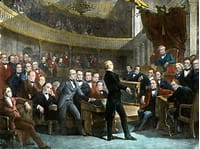
1850 – Henry Clay introduced in the Senate a compromise bill on slavery that included the admission of California into the Union as a free state
The Compromise was actually a series of bills passed mainly to address issues related to slavery. The bills provided for slavery to be decided by popular sovereignty in the admission of new states, prohibited the slave trade in the District of Columbia, settled a Texas boundary dispute, and established a stricter fugitive slave act.
By 1850 sectional disagreements related to slavery were straining the bonds of union between the North and South. These tensions became especially critical when Congress began to consider whether western lands acquired after the Mexican-American War would permit slavery. In 1849, California requested permission to enter the Union as a “free state” – meaning one where slavery was banned. Adding more “free state” senators to Congress would destroy the balance between “slave” and “free” states that had existed since the Missouri Compromise of 1820.
Because everyone looked to the Senate to defuse the growing crisis, Senator Henry Clay of Kentucky proposed a series of resolutions designed to “adjust amicably all existing questions of controversy…arising out of the institution of slavery.” Clay attempted to frame his compromise so that nationally minded senators would vote for legislation in the interest of the Union.
In one of the most famous congressional debates in American history, the Senate discussed Clay’s solution for seven months. It initially voted down his legislative package, but Senator Stephen A. Douglas of Illinois stepped forward with substitute bills, which passed both Houses. With the Compromise of 1850, Congress had addressed the immediate crisis created by the recent territorial expansion.
Long ignored by historians, the enslaved people of the White House are coming into focus through a new book by Jesse J. Holland
Jesse J. Holland’s book, “The Invisibles: The Untold Story of African American Slaves in the White House” offers new insight into lives of these men and women who lived in bondage in the White House. (Bettmann/CORBIS )
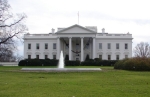
President Barack Obama might be the first black president to serve in the White House, but he certainly was not the first black person to live there. Yet the history of the original black residents of 1600 Pennsylvania Avenue has been sparsely reported on, as Associated Press reporter Jesse J. Holland discovered when he began researching his latest book, The Invisibles: The Untold Story of African American Slaves in the White House. The Invisibles—a smart sketch on the lives of these men and women in bondage—is intended to serve as a historical first take. Holland’s goal writing about the slaves who resided alongside 10 of the first 12 presidents who lived in the White House is to start a conversation on who these enslaved people were, what they were like, and what happened to them if they were able to escape from bondage.
Your first book, Black Men Built the Capitol: Discovering African-American History In and Around Washington, D.C., touches on similar themes to The Invisibles. How did you get the idea for writing about this specific lost chapter of black history in the United States?
I was covering politics for the AP back when Obama was doing his first presidential campaign around the country. He decided that weekend to go back home to Chicago. I was on the press bus, sitting in Chicago outside of Obama’s townhouse, trying to think about what book to write next. I wanted to do a follow-up book to my first—which was published in 2007—but I was struggling to come up with a coherent idea. As I was sitting there in Chicago, covering Obama, it hit me: We had always talked about the history of Obama possibly becoming the first black president of the United States, but I knew Obama couldn’t have been the first black man to live in the White House. Washington, D.C. is a southern city and almost all mansions in the South were constructed and run by African Americans. So I said to myself, I want to know who these African American slaves were who lived in the White House.
Only one or two of the slaves who worked for the president ever had anything written—Paul Jennings wrote a memoir—but there’s very little written about these men and women enslaved by the presidents. Most of my research was done by reading between lines of presidential memoirs and piecing all of it into one coherent narrative. Presidential historians that work at Monticello and Hermitage in Tennessee, for example, want this research done; they were thrilled when someone wanted to look at these records and were able to send me a lot of materials.
What were some of the more unexpected details you can across during your research?
One of the things that surprised me is how much information was written about these slaves without calling them slaves. They were called servants, they were staff— but they were slaves. Andrew Jackson’s horse racing operation included slave jockeys. There have been things written about Andrew Jackson and horses and jockeys, but not one mentioned the word “slaves.” They were called employees in all the records. So, it’s there, once you know the words to look for. I was also surprised with how much time the presidents spent talking about their slaves in those same code words. When you start reading memoirs, ledgers, these people show up again and again and again, but they are never actually called slaves.
Which president’s relationship with his slaves surprised you the most?
With Thomas Jefferson, there’s been so much said about him and his family, I don’t know if I discovered anything new, but everything is about context. We mostly talk about Thomas Jefferson and Sally Hemings, but James Hemings would have been the first White House chef, if not for the spat between him and Thomas Jefferson.
Or you look at [Joseph] Fossett being caught on White House grounds trying to see his wife. It surprised me because you would think things like that would be more well known. The Thomas Jefferson story is overwhelmed about him and Sally Hemmings, but there are so many stories there.
Definitely.
Also, with everything we know about George Washington, I was shocked to find he advertised in the newspaper for a recapture of an escaped slave. I hadn’t thought any had escaped until I started working on this and then to find he’d advertised for the return, that’s not subtle. He wanted him back and he took whatever route he could take, including taking out an advertisement.
How does reading about these slaves help us better understand the early presidents?
In the past, we’ve talked about their attitudes in general toward slaves and now we can talk in specifics, and include the names of the slaves they were dealing with. That’s one thing I hope not just historians, but people in general pick out of the abstract. Begin talking about the specifics: this is how the relationships between George Washington and William Lee or Thomas Jefferson with James Hemings or Andrew Jackson with Monkey Simon. This helps us understand presidents’ policies when it came to slavery and race relations at this time. If they said something publicly but did something else privately, it gives us insight into who they are.
Was it frustrating writing around the limited information available?
One of the things I talk about in the book is that this is just a first step. There is no telling how many stories have been lost because, as a country, we didn’t value these stories. We’re always learning more about the presidents as we go forward and we’ll also learn more about the people who cooked their meals and dressed them.
There are people doing great work on slave dwellings in the South, great work on the history of African American cooking, slave cooking in the past. It’s not the information wasn’t always here, we’re just interested in it now. As we go forward and learn more information and find these old hidden ledgers and photographs, we’ll have a clearer picture of where we came from as a country and that will help us decide where we are going in the future.
Black Farmers Will Lobby Senate for Quick Action, Seek Meeting with President Obama
WASHINGTON, DC — John W. Boyd, Jr., founder and president of the National Black Farmers Association, released the following statement today after the U.S. House of Representatives approved funding – as part of a larger – for the historic settlement to resolve decades of discrimination against black farmers by the U.S. Department of Agriculture.
“With today’s action, we are one important step closer to bringing justice for the tens of thousands of black farmers in this country whose lives and livelihoods were impacted by discrimination from the U.S. Department of Agriculture.
“It is important to recognize speaker of the House Nancy Pelosi and her colleagues in the House leadership for their work. It is also important to recognize the tireless and ongoing efforts of the Congressional Black Caucus.
“We look forward to working with the Senate, following the holiday recess, to ensure passage of these funds as soon as possible. Every delay means the likelihood of more farm foreclosures and more black farmers who will not live to see the day they receive the payments they have waited for and deserve.
“I would like to extend my request for a meeting with President Obama so I can ask for his personal help in working with the Senate to resolve this matter and the other issues facing the Black farmers.”
Reid: Republicans Blocking Justice For Minority Farmers And Native American Trust Account Holders
May 7, 2010
Washington, D.C.—Nevada Senator Harry Reid made the following statement today after Republicans blocked a unanimous consent request to provide funding for the settlement of lawsuits by black farmers and Native American trust account holders:
“Where we see injustices, it is our responsibility to stand up for those who need a voice. That’s why I am pleased that this morning, Senate Democrats attempted to correct historic injustices for black farmers and Native American trust account holders. This represents a long-standing commitment on my part to seek a fair resolution to these issues. Not to mention, we must continue working to resolve other cases of discrimination at the Department of Agriculture against Hispanic and women farmers. Unfortunately, Republican obstruction denied justice to those who only seek fair settlement of their grievances.
“There is no excuse for Republicans to continue to employ these partisan delay tactics – in this case, as in so many others, they are only hurting those who were wronged and are fighting for what is rightfully theirs. We will continue to work on this issue until it is resolved. My view on this is simple: justice delayed is justice denied.”
Obama backs $1.25 billion payment to black farmers who suffered government racism for decades
March 01, 2010
When the record of the Obama administration is written, one major accomplishment will likely be attributed to the president’s race.
The first black president seems determined to make the U.S. government finally settle the claims of 70,000 black farmers, people whose hopes were crushed by government racism. Obama has championed a $1.25 billion settlement that would put these claims to rest.
Termed by some the “last plantation,” the Department of Agriculture for decades systematically denied loans, crop subsidies and other aid to black farmers, at one point bringing them to near extinction.
In the 1920s, blacks operated one of every seven U.S. farms. By 1992, the number had sunk to one in 100.
Meanwhile, many of their white neighbors’ farms prospered. But it wasn’t always because white farmers were harder workers, smarter with agriculture or luckier with the weather. They were given help denied blacks. That’s racism.
Rising Up: Hale Woodruff’s Murals at Taladega College
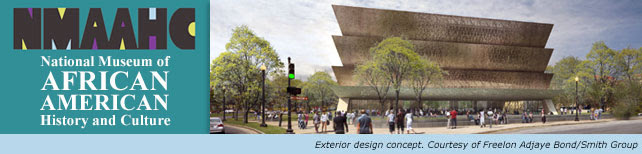
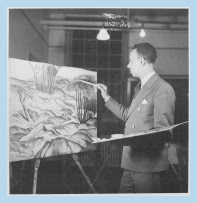
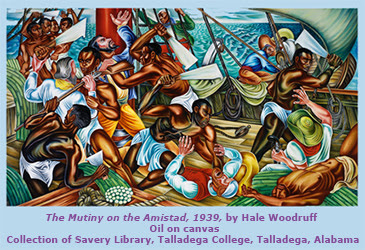
Talladega College in Alabama commissioned prominent African American artist Hale Woodruff to paint a series of murals for its newly built Savery Library in 1938. Woodruff painted six murals portraying significant events in the journey of African Americans from slavery to freedom. Today, the Smithsonian’s National Museum of African American History and Culture will present “Rising Up: Hale Woodruff’s Murals at Talladega College,” an exhibition of murals and other significant works by the artist. The exhibition will be on view in the NMAAHC Gallery on level 2 of the Smithsonian’s National Museum of American History through March 1, 2015.
This will be the first time the murals have been exhibited in the Washington metro area. The murals were removed from Talladega College for a five-year collaborative restoration project organized by the High Museum of Art in Atlanta, which also organized a multicity tour of the works. The murals are six monumental canvases arranged in two cycles of three, portraying heroic efforts of resistance to slavery and moments in the history of Talladega College, which opened in 1867 to serve the educational needs of a new population of freed slaves. The first cycle includes the murals “The Mutiny on the Amistad,” which depicts the uprising on the slave ship La Amistad; “The Trial of the Amistad Captives,” depicting the court proceedings that followed the mutiny; and “The Repatriation of the Freed Captives,” portraying the subsequent freedom and return to Africa of the Amistad captives.
The companion murals “The Underground Railroad,” “The Building of Savery Library” and “Opening Day at Talladega College” show themes of the Underground Railroad, the construction of Savery Library at Talladega College and the early days of the college campus, for which the murals were commissioned, respectively.
“Rising Up: Hale Woodruff’s Murals at Talladega College” is presented by the Smithsonian’s National Museum of African American History and Culture and is organized by the High Museum of Art in collaboration with Talladega College. The exhibition is co-curated by Jacquelyn Serwer, chief curator at NMAAHC, and Rhea Combs, museum curator. A full-color, 155-page catalog, published by the High Museum of Art, will be on sale in the National Museum of American History’s store during the exhibition. Read the Press Release about this exciting exhibition.






 Be a Seed for Change
You must be logged in to post a comment.