Central High School Crisis: A Timeline
September 21, 200712:01 AM ET
JUAN WILLIAMS –

Enlarge this image
Daisy Bates (second from right in back row) stands with the students known as the Little Rock Nine, in an undated photo. Library of Congress; Courtesy NAACP
The following events occurred in 1957, three years after the decision of Brown vs. Board of Education, which declared racial segregation in public schools unconstitutional.
Aug. 27: The Mother’s League of Central High School, a group of women from Broadmoor Baptist Church with ties to a segregationist group, has its first public meeting. After discussing “inter-racial marriages and resulting diseases which might arise,” they decide to petition the governor to prevent integration. Lawyer Amis Guthridge draws up the document and Arkansas Gov. Orval Faubus supports it. Mrs. Clyde Thompson, recording secretary of the Mother’s League of Little Rock Central High School, files a motion seeking a temporary injunction against school integration. Her suit also asks for clarification on the “segregation” laws.
Aug. 29: Pulaski County Chancellor Murray Reed grants the injunction, on the grounds that integration could lead to violence.
Aug. 30: Federal District Judge Ronald Davies orders the Little Rock School Board to proceed with its plan of gradual integration and the opening of the school on Sept. 3, and nullifies Reed’s injunction.
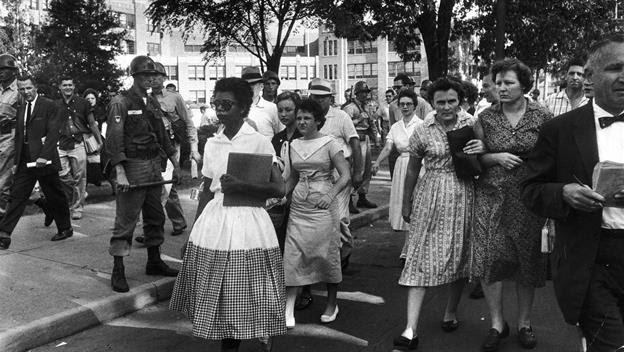
Sept. 2: (Labor Day) Gov. Faubus orders the Arkansas National Guard to prohibit nine black students from entering Central High School. In a televised speech, he states that he did so to prevent violence. Afterward, the school board orders the nine black students who had registered at Central not to attempt to attend school.
Sept. 3: Judge Ronald Davies orders desegregation to start Sept. 4, while Gov. Faubus orders the National Guard to remain at Central.
Sept. 4: Nine black students attempt to enter Central High School, but are turned away by the National Guard. One of the nine, Elizabeth Eckford, does not have a telephone and so was not notified ahead of time of the change in plans. She arrives alone at the school to face the Guardsmen alone. She is able to reach a bus stop bench and Mrs. Grace Lorch, a white woman, stays with her and boards the bus with her to help take her to her mother’s school.
Sept. 5: None of “the nine” try to attend school. The school board asks Judge Davies to temporarily suspend its integration plan.
Sept. 7: Federal Judge Davies denies the school board’s request.
Sept. 8: Gov. Faubus goes on national television to re-affirm his stand and insists that the federal government halt its demand for integration. When confronted to produce evidence of reported violence, Faubus refuses.
Sept. 9: Judge Davies begins injunction proceedings against Gov. Faubus and two National Guardsmen for interfering with integration.
Sept. 10: Judge Davies tells the United States Justice Department to begin injunction proceedings against Faubus. He schedules a hearing for Sept. 20 for a preliminary injunction.
Sept. 14: Gov. Faubus meets with President Eisenhower in Newport, R.I., to discuss issues of the prevention of violence and the desegregation of Arkansas’ public schools. “I have assured the president of my desire to cooperate with him in carrying out the duties resting upon both of us under the Federal Constitution,” Faubus says in a statement. “In addition, I must harmonize my actions under the Constitution of Arkansas with the requirements of the Constitution of the United States.”
Sept. 20: Judge Davies rules Faubus has not used the troops to preserve law and order and orders them removed, unless they protect the nine black students as they enter the school. Faubus removes the Guardsmen and the Little Rock police move in.
Sept. 23: An angry mob of more than 1,000 white people curses and fights in front of Central High School, while the nine black children are escorted inside. A number of white students, including Sammie Dean Parker, jump out of windows to avoid contact with the black students. Parker is arrested and taken away. The Little Rock police cannot control the mob and, fearing for their safety, remove the nine children from the school. Three black journalists covering the story are first harassed and then physically attacked and chased by a mob. They finally run to safety in a black section of town. President Eisenhower calls the rioting “disgraceful” and orders federal troops into Little Rock.
Sept. 24: Members of the 101st Airborne Division, the “Screaming Eagles” of Fort Campbell, Ky., roll into Little Rock. The Arkansas National Guard is placed under federal orders.
Sept. 25: Under troop escort, the nine black children are escorted back into Central High School. Gen. Edwin Walker, U.S. Army, addresses the white students in the school’s auditorium before the nine students arrive.
Oct. 1: The 101st Airborne turns over most duties to the federalized Arkansas National Guard. Discipline problems resurface at Central for the remainder of the school year.
Source: Johanna Lewis, University of Arkansas






 Richard Wright 9/4/1908 – 11/28/1960
 Be a Seed for Change
You must be logged in to post a comment.