
For the complete article
chicagotribune.com

 1146 – European leaders outlawed the crossbow.
1645 – American Indians and the Dutch made a peace treaty at New Amsterdam. New Amsterdam later became known as New York.
1682 – William Penn sailed from England and later established the colony of Pennsylvania in America.
1780 – General Benedict Arnold secretly promised to surrender the West Point fort to the British army.
1806 – New York City’s second daily newspaper, the “Daily Advertiser,” was published for the last time.
1809 – Charles Doolittle Walcott first discovered fossils near Burgess Pass. He named the site Burgess Shale after nearby Mt. Burgess.
1862 – The Confederates defeated Union forces at the second Battle of Bull Run in Manassas, VA.
1928 – The Independence of India League was established in India.
1941 – During World War II, the Nazis severed the last railroad link between Leningrad and the rest of the Soviet Union.
1945 – General Douglas MacArthur set up Allied occupation headquarters in Japan.
1951 – The Philippines and the United States signed a defense pact.
1956 – In Louisianna, the Lake Pontchartrain Causeway opened.
1960 – A partial blockade was imposed on West Berlin by East Germany.
1963 – The “Hotline” between Moscow and Washington, DC, went into operation.
1965 – Thurgood Marshall was confirmed by the U.S. Senate as a Supreme Court justice. Marshall was the first black justice to sit on the Supreme Court.
1982 – P.L.O. leader Yasir Arafat left Beirut for Greece.
1983 – The space shuttle Challenger blasted off with Guion S. Bluford Jr. aboard. He was the first black American to travel in space.
1984 – The space shuttle Discovery lifted off for the first time. On the voyage three communications satellites were deployed.
1984 – U.S. President Ronald Reagan, and several others, were inducted into the Sportscasters Hall of Fame.
1991 – The Soviet republic of Azerbaijan declared its independence.
1993 – On CBS-TV “The Late Show with David Letterman” premiered.
1994 – Rosa Parks was robbed and beaten by Joseph Skipper. Parks was known for her refusal to give up her seat on a bus in 1955, which sparked the civil rights movement.
1994 – The largest U.S. defense contractor was created when the Lockheed and Martin Marietta corporations agreed to a merger.
1996 – An expedition to raise part of the Titanic failed when the nylon lines being used to raise part of the hull snapped.
1999 – The residents of East Timor overwhelmingly voted for independence from Indonesia. The U.N. announced the result on September 4.
2002 – Conoco Inc. and Phillips Petroleum merged to create ConocoPhillips. The new company was the third largest integrated energy company and the second largest refining company in the U.S.
** BETHLEHEM, PA – August 19, 2025 – B. Braun Medical Inc. (B. Braun) is voluntarily recalling two lots of Lactated Ringers Injection USP 1000 mL,and 0.9% Sodium Chloride Injection USP 1000 mL to the hospital level due to the presence of particulate matter inside the container.
B. Braun has identified through complaints the potential for the product to contain particulate matter in solution. To date there have been no reports of serious injury, death or other adverse events associated with this issue. If the particulate matter is observed before use, a minor delay could occur while obtaining a replacement product. If the particulate matter is loose and the container is used on a patient, there is a potential for the particulate to be infused into the circulatory system. This could lead to patient harm that may require additional medical intervention and/or lead to permanent impairment or death.

** Viva Raw LLC, Charlotte, NC is voluntarily recalling two lots of dog and cat foods due to contamination with Salmonella and Listeria monocytogenes. The recall is for Lot 21495 (Viva Ground Beef for Dogs; Viva Beef & Turkey for Puppies) and Lot 21975 (Viva Ground Chicken for Dogs; Viva Chunked Chicken for Dogs; Viva Chicken for Cats; Viva Pure Chicken) The potential for contamination was identified after routine testing was conducted by the North Carolina Department of Agriculture. Only products from Lots 21495 and 21975 are affected. No illnesses in dogs, cats, or humans related to these lots have been reported to date.
If you have products from Lot 21495 or Lot 21975, please contact Viva Raw at info@vivarawpets.com for a refund on any remaining product. You should then dispose of the food in a way that children, pets, and wildlife cannot access. Do not sell or donate the recalled products. Do not feed the recalled product to pets or any other animals. Wash and sanitize pet food bowls, cups, and storage containers. Always ensure you wash and sanitize your hands after handling recalled food or any utensils that come in contact with recalled food.
** French Listeria outbreak spreads to other countries; 2 patients dead
By Joe Whitworth on August 19, 2025
The European Centre for Disease Prevention and Control (ECDC) has weighed in on a multi-country outbreak of Listeria monocytogenes with 25 cases.
France has 21 infections since December 2024, including 18 since June 2025. Two people died.
Patients are between 34 and 95 years old and 11 are women. Dates…Continue Reading
**
** Five sick in Argentinian Listeria outbreak
By Joe Whitworth on August 19, 2025
A Listeria outbreak that sickened five people in Argentina has been traced to a type of cheese.
Outbreak details were reported in Argentina’s national epidemiological bulletin (Boletín Epidemiológico Nacional).
It is the first time that a link between human cases of listeriosis and a common source, confirmed by…Continue Reading
** Wegmans: The affected products were sold in the cheese department at all Wegmans stores located in Connecticut, Delaware, Maryland, Massachusetts, New Jersey, New York, North Carolina, Pennsylvania, Virginia, and Washington, D.C. No illnesses associated with this recall have been reported to Wegmans or its supplier, to date.
Wegmans has placed automated phone calls to alert customers who purchased these products using Shoppers Club.
Customers should not consume the products and return them to the service desk for a full refund. Those with questions may contact Wegmans Food Markets at 1-855-934-3663, available daily from 8:00 a.m. through 8:00 p.m. EST.
Affected items, sold between July 1 and August 12, 2025, include:
Wegmans Caramel Apple Pecan Topped Brie Cheese, 13 OZ, UPC: 2-77645-00000-3
Wegmans Medium Camembert Soft Ripened Cheese, 8.8 OZ, UPC: 77890-53515 with best by dates of 7/26/25, 8/12/25, and 8/19/25
Wegmans Assorted Cheese Flight, 1 LB, UPC: 2-77100-00000-0
Wegmans Grilling Camembert with Tapenade & Roasted Tomatoes, 10 OZ, UPC: 2-77297-00000-0
** Dollar General: No illnesses or injuries have been reported to date. August 11, 2025 –Dollar General Corporation is recalling three (3) lots of its eight (8) ounce Clover Valley® Instant Coffee due to the potential presence of glass.
8-Ounce Clover Valley® Instant Coffee
Package UPC: 876941004069
Lot: L-5163 / Best By 12/13/2026
Lot: L-5164 / Best by 12/13/2026
Lot: L-5165 / Best by 12/14/2026
Customers can find the lot and best by date information around the neck of the unit.
Clover Valley® Instant Coffee was sold and distributed between July 9-21, 2025 exclusively in Dollar General retail stores located in the following states: AL, AR, AZ, CA, CO, CT, DE, FL, GA, IA,ID, IL, IN, KS, KY, LA, MA, MD, ME, MI, MN, MO, MS, MT, NC, ND, NE, NH, NJ, NM, NV, NY, OH, OK, OR, PA, RI, SC, SD, TN, TX, UT, VA, VT, WA, WI ,WV, and WY.
Customers who purchased this product are encouraged to discard it and contact Dollar General either via email at customercare@dollargeneral.com or by phone at 1-888-309-9030 from 6 a.m. to 1 a.m. CST seven days a week to request a full refund of the purchase price (including any tax).
** Fromi USA Recalls Brie Royal Faucon 1kg Because of Possible Health Risk
** Quesito El Establo Recalls Spanish Cheese (Quesito Colombiano) Because of Possible Health Risk
By Joe Whitworth on August 14, 2025
Two people have died in a Listeria outbreak in France linked to cheese.
French health authorities reported 21 cases of listeriosis caused by bacterial strains with similar characteristics, including 18 cases since the beginning of June. Patients range in age from 34 to 95.
Pasteurized cow’s and goat’s milk cheeses…Continue Reading
** Goodlettsville, Tennessee – August 11, 2025 –Dollar General Corporation is recalling three (3) lots of its eight (8) ounce Clover Valley® Instant Coffee due to the potential presence of glass.
8-Ounce Clover Valley® Instant Coffee
Package UPC: 876941004069
Lot: L-5163 / Best By 12/13/2026
Lot: L-5164 / Best by 12/13/2026
Lot: L-5165 / Best by 12/14/2026
Customers can find the lot and best by date information around the neck of the unit.
Clover Valley® Instant Coffee was sold and distributed between July 9-21, 2025 exclusively in Dollar General retail stores located in the following states: AL, AR, AZ, CA, CO, CT, DE, FL, GA, IA,ID, IL, IN, KS, KY, LA, MA, MD, ME, MI, MN, MO, MS, MT, NC, ND, NE, NH, NJ, NM, NV, NY, OH, OK, OR, PA, RI, SC, SD, TN, TX, UT, VA, VT, WA, WI ,WV, and WY.
** Quesito El Establo, of Salem, NH, is recalling all of its Spanish Cheese (Quesito Colombiano) products manufactured at its facility, due to the presence of rodents, rodent activity, and other unsanitary conditions during the production and storage process. Consumers who have purchased the recalled product are encouraged not to consume it and return it to the place of purchase for a full refund. Consumers with questions can contact the company at 617-842-0513 (Monday through Saturday, 9:00 a.m. to 5:00 p.m., Eastern time).
** Wegmans The affected products were sold in the cheese department at all Wegmans stores located in Connecticut, Delaware, Maryland, Massachusetts, New Jersey, New York, North Carolina, Pennsylvania, Virginia, and Washington, D.C.
Affected items, sold between July 1 and August 12, 2025, include:
Wegmans Caramel Apple Pecan Topped Brie Cheese, 13 OZ, UPC: 2-77645-00000-3 The affected products were sold in the cheese department at all Wegmans stores located in Connecticut, Delaware, Maryland, Massachusetts, New Jersey, New York, North Carolina, Pennsylvania, Virginia, and Washington, D.C.
Wegmans Medium Camembert Soft Ripened Cheese, 8.8 OZ, UPC: 77890-53515 with best by dates of 7/26/25, 8/12/25, and 8/19/25
Wegmans Assorted Cheese Flight, 1 LB, UPC: 2-77100-00000-0
Wegmans Grilling Camembert with Tapenade & Roasted Tomatoes, 10 OZ, UPC: 2-77297-00000-0
Affected items, sold between July 1 and August 12, 2025, include:
Wegmans Caramel Apple Pecan Topped Brie Cheese, 13 OZ, UPC: 2-77645-00000-3
Wegmans Medium Camembert Soft Ripened Cheese, 8.8 OZ, UPC: 77890-53515 with best by dates of 7/26/25, 8/12/25, and 8/19/25
Wegmans Assorted Cheese Flight, 1 LB, UPC: 2-77100-00000-0
Wegmans Grilling Camembert with Tapenade & Roasted Tomatoes, 10 OZ, UPC: 2-77297-00000-0
No illnesses associated with this recall have been reported to Wegmans or its supplier, to date.
Wegmans has placed automated phone calls to alert customers who purchased these products using Shoppers Club.
Customers should not consume the products and return them to the service desk for a full refund. Those with questions may contact Wegmans Food Markets at 1-855-934-3663, available daily from 8:00 a.m. through 8:00 p.m. EST.
** Louisa Food Products, Inc. told Newsweek in a statement: “We have voluntarily recalled a limited quantity of our Jalapeño Mac and Cheese Bites with lot code 2507092 due to potential listeria contamination. This recall was initiated out of an abundance of caution following a supplier’s recall of the breadcrumb ingredient used in this product. All recalled cases have been located, isolated, and are awaiting proper handling and disposal.
“We are actively collaborating with our supplier to address the root cause of this issue and are implementing additional preventive measures to ensure it does not recur. The quality and safety of our products will always be our highest priority, and we appreciate the understanding and trust of our customers.”
** The recall affects 8-ounce packages of the brand’s Three Cheese Mac & Cheese Bites. Over 4,000 cases have been affected, according to the FDA.
Best by dates: June 19, 2026 or June 20, 2026
UPC: 8-99039-00280-8
Lot codes: 24354AV1 or 24355AV1
** Power Stick: On July 10, the Food and Drug Administration announced the recall of certain Power Stick deodorants, made by A.P. Deauville, LLC.1
** DermaRite Consumers with questions regarding this recall can call Mary Goldberg at 973-569-9000 x104 Monday through Friday, 9:00 am – 5:00 pm EST or email voluntary.action@dermarite.com.
To date, DermaRite has not received any reports of adverse events related to this recall.
DermaKleen is an OTC Healthcare antiseptic lotion soap with Vitamin E indicated for handwashing to decrease bacteria on the skin.
DermaSarra is an OTC External analgesic indicated for temporary relief of itching associated with minor skin irritations due to: dry skin, insect bites, detergents, sunburn.
KleenFoam is an OTC Antimicrobial foam soap with Aloe Vera indicated for handwashing to decrease bacteria on the skin after changing diapers, after assisting ill people, or before contact with a person under medical care or treatment.
PeriGiene is an OTC Antiseptic cleanser indicated for use in the perineal area.
The recalled products were distributed nationwide in the United States and in Puerto Rico.
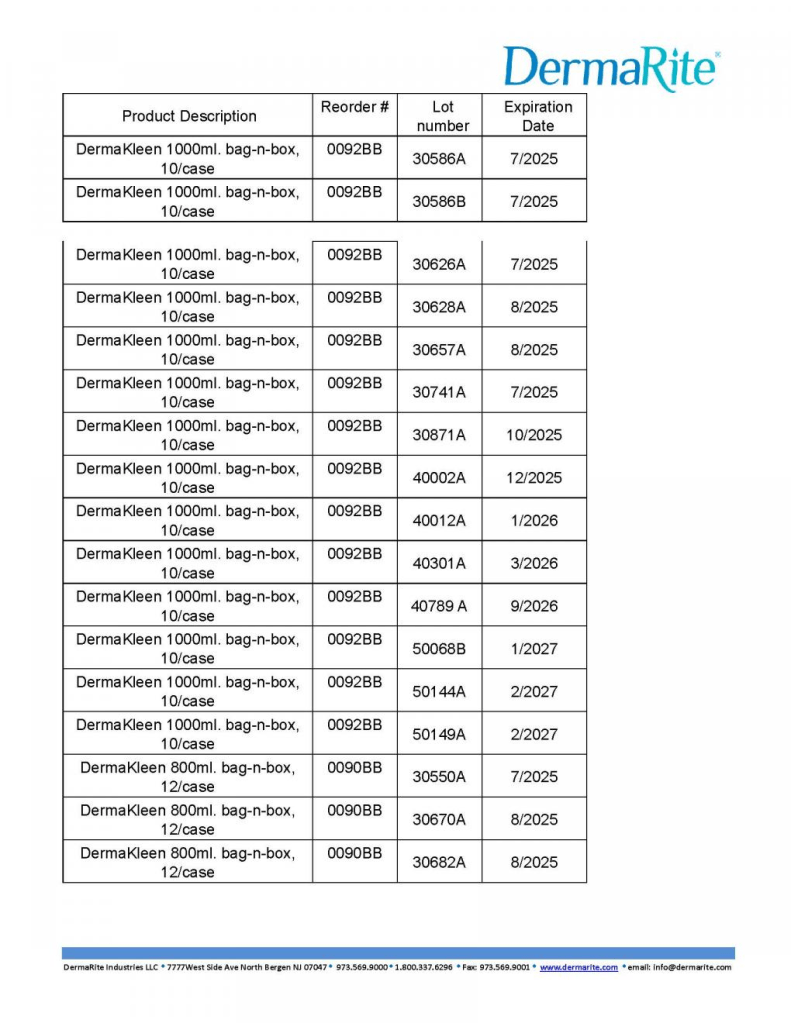
Recalled Product Information: (see Table image below)
DermaRite has notified its distributors and customers by e-mail to immediately examine available inventory and destroy all affected products in accordance with each facility’s process.
** July 31, 2025
Sold at: Select Sam’s Clubs in the following states: AL, AZ, CA, CO, CT, DE, FL, GA, HI, IA, ID, IL, IN, KS, LA, MD, ME, MI, MN, MO, MS, MT, NC, ND, NE, NH, NJ, NM, NV, NY, OH, OK, PA, PR, SC, SD, TN, TX, UT, VA, WI, WV, WY
** July 18, 2025
Sold at: All stores
June 11, 2025
Sold at: Walmart stores, Walmart.com
June 10, 2025
Amneal Pharmaceutical LLC Issues a Nationwide Recall of Sulfamethoxazole / Trimethoprim Tablets
Sold at: Select Walmart stores. See list of stores.
** Four ill in Salmonella outbreak linked to egg product supplement
** UKHSA reports continued rise in E. coli infections
** Aug. 1, 2025
Sold at: Walmart.com
By News Desk on August 1, 2025
Recently released data from the UK Health Security Agency (UKHSA) has shown another rise in E. coli infections in England in 2024.
Overall, 2,544 cultured-confirmed cases of Shiga toxin-producing E. coli (STEC) were reported with 564 STEC O157 and 1,980 non-O157. In 2023, 2,018 cultured-confirmed infections were noted compared to 2,063 in…Continue Reading
By Joe Whitworth on August 1, 2025
Four people have fallen sick after consuming a type of egg product supplement in the United Kingdom.
Public Health Scotland is leading the probe into a cluster of multidrug resistant Salmonella infections associated with an eggshell membrane food supplement sold online.
The UK Health Security Agency (UKHSA), Food Standards Agency…Continue Reading
**
** Albertsons Companies Stores in Arkansas, Louisiana, Oklahoma and Texas Voluntarily Expands Recall to Select Items Containing Tuna Salad from Reser’s Fine Foods Due to an Ingredient Recall Linked to Possible Listeria monocytogenes Contamination. The items containing tuna salad were available for purchase at the following banner stores: Albertsons, Randalls and Tom Thumb in Arkansas, Louisiana, Oklahoma and Texas.
Consumers with questions should contact Albertsons Companies’ Customer Service Center at 1-877-723-3929 Monday through Friday from 5 a.m. to 9 p.m. PST.
Product Recall Details:
| Product Name | UPC | Size | Sell Thru Dates (if applicable, Or Lot Code/Est. Number) | Store Banners | States |
|---|---|---|---|---|---|
| RM DUO TUNA SALAD W/CRACKER S | 27183000000 | EA | Jul 24 25 Thru Jul 29 25 | Albertsons, Randalls, Tom Thumb | AR, LA, OK, TX |
| RM SALAD TUNA PREMIUM SS | 21425000000 | EA | Jul 24 25 Thru Jul 29 25 | Albertsons, Randalls, Tom Thumb | AR, LA, OK, TX |
| RM SNACKER TRAY TUNA SALAD | 21151300000 | EA | Jul 24 25 Thru Jul 29 25 | Albertsons, Randalls, Tom Thumb | AR, LA, OK, TX |
| RM SNACKER TRAY TUNA SALAD | 21151300000 | EA | JUL 24 25 Thru Jul 29 25 | Albertsons, Randalls, Tom Thumb | AR, LA, OK, TX |
| RM SNDWCH TUNA SALAD CROISSANT SS COLD | 21788400000 | EA | Jul 23 25 Thru Jul 28 25 | Albertsons, Randalls, Tom Thumb | AR, LA, OK, TX |
| RM TUNA SALAD OVER BED OF LETTUCE SS | 21786400000 | EA | Jul 23 25 Thru Jul 28 25 | Albertsons, Randalls, Tom Thumb | AR, LA, OK, TX |
| SALAD TUNA PREMIUM | 21228800000 | Variable Weight | Jul 24 25 Thru Jul 29 25 | Albertsons, Randalls, Tom Thumb | AR, LA, OK, TX |
| TRAY CROISSANT MINI SALAD 16 IN | 27841300000 | EA | Jul 23 25 Thru Jul 28 25 | Albertsons, Randalls, Tom Thumb | AR, LA, OK, TX |
| TRAY CROISSANT MINI SALAD 18 IN | 27841200000 | EA | Jul 23 25 Thru Jul 28 25 | Albertsons, Randalls, Tom Thumb | AR, LA, OK, TX |
| TRAY SALAD SANDWICH 12 IN | 27841500000 | EA | Jul 23 25 Thru Jul 28 25 | Albertsons, Randalls, Tom Thumb | AR, LA, OK, TX |
| TRAY SALAD SANDWICH 16 IN | 27841400000 | EA | Jul 23 25 Thru Jul 28 25 | Albertsons, Randalls, Tom Thumb | AR, LA, OK, TX |

Around dusk on the evening on August 29, 1970, a group of 23 Native American activists climbs to the top of Mount Rushmore. Renaming the landmark Crazy Horse Mountain, in honor of the Lakota Sioux leader who famously resisted white Americans’ incursions into the area, the protesters are there to reclaim land they believe to be rightfully theirs under the 1868 Treaty of Fort Laramie, which guaranteed Indigenous people the right to all of Western South Dakota. The occupation will last for two months, beginning a new chapter in Native American activism.
Signed at Fort Laramie in the Wyoming Territory, the 1868 treaty was meant to end hostilities between the United States and the Lakota people, Yanktonai Dakota and Arapaho Nation. The treaty allocated the Black Hills and adjacent lands west of the Missouri River—roughly half of what is now South Dakota—to Indigenous peoples. But it tried to incentivize Native Americans to give up their traditional way of life in favor of farming. And it was designed to assimilate Native Americans into white American culture, with U.S. courts, not tribal ones, given jurisdiction over the reservation.
In a sadly predictable turn of events, the United States broke the treaty within a decade. After George Armstrong Custer’s expedition found gold in the Black Hills region in 1874, white prospectors and settlers rushed into the region, leading to the Great Sioux War of 1876 and American occupation of most of the land promised to the Lakota.
Source: history.com for more information


 Be a Seed for Change
You must be logged in to post a comment.