Category Archives: ~ politics petitions pollution and pop culture

1787 Constitutional Convention delegates begin to assemble May 14 pushed back to the 25th


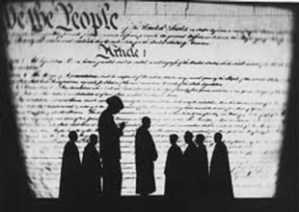
U.S. Constitution
U.S. Constitutional Convention opened in Philadelphia
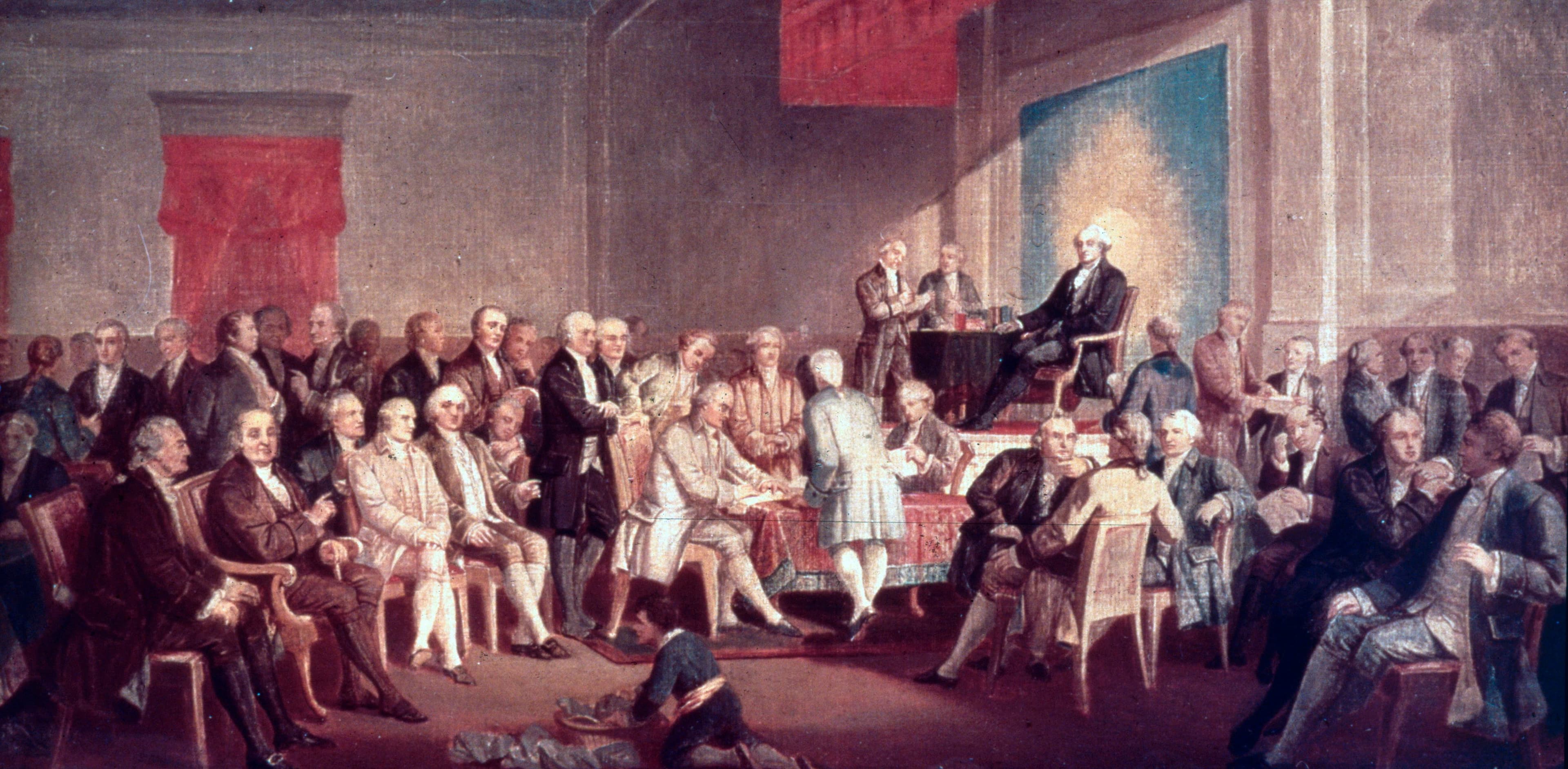
On this day in 1787, the Constitutional Convention opened in Philadelphia, where 55 state delegates, initially charged with amending the Articles of Confederation, later drafted the Constitution of the United States.
Architect of the Capitol


George Washington presides over the Constitutional Convention

On this day in 1787, delegates to the Constitutional Convention begin to assemble in Philadelphia to confront a daunting task: the peaceful overthrow of the new American government as defined by the Article of Confederation. Although the convention was originally supposed to begin on May 14, James Madison reported that a small number only had assembled. Meetings had to be pushed back until May 25, when a sufficient quorum of the participating states—MassachusettsNew YorkNew JerseyPennsylvaniaDelawareVirginiaNorth CarolinaSouth Carolina and Georgia—had arrived.

As the new United States descended into economic crisis and inter-state quarrels, the new nation’s leaders had become increasingly frustrated with their limited power. When in 1785, Maryland and Virginia could not agree on their rights to the Potomac River, George Washington called a conference to settle the matter at Mt. Vernon. James Madison then convinced the Virginia legislature to call a convention of all the states to discuss such sticky trade-related issues at Annapolis, Maryland. The Annapolis Convention of September 1786 in turn called the Philadelphia Convention, to devise such further provisions as shall appear to them necessary to render the constitution of the Federal Government adequate to the exigencies of the Union.

Between Madison’s initial call for the states to send delegates to Annapolis and the presentation of Madison’s Virginia plan for a new government to the convention in Philadelphia, a fundamental shift in the aims of the convention process had taken place. No longer were the delegates gathered with the aim of tweaking trade agreements. A significant number of the men present were now determined to overhaul the new American government as a whole, without a single ballot being cast by the voting public.

resource: history.com     britannica.com

foreboding …

history… may 25


585 BC – The first known prediction of a solar eclipse was made in Greece.

1085 – Alfonso VI took Toledo, Spain from the Moslems.

1787 – The Constitutional convention opened in Philadelphia with George Washington presiding.

1810 – Argentina declared independence from Napoleonic Spain.

1844 – The gasoline engine was patented by Stuart Perry.

1844 – The first telegraphed news dispatch, sent from Washington, DC, to Baltimore, MD, appeared in the Baltimore “Patriot.”

1895 – Oscar Wilde, a playwright, poet and novelist, was convicted of a morals charge and sentenced to prison in London.

1895 – James P. Lee first published “Gold in America — A Practical Manual.”

1911 – President of Mexico, Porfolio Diaz, resigned his office.

1925 – John Scopes was indicted for teaching the Darwinian theory in school.

1927 – Ford Motor Company announced that the Model A would replace the Model T.

1927 – The “Movietone News” was shown for the first time at the Sam Harris Theatre in New York City.

1935 – Babe Ruth hit his final homerun, his 714th, and set a record that would stand for 39 years.

1935 – Jesse Owens tied the world record for the 100-yard dash. He ran it in 9.4 seconds. He also broke three other world track records.

1946 – Jordan gained independence from Britain.

1953 – In Nevada, the first atomic cannon was fired.

1961 – America was asked by U.S. President Kennedy to work toward putting a man on the moon before the end of the decade.

1963 – The Organization of African Unity was founded, in Addis Ababa, Ethiopia.

1968 – The Gateway Arch, part of the Jefferson National Expansion Memorial in St. Louis, MO, was dedicated.

1970 – Boeing Computer Services was founded.

1977 – “Star Wars Episode IV: A New Hope” opened and became the largest grossing film to date.
Today in Star Wars History

1977 – An opinion piece by Vietnam verteran Jan Scruggs appeared in “The Washington Post.” The article called for a national memorial to “remind an ungrateful nation of what it has done to its sons” that had served in the Vietnam War.

1979 – An American Airlines DC-10 crashed during takeoff at Chicago’s O’Hare International Airport. 275 people were killed.

1981 – Daredevil Daniel Goodwin scaled Chicago’s Sears Tower, while wearing a “Spiderman” costume, in 7 1/2 hours.

1983 – “The Return of the Jedi” opened nationwide. It set a new record in opening day box office sales. The gross was $6,219,629.

1985 – Bangladesh was hit with a hurricane and tidal wave that killed more than 11,000 people.

1986 – Approximately 7 million Americans participated in “Hands Across America.”

1989 – The Calgary Flames won their first NHL Stanley Cup by defeating the Montreal Canadiens.

1992 – Jay Leno debuted as the new permanent host of NBC’s “Tonight Show.”

1996 – In Nimes, France, Christina Sanchez became the first woman to achieve the rank of matadore in Europe.

1997 – In Sierra Leone a military coup overthrew the popularly elected President Ahmad Tejan Kabbah. He was replaced with Major Johnny Paul Koromah.

1997 – U.S. Senator Strom Thurmond became the longest-serving senator in U.S. history (41 years and 10 months).

1997 – Poland adopted a constitution that removed all traces of communism.

1999 – A report by the U.S. House of Representatives Select Committee on U.S. National Security and Military/Commercial Concerns with the People’s Republic of China concluded that China had “stolen design information on the U.S. most-advanced thermonuclear weapons” and that China’s penetration of U.S. weapons laboratories “spans at least the past several decades and almost certainly continues today.”

2000 – The Walt Disney Co. and Time Warner Inc. signed a long-term deal that ended a dispute over the airing policies of Time Warner. Time Warner had blacked out Disney programs for a 39 hour period the previous month due to the lack of an agreement.

2001 – Erik Weihenmayer, 32, of Golden, CO, became the first blind climber to reach the summit of Mount Everest.

2001 – Sherman Bull, 64, of New Canaan, CT, became the oldest climber to reach the summit of Mount Everest.

2006 – In Houston, former Enron Corp. chiefs Kenneth Lay and Jeffrey Skillinng were convicted of conspiracy and fraud for the downfall of Enron.

2008 – NASA’s Phoenix Mars Lander landed in the arctic plains of Mars.

2009 – North Korea announced that it had conducted a second successful nuclear test in the province of North Hamgyong. The United Nations Security Council condemned the reported test.

on-this-day.com

What is Asian American and Pacific Islander Heritage Month? When it started, significance in US


Mariyam Muhammad

Cincinnati Enquirer

May is AAPI month, also known as Asian American, Native Hawaiian and Pacific Islander Heritage Month or Asian American and Pacific Islander Heritage Month. AAPI month is observed to celebrate the roles, achievements and contributions of those of AAPI heritage, history, and culture in the United States.

This month aims to pay tribute to the generations of Asian and Pacific Islanders who have enhanced America’s history and to recognize the importance of AAPI peoples’ presence in its future success, according to the Asian/Pacific Heritage Month website.

When is AAPI month celebrated?

The observance of AAPI month began in 1979 through Congressional action. It was initially observed for a week in May, until 1992, when it expanded to the entire month.Need a break? Play the USA TODAY Daily Crossword Puzzle.

AAPI Month begins May 1 and continues throughout May each year.

Why was May chosen as AAPI month?

May was designated as AAPI Month to honor the first Japanese immigrants to the United States, who arrived on May 7, 1843, per the Asian/Pacific Heritage Month website.

Source: cincinnati.com

May Awareness


Mayflowers
  • National Astronaut Day
  • Asthma and Allergy Awareness Month (National) Asthma and Allergy Foundation of America (AAFA) 800.727.8462
  • According to the American Counseling Association (ACA), May is the month that we are made aware of Mental Health illnesses.
  • National Cartoonists Day
  • American Stroke Awareness Month
  • Arthritis Awareness Month
  • Better Hearing and Speech Month
  • Clean Air Month
  • Cystic Fibrosis Awareness Month
  • Food Allergy Action Month
  • Global Employee Health and Fitness Month
  • Healthy Vision Month
  • Hepatitis Awareness Month
  • International Mediterranean Diet Month
  • Lupus Awareness Month
  • Melanoma/Skin Cancer Detection and Prevention Month
  • National Silence the Shame Day
  • National Totally Chipotle Day
  • National Hoagie Day
  • Cinco de Mayo
  • National Bike To School Day
  • National Skilled Trades Day
  • National Interpreter Appreciation Day

1983 – The U.S. Supreme Court ruled that the federal government had the right to deny tax breaks to schools that racially discriminate


See the source image

Bob Jones University v. United States, legal case in which the U.S. Supreme Court ruled (8–1) on May 24, 1983, that nonprofit private universities that prescribe and enforce racially discriminatory admission standards on the basis of religious doctrine do not qualify as tax-exempt organizations under Section 501(c)(3) of the U.S. Internal Revenue Code. Institutions of higher education in the United States, whether public or private, are generally exempt from most forms of taxation, on the ground that they provide an essential public service

U.S. Supreme Court

Bob Jones Univ. v. United States, 461 U.S. 574 (1983)

Bob Jones University v. United States

No. 81-3

Argued October 12, 1982

Decided May 24, 1983*

461 U.S. 574

Syllabus

Section 501(c)(3) of the Internal Revenue Code of 1954 (IRC) provides that “[c]orporations . . . organized and operated exclusively for religious, charitable . . . or educational purposes” are entitled to tax exemption. Until 1970, the Internal Revenue Service (IRS) granted tax-exempt status under § 501(c)(3) to private schools, independent of racial admissions policies, and granted charitable deductions for contributions to such schools under § 170 of the IRC. But in 1970, the IRS concluded that it could no longer justify allowing tax-exempt status under § 501(c)(3) to private schools that practiced racial discrimination, and in 1971 issued Revenue Ruling 71-447 providing that a private school not having a racially nondiscriminatory policy as to students is not “charitable” within the common law concepts reflected in §§ 170 and 501(c)(3). In No. 81-3, petitioner Bob Jones University, while permitting unmarried Negroes to enroll as students, denies admission to applicants engaged in an interracial marriage or known to advocate interracial marriage or dating. Because of this admissions policy, the IRS revoked the University’s tax-exempt status. After paying a portion of the federal unemployment taxes for a certain taxable year, the University filed a refund action in Federal District Court, and the Government counterclaimed for unpaid taxes for that and other taxable years. Holding that the IRS exceeded its powers in revoking the University’s tax-exempt status and violated the University’s rights under the Religion Clauses of the First Amendment, the District Court ordered the IRS to refund the taxes paid and rejected the counterclaim. The Court of Appeals reversed. In No. 81-1, petitioner Goldsboro Christian Schools maintains a racially discriminatory admissions policy based upon its interpretation of the Bible, accepting for the most part only Caucasian students. The IRS determined that Goldsboro was not an organization described in § 501(c)(3), and hence was required to pay federal social security and unemployment taxes. After paying a portion of such taxes for certain years, Goldsboro filed a refund suit in Federal District Court, and the IRS counterclaimed for unpaid taxes. The District Court entered summary judgment for

Page 461 U. S. 575

Sources: for complete article: britannica.com supreme.justia.com