
Category Archives: ~ politics petitions pollution and pop culture

1838 – Victoria Chaflin Woodhull was born. She became the first female candidate for the U.S. Presidency.
9 Things You Should Know About Victoria Woodhull
1. Woodhull received almost no formal education.
Victoria Claflin, later Victoria Woodhull, was born on September 23, 1838, to an illiterate mother and a petty criminal father. One of 10 children, Woodhull did not start elementary school until she turned 8. She then attended off and on for only three years before dropping out. Any hope of further education was dashed at age 15, when she married a doctor who soon revealed himself as an alcoholic philanderer. To make matters even more difficult, Woodhull gave birth to a mentally handicapped son in 1854.
2. Woodhull worked as a traveling clairvoyant.
As a child in rural Ohio, Woodhull purportedly believed that she could communicate with three siblings who had died in infancy and that she could heal the sick. Always on the lookout for a good moneymaking scheme, her father put her and her sister Tennessee to work telling fortunes and contacting spirits. The family also went into the alternative healing business, selling life elixirs, giving massages and offering cures for diseases ranging from cancer to asthma. But although Woodhull later claimed to have made a small fortune during the Civil War as a traveling medical clairvoyant, she and Tennessee both had their share of setbacks. Tennessee, for example, was indicted for manslaughter in Illinois after one of her cancer patients died.
3. Woodhull and her sister were the first female brokers on Wall Street.
Upon moving to New York City in 1868, Victoria and Tennessee began working as clairvoyants for the railroad baron Cornelius Vanderbilt, who distrusted medically trained doctors. Tennessee also apparently became Vanderbilt’s lover and may even have received a marriage proposal from him. Stock tips gleaned from this relationship proved handy during an 1869 gold panic, during which the sisters claimed to have netted around $700,000. With Vanderbilt’s financial backing, Victoria and Tennessee then opened their own highly publicized firm named Woodhull, Claflin & Co., becoming the first female stockbrokers on Wall Street. Nonetheless, they never gained a seat on the New York Stock Exchange, something no woman would achieve until 1967.
ADVERTISEMENT
4. Woodhull was the first woman to address a congressional committee.
Woodhull attended a female suffrage convention in January 1869 and became a devout believer in the cause. Not long afterward she befriended Massachusetts congressman Benjamin Butler, from whom she cajoled an invitation to testify before the House Judiciary Committee. On January 11, 1871, Woodhull declared to the panel that women had already won the right to vote under the recently enacted 14th and 15th amendments. Women are citizens, she argued, and “the citizen who is taxed should also have a voice in the subject matter of taxation.” Although the committee rejected her petition to pass “enabling legislation,” her history-making appearance immediately propelled her into a leadership position among suffragists.
5. Woodhull was the first woman to run for president.
In April 1870, just two months after opening her brokerage firm, Woodhull announced her candidacy for president of the United States. She campaigned on a platform of women’s suffrage, regulation of monopolies, nationalization of railroads, an eight-hour workday, direct taxation, abolition of the death penalty and welfare for the poor, among other things. In addition to promoting herself in her weekly newspaper, Woodhull organized an Equal Rights Party, which nominated her at its May 1872 convention. Famed abolitionist Frederick Douglass was selected as her running mate. He never acknowledged it, however, and in fact campaigned for Republican Ulysses S. Grant. Woodhull was furthermore hurt by embarrassing details about her private life, which came to light during a lawsuit that her mother brought against her second husband. In the end, Woodhull’s name appeared on ballots in at least some states. No one knows how many votes she received because they apparently weren’t counted.
6. Woodhull spent Election Day in jail.
A few days before the 1872 presidential election returned Grant to office, Woodhull published an article in her newspaper aimed at exposing popular preacher Henry Ward Beecher as an adulterous hypocrite. The backlash was immediate, as Beecher’s supporters helped garner arrest warrants for Victoria and Tennessee on charges of sending obscene material through the mail. They also faced libel charges over a second article that accused a Wall Street trader of getting two teenage girls drunk and seducing them. Police took the sisters into custody on November 2, and they remained in jail for about a month. Additional arrests followed, including one after a briefly on-the-lam Woodhull snuck up on stage in disguise in order to give a speech. The sisters were eventually found not guilty, but not before taking a beating in the press. Their harshest critics included Harriet Beecher Stowe, Beecher’s sister and the author of “Uncle Tom’s Cabin,” who called Woodhull a “vile jailbird” and an “impudent witch,” and cartoonist Thomas Nast, who depicted Woodhull as “Mrs. Satan.”
7. Woodhull was a proponent of free love.
Woodhull often spoke about sex on the lecture circuit, saying, among other things, that women should have the right to escape bad marriages and control their own bodies. Even more shocking to Victorian sensibilities, she espoused free love. “I want the love of you all, promiscuously,” she once declared. “It makes no difference who or what you are, old or young, black or white, pagan, Jew, or Christian, I want to love you all and be loved by you all, and I mean to have your love.” Woodhull practiced what she preached, at one point living with her ex-husband, her husband and her lover in the same apartment. Yet she also knew when to hold back her amorous affections. “Let women issue a declaration of independence sexually, and absolutely refuse to cohabit with men until they are acknowledged as equals in everything, and the victory would be won in a single week,” she wrote.
8. Woodhull spent over half her life as an expat.
When Vanderbilt died in January 1877, his children began fighting in court over his $100 million estate. Rumor holds that Victoria and Tennessee were paid off to not testify at trial. Either way, they left that August for England, where Woodhull met her third husband, a wealthy banker. She resided there until her death in 1927, devoting her later years to running a new newspaper and preserving the English home of George Washington’s ancestors. Woodhull also became an automobile enthusiast, donated money and services to the townspeople around her estate, traveled overseas to run again for U.S. president in 1892, founded a short-lived agricultural school and volunteered with the Red Cross during World War I.
9. Woodhull lost the backing of other suffragist leaders.
Susan B. Anthony, Elizabeth Cady Stanton and other giants of the women’s suffrage movement embraced Woodhull around the time of her congressional appearance. But they soon had a falling out, in part over Woodhull’s political ambitions and love of the limelight. She did not get invited to speak at suffrage conventions following her first run for president, and Anthony even advised a British suffrage leader not to meet with her. “Both sisters are regarded as lewd and indecent,” Anthony wrote in a letter. Moreover, when Anthony, Stanton and Matilda Joslyn Gage published a comprehensive history of the women’s suffrage movement in the 1880s, they essentially left out Woodhull entirely.
Resources: history.com on-this-day.com
Share this:

Nia Simone – In Memory

Nina Simone (born February 21, 1933, Tryon, North Carolina, U.S.—died April 21, 2003, Carry-le-Rouet, France) American singer who created urgent emotional intensity by singing songs of love, protest, and Black empowerment in a dramatic style, with a rough-edged voice.
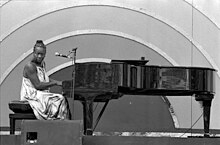
A precocious child, Simone played piano and organ in girlhood. She became sensitive to racism when at age 12 she gave a piano recital in a library where her parents had to stand in back because they were Black. A student of classical music at the Juilliard School of Music in New York City, she began performing as a pianist. Her vocal career began in 1954 in an Atlantic City, New Jersey, nightclub when the club owner threatened to fire her unless she sang too. Her first album featured her distinctive versions of jazz and cabaret standards, including “I Loves You, Porgy,” which became a 1959 hit.
Source: britannica.com
Share this:

Why the 19th Amendment Did Not Guarantee All Women the Right to Vote

Despite the adoption of the 19th Amendment, many women of color, immigrant women, and poorer women continued to face barriers at the polls.
With the certification of the 19th Amendment to the U.S. Constitution on August 26, 1920, women secured the right to vote after a decades-long fight. “The right of citizens of the United States to vote shall not be denied or abridged by the United States or by any State on account of sex,” it reads.
But while the passage of the 19th Amendment enabled most white women to vote, that wasn’t the case for many women of color.
“For Black women, their votes weren’t lifted by that tide in the South,” Christina Rivers, associate professor of political science at Depaul University, says. “Their votes were suppressed solely on the basis of race.”
Source: history.com
Share this:

on this day … 3/23 1889 – U.S. President Harrison opened Oklahoma for white colonization.
 1026 – Koenraad II crowned himself king of Italy.
1066 – The 18th recorded perihelion passage of Halley’s Comet took place.
1490 – The first dated edition of Maimonides “Mishna Torah” was published.
1657 – France and England formed an alliance against Spain.
1775 – American revolutionary Patrick Henry declared, “give me liberty, or give me death!”
1794 – Josiah G. Pierson patented a rivet machine.
1806 – Explorers Lewis and Clark, reached the Pacific coast, and began their return journey to the east.
1808 – Napoleon’s brother Joseph took the throne of Spain.
1835 – Charles Darwin reached Los Arenales, in the Andes.
1836 – The coin press was invented by Franklin Beale.
1839 – The first recorded printed use of “OK” [oll korrect] occurred in Boston’s Morning Post.
1840 – The first successful photo of the Moon was taken.
1848 – Hungary proclaimed its independence of Austria.
1857 – Elisha Otis installed the first modern passenger elevator in a public building. It was at the corner of Broome Street and Broadway in New York City.
1858 – Eleazer A. Gardner patented the cable streetcar.
1861 – John D. Defrees became the first Superintendent of the United States Government Printing Office.
1861 – London’s first tramcars began operations.
1868 – The University of California was founded in Oakland, CA.
1880 – John Stevens patented the grain crushing mill. The mill increased flour production by 70 percent.
1881 – The Boers and Britain signed a peace accord ending the first Boer war.
1881 – A gas lamp caused a fire in an opera house in Nice, France. 70 people were killed.
1889 – U.S. President Harrison opened Oklahoma for white colonization.
1901 – Dame Nellie Melba, revealed the secret of her now famous toast.
1901 – It was learned that Boers were starving in British concentration camps in South Africa.
1901 – Shots were fired at Privy Councilor Pobyedonostzev, who was considered to be Russia’s most hated man.
1902 – In Italy, the minimum legal working age was raised from 9 to 12 for boys and from 11 to 15 for girls.
1903 – The Wright brothers obtained an airplane patent.
1903 – U.S. troops were sent to Honduras to protect the American consulate during revolutionary activity.
1909 – British Lt. Shackleton found the magnetic South Pole.
1909 – Theodore Roosevelt began an African safari sponsored by the Smithsonian Institution and National Geographic Society.
1910 – In the Canary Islands, women offered candidates for legislative elections.
1912 – The Dixie Cup was invented.
1917 – Austrian Emperor Charles I made a peace proposal to French President Poincare.
1917 – In the Midwest U.S., four tornadoes kill 211 people over a four day period.
1918 – Lithuania proclaimed independence.
1919 – Benito Mussolini founded his Fascist political movement in Milan, Italy.
1920 – Britain denounced the U.S. because of their delay in joining the League of Nations.
1920 – The Perserikatan Communist of India (PKI) political party was formed.
1921 – Arthur G. Hamilton set a new parachute record when he safely jumped from 24,400 feet.
1922 – The first airplane landed at the U.S. Capitol in Washington, DC.
1932 – In the U.S., the Norris-LaGuardia Act established workers’ right to strike.
1933 – The German Reichstag adopted the Enabling Act. The act effectively granted Adolf Hitler dictatorial legislative powers.
1934 – The U.S. Congress accepted the independence of the Philippines in 1945.
1936 – Italy, Austria & Hungary signed the Pact of Rome.
1937 – The L.A. Railway Co. started using PCC streetcars.
1940 – “Truth or Consequences” was heard on radio for the first time.
1942 – The Japanese occupy the Andaman Islands.
1942 – During World War II, the U.S. government began evacuating Japanese-Americans from West Coast homes to detention centers.
1950 – “Beat the Clock” premiered on CBS-TV.
1951 – U.S. paratroopers descended from flying boxcars in a surprise attack in Korea.
1956 – Pakistan became the first Islamic republic. It was still within the British Commonwealth.
1956 – Sudan became independent.
1957 – The U.S. Army sold the last of its homing pigeons.
1965 – America’s first two-person space flight took off from Cape Kennedy with astronauts Virgil I. Grissom and John W. Young aboard. The craft was the Gemini 3.
1965 – The Moroccan Army shot at demonstrators. About 100 people were killed.
1967 – Reverend Martin Luther King Jr. called the Vietnam War the biggest obstacle to the civil rights movement.
1970 – Mafia “Boss” Carlo Gambino was arrested for plotting to steal $3 million.
1972 – The U.S. called a halt to the peace talks on Vietnam being held in Paris.
1972 – Evel Knievel broke 93 bones after successfully jumping 35 cars.
1973 – The last airing of “Concentration” took place. The show had been on NBC for 15 years.
1980 – The deposed shah of Iran, Muhammad Riza Pahlavi, left Panama for Egypt.
1981 – U.S. Supreme Court upheld a law making statutory rape a crime for men but not women.
1981 – CBS Television announced plans to reduce “Captain Kangaroo” to a 30-minute show each weekday morning.
1983 – U.S. President Reagan first proposed development of technology to intercept enemy missiles. The proposal became known as the Strategic Defense Initiative and “Star Wars.”
1983 – Dr. Barney Clark died after 112 days with a permanent artificial heart.
1989 – A 1,000-foot diameter asteroid missed Earth by 500,000 miles.
1989 – Joel Steinberg was sentenced to 25 years for killing his adopted daughter.
1989 – Two electrochemists, Stanley Pons and Martin Fleischman, announced that they had created nuclear fusion in a test tube at room temperature.
1990 – Former Exxon Valdez Captain Joseph Hazelwood was ordered to help clean up Prince William Sound and pay $50,000 in restitution for the 1989 oil spill.
1993 – U.N. experts announced that record ozone lows had been registered over a large area of the Western Hemisphere.
1994 – Luis Donaldo Colosio, Mexico’s leading presidential candidate, was assassinated in Tijuana. Mario Aburto Martinez was arrested at the scene and confessed to the killing.
1994 – Wayne Gretzky broke Gordie Howe‘s National Hockey League (NHL) career record with his 802nd goal.
1994 – Howard Stern formally announced his Libertarian run for New York governor.
1996 – Taiwan held its first democratic presidential elections.
1998 – Germany’s largest bank pledged $3.1 million to Jewish foundations as restitution for Nazi looting.
1998 – The U.S. Supreme Court ruled that term limits for state lawmakers were constitutional.
1998 – Russian President Boris Yeltsin fired his Cabinet.
1998 – The movie “Titanic” won 11 Oscars at the Academy Awards.
1998 – The German company Bertelsmann AG agreed to purchase the American publisher Random House for $1.4 billion. The merger created the largest English-language book-publishing company in the world.
1999 – Paraguay’s Vice President Luis Maria Argana was shot to death by two gunmen.
1999 – NATO Secretary-General Javier Solana gave formal approval for air strikes against Serbian targets.
1999 – Near Mandi Bahauddin, Pakistan, a bus fell into a fast-moving canal. Nine were confirmed dead, 31 were missing and presumed dead, and 20 were injured.
2001 – Russia’s orbiting Mir space station plunged into the South Pacific after its 15-years of use.

 Be a Seed for Change
You must be logged in to post a comment.