
Source: youtube
Category Archives: ~ politics petitions pollution and pop culture

1797 US Congress refuses to accept 1st petition from African American
National Humanities Center Resource Toolbox
The Making of African American Identity: Vol. I, 1500-1865
“a direct violation of the declared
fundamental principles of the Constitution”
AND
THE 1797 PETITION
to Congress from four free African Americans
to protect freed slaves from capture and resale
THE DEBATE
in the House of Representatives to consider the
petition and the vote to deny its hearing in committee
♦ SUBMITTED 23 January 1797 by Jupiter Nicholson, Jacob Nicholson, Joe Albert, and Thomas Pritchet, residents of
Philadelphia; Pennsylvania, formerly enslaved in North Carolina before being freed by their owners
♦ PRESENTED by Congressman John Swanwick, Pennsylvania, 30 January 1797
♦ DEBATED and consideration denied in the U.S. House of Representatives, 30 January 1797*
EXCERPTS________________________________________________________
In 1775 North Carolina made it illegal to free slaves unless approved by a county court. Over the next decade, however, “persons
from religious motives,” mostly members of the Society of Friends (Quakers), continued to free their slaves, in some cases buying
slaves in order to free them. In response, North Carolina passed another law in 1788 allowing the capture and sale of any former
slave who had been freed without court approval, with twenty percent of the sale price going to the person who reported the illegal
manumission. Many freed African Americans fled the state to avoid being captured and sold back into slavery.
Four such men, living in the North after being freed in North Carolina, petitioned the U.S. Congress in 1797 to consider the plight of
these former slaves and adopt “some remedy for an evil of such magnitude.” Was not this act of North Carolina, they asked, “a
direct violation of the declared fundamental principles of the Constitution?” Below are excerpts from the men’s petition (written by
the black religious leader Absalom Jones) and the congressmen’s debate on sending the petition to a committee for consideration,
as recorded in the Annals of Congress, 1797.
Mr. SWANWICK presented the following petition: To the President, Senate, and House of Representatives.
The Petition and Representation of the under-named Freemen, respectfully showeth: —
THAT, being of African descent, late inhabitants and natives of North Carolina, to you only,
under God, can we apply with any hope of effect, for redress of our grievances, having
been compelled to leave the State wherein we had a right of residence, as freemen liberated
under the hand and seal of humane and conscientious masters, the validity of which act of
justice, in restoring us to our native right of freedom, was confirmed by judgment of the
Superior Court of North Carolina, wherein it was brought to trial; yet, not long after this decision, a law of that State was enacted, under which men of cruel disposition, and void of
just principle, received countenance and authority in violently seizing, imprisoning, and
selling into slavery, such as had been so emancipated; whereby we were reduced to the
necessity of separating from some of our nearest and most tender connexions, and of
seeking refuge in such parts of the Union where more regard is paid to the public
declaration in favor of liberty and the common right of man, several hundreds, under our
circumstances, having in consequence of the said law, been hunted day and night, like
beasts of the forest, by armed men with dogs, and made a prey of as free and lawful
plunder.
late: in the
recent past
petition for
redress of
grievances:
one of the
five rights
guaranteed
by the First
Amendment
(Bill of Rights),
i.e., to petition
Congress if
one’s rights
have been
violated by the
government
Among others thus exposed, I, JUPITER NICHOLSON, of Perquimans county, N.C.,
after being set free by my master, Thomas Nicholson, and having been about two years
employed as a seaman in the service of Zachary Nickson, on coming on shore, was pursued
- National Humanities Center, 2007: nationalhumanitiescenter.org/pds/. In Annals of the Congress of the United States, 4th Congress, 2nd Session
[March 1795-March 1797] VI (Washington, DC: 1849), pp. 2015-2024; online in American Memory (Library of Congress) at memory.loc.gov/ammem/
amlaw/lwac.html. In the public domain. Sidenotes, some paragraphing, and bracketed comments (except names of previous speakers) added by NHC.
Image from petition from Annals of Congress. Complete image credits at nationalhumanitiescenter.org/pds/maai/imagecredits.htm.
Share this:

1863 – The Bear River Massacre: New Historical Evidence
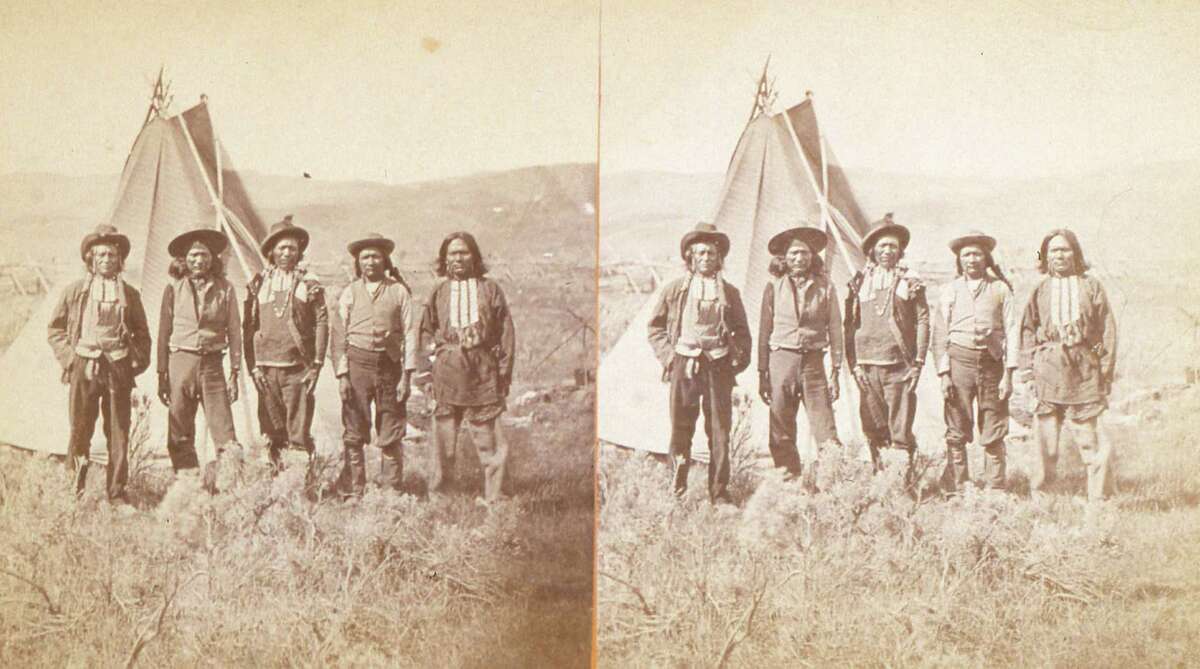
Controversy has dogged the Bear River Massacre from the first.
The event in question occurred when, on January 29, 1863, volunteer soldiers under Colonel Patrick Edward Connor attacked a Shoshoni camp on the Bear River, killing nearly three hundred men, women, and children. The bloody encounter culminated years of increasing tension between whites and the Shoshonis, who, faced with dwindling lands and food sources, had resorted to theft in order to survive. By the time of the battle, confrontations between the once-friendly Indians and the settlers and emigrants were common.
So it was that “in deep snow and bitter cold”
Connor set forth from Fort Douglas with nearly three hundred men, mostly cavalry, late in January 1863. Intelligence reports had correctly located Bear Hunter’s village on Bear River about 140 miles north of Salt Lake City, near present Preston, Idaho. Mustering three hundred warriors by Connor’s [p. 301] estimate, the camp lay in a dry ravine about forty feet wide and was shielded by twelve-foot embankments in which the Indians had cut firing steps. . . .
When the soldiers appeared shortly after daybreak on January 27 [sic], the Shoshonis were waiting in their defenses.
About two-thirds of the command succeeded in fording ice-choked Bear River. While Connor tarried to hasten the crossing, Major [Edward] McGarry dismounted his troops and launched a frontal attack. It was repulsed with heavy loss. Connor assumed control and shifted tactics, sending flanking parties to where the ravine issued from some hills. While detachments sealed off the head and mouth of the ravine, others swept down both rims, pouring a murderous enfilading fire into the lodges below. Escape blocked, the Shoshonis fought desperately in their positions until slain, often in hand-to-hand combat. Of those who broke free, many were shot while swimming the icy river. By mid-morning the fighting had ended.
On the battlefield the troops counted 224 bodies, including that of Bear Hunter, and knew that the toll was actually higher. They destroyed 70 lodges and quantities of provisions, seized 175 Indian horses, and captured 160 women and children, who were left in the wrecked village with a store of food. The Californians had been hurt, too: 14 dead, 4 officers and 49 men wounded (of whom 1 officer and 6 men died later), and 75 men with frostbitten feet. Even so, it had been a signal victory, winning Connor the fulsome praise of the War Department and prompt promotion to brigadier general.[1]
Controversies over the battle have tainted it ever since. For one thing, Chief Justice John F. Kinney of the Utah Supreme Court had issued warrants for the arrest of several Shoshoni chiefs for the murder of a miner. But critics have questioned whether the warrants could legally be served, since the chiefs were no longer within the court’s jurisdiction.[2] The legality of the federal writs was irrelevant, however, to Colonel Connor, commander of the California Volunteers at Camp Douglas. At the onset of his expedition against the Bear River band, he announced that he was satisfied that these Indians were among those who had been murdering emigrants on the Overland Mail Route for the previous fifteen years. Because of their apparent role as “principal actors and leaders in the horrid massacres of the past summer, I determined . . . to chastise them if possible.” He told U.S. marshal Isaac L. Gibbs that Gibbs could accompany the troops with his federal warrants if he wanted, but “it [p. 302] was not intended to have any prisoners.”[3] However—and this is another controversy—there have been many who have questioned whether Connor’s soldiers actually tangled with the guilty Indians.
Source: rsc.byu.edu
Share this:

John Lewis on the For the People Act: Voting Rights ~ In Memory
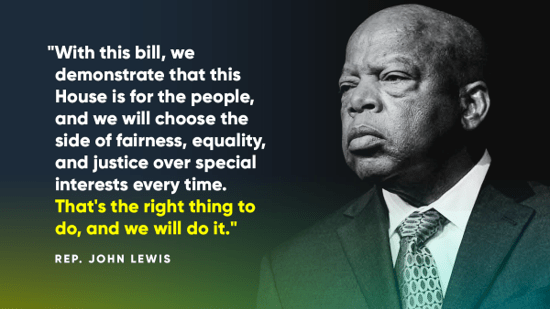
Those were Former Congressman John Lewis’s remarks advocating for the For the People Act (H.R. 1) just days before it passed the House. Almost two years ago.
That’s how long Mitch McConnell has refused to try and pass this bill — legislation that would reform redistricting and make our government work for the people, not the special interests.
With more pro-democracy senators now in Washington, there may be enough Senate votes to pass a new version of the bill Former Congressman Lewis spoke of — but it could come down to every last vote.
| CONTACT CONGRESS » |
Share this:

The 1917 Bath Riots
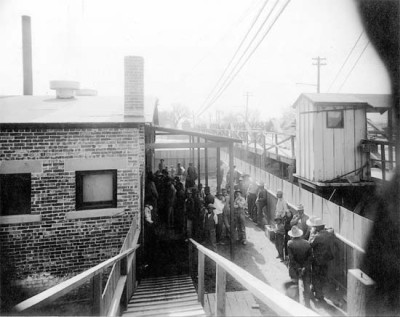
On Jan. 28, 1917, 17-year-old Carmelita Torres, who crossed the border daily from Juarez to clean houses in El Paso, refused to take a toxic disinfectant bath. Press accounts estimated that, by noon, she was joined by several thousand demonstrators at the border bridge. The protest became known as the “Bath Riots.”
By David Dorado Romo
Mexican border crossers were not considered illegal in the United States until 1917, when a new law imposed formidable barriers to entry: a literacy test, a head tax and a prohibition against contract labor. Mexican nationals for the first time needed a passport to enter the United States. That’s also the year that the U.S. entered World War I.
The war stirred deep feelings of paranoia and anti-foreigner patriotism in this country. Americans were afraid that Germans would launch bombing raids from Mexico. As a protest against Germany, Americans changed the name of frankfurters to hot dogs and sauerkraut to “liberty cabbage.” And to protect the country from the threat of typhus, U.S. Customs agents began the mandatory delousing of Mexican border crossers at the El Paso-Juarez international bridge; 127,000 people were subjected to this procedure in 1917 alone.
All immigrants from the interior of Mexico, and those whom U.S. Customs officials deemed “second-class” residents of Juarez, were required to strip completely, turn in their clothes to be sterilized in a steam dryer and fumigated with hydrocyanic acid, and stand naked before a Customs inspector who would check his or her “hairy parts” — scalp, armpits, chest, genital area — for lice. Those found to have lice would be required to shave their heads and body hair with clippers and bathe with kerosene and vinegar.
My great-aunt, Adela Dorado, would tell our family about the humiliation of having to go through the delousing every eight days just to clean American homes in El Paso. She recalled how on one occasion the U.S. Customs officials put her clothes and shoes through the steam dryer and her shoes melted
Source: zinnedproject.org

 Be a Seed for Change
You must be logged in to post a comment.