
If you’re located in an area with a strong Native American presence, consider partnering to create programs, products, fundraisers, or other offerings to honor local Native people.
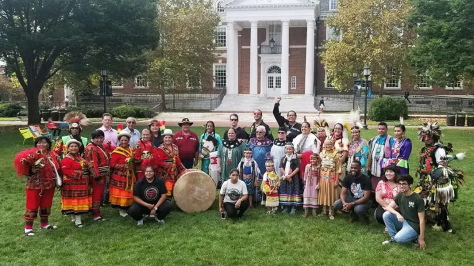

If you’re located in an area with a strong Native American presence, consider partnering to create programs, products, fundraisers, or other offerings to honor local Native people.

On this day in 1954, Ellis Island, the gateway to America, shuts it doors after processing more than 12 million immigrants since opening in 1892. Today, an estimated 40% of all Americans can trace their roots through Ellis Island, located in New York Harbor off the New Jersey coast and named… read more »
 1477 – William Caxton produced “Dictes or Sayengis of the Philosophres,” which was the first book to be printed in England.
1820 – Captain Nathaniel Palmer became the first American to sight the continent of Antarctica.
1865 – Samuel L. Clemens published “The Celebrated Jumping Frog of Calaveras County” under the pen name “Mark Twain” in the New York “Saturday Press.”
1883 – The U.S. and Canada adopted a system of standard time zones.
1903 – The U.S. and Panama signed a treaty that granted the U.S. rights to build the Panama Canal.
1916 – Douglas Haig, commander of the British Expeditionary Force in World War I, called off the Battle of the Somme in France. The offensive began on July 1, 1916.
1928 – The first successful sound-synchronized animated cartoon premiered in New York. It was Walt Disney’s “Steamboat Willie,” starring Mickey Mouse.
Disney movies, music and books
1936 – Germany and Italy recognized the Spanish government of Francisco Franco.
1942 – “The Skin of Our Teeth,” by Thornton Wilder opened on Broadway.
1959 – William Wyler’s “Ben-Hur” premiered at Loew’s Theater in New York City’s Times Square.
1966 – Sandy Koufax (Los Angeles Dodgers) announced his retirement from major league baseball.
1966 – U.S. Roman Catholic bishops did away with the rule against eating meat on Fridays.
1969 – Apollo 12 astronauts Charles “Pete” Conrad Jr. and Alan L. Bean landed on the lunar surface during the second manned mission to the moon.
1976 – The parliament of Spain approved a bill that established a democracy after 37 years of dictatorship.
1983 – Argentina announced its ability to produce enriched uranium for use in nuclear weapons.
1985 – Joe Theismann (Washington Redskins) broke his leg after being hit by Lawrence Taylor (New York Giants). The injury ended Theismann’s 12 year National Football League (NFL) career.
1987 – The U.S. Congress issued the Iran-Contra Affair report. The report said that President Ronald Reagan bore “ultimate responsibility” for wrongdoing by his aides.
1987 – CBS Inc. announced it had agreed to sell its record division to Sony Corp. for about $2 billion.
1988 – U.S. President Reagan signed major legislation provided the death penalty for drug traffickers who kill.
1993 – The U.S. House of Representatives joined the U.S. Senate in approving legislation aimed at protecting abortion facilities, staff and patients.
1993 – American Airlines flight attendants went on strike. They ended their strike only 4 days later.
1993 – Representatives from 21 South African political parties approved a new constitution.
1997 – First Union Corp. announced its purchase of CoreStates Financial Corp. for $16.1 billion. To date it was the largest banking deal in U.S. history.
2001 – Nintendo released the GameCube home video game console in the United States.
At exactly noon on this day, American and Canadian railroads begin using four continental time zones to end the confusion of dealing with thousands of local times. The bold move was emblematic of the power shared by the railroad companies. The need for continental time zones …read more

They sent their babies into a mob.
That’s what’s so impressive — and bewildering — about the parents of Ruby Bridges, Gail Etienne, Pam Foreman, Yolanda Gabrielle, Tessie Prevost and Leona Tate. Fifty years ago this week, they sent their babies — five first-graders and a kindergartner — to William Frantz Elementary and McDonogh No. 19 through a gauntlet of spewing and sputtering segregationists so committed to their backwardness that they assembled to yell obscenities at small children.
If the natural instinct of most parents is to protect their children from harm, how remarkable it is that the parents of Gail, Leona, Pam, Ruby, Tessie and Yolanda deliberately sent them into harm’s way. The girls were sometimes escorted through the hostile crowds by badge-wearing U.S. marshals, which put the protesters on notice that physical violence wouldn’t be tolerated. But those stony-faced federal officers couldn’t protect the girls from the insults being hurled at them. We can take some solace, though, that some of the language was too complex for the intended targets to understand.

Ruby Bridges, for example, taught one of her playmates a new chant she’d heard, and the girls jumped rope to it: “Two, four, six, eight, we don’t want to integrate.”

Nobody would have blamed the girls’ parents if they’d decided to protect their children from such hate-filled madness. Good people would have understood if the parents succumbed to a loving impulse to cover the girls’ eyes and ears and remove them from a campus where so many bigots had gathered to yell at them. Nobody would have blamed them. Which makes their decisions all the more worthy of praise. They didn’t have to buck against the status quo. They didn’t have to offer their children up for the integration experiment. But they did.
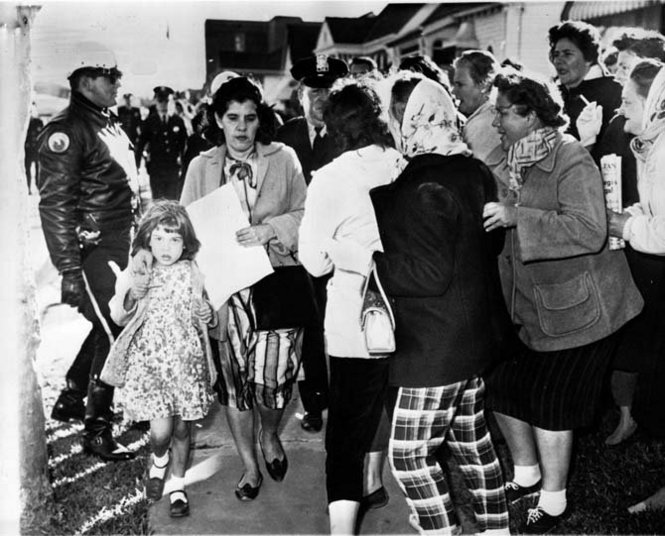
That goes for the black parents who sent their children to Frantz and McDonogh No. 19 and the parents of the two white girls who refused to succumb to mob-rule and enroll their children elsewhere. Pam’s father was a preacher and a war veteran who, according to the writer John Updike, “wasn’t going to let a mob of women tell him what to do.” Yolanda’s mother was initially afraid for the girl’s safety but kept her at Frantz because, she said, “It was the principle of the thing.”

“When there is to be a lynching the people hitch up and come miles to see it, bringing their wives and children. Really to see it? No — they come only because they are afraid to stay at home, lest it be noticed and offensively commented upon.”

New Orleans students are loaded onto buses to be transported to St. Bernard Parish, November 28, 1960, after McDonogh 19 school was integrated in September.
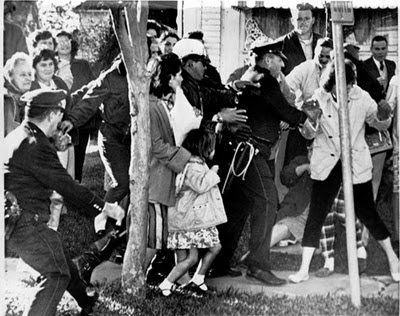
Children seemed to always be on the front lines in our country’s often bloody battle for civil rights. Not all of them wanted to be. The 1955 lynching of 14-year-old Emmett Till in Money, Miss., shocked the national conscience, and months later, Rosa Parks was refusing to budge from her seat on a Montgomery, Ala., bus. In September 1963, four little girls in Sunday School at Birmingham’s Sixteenth Street Baptist Church died when the Ku Klux Klan attacked their church with dynamite. The next year President Lyndon Johnson signed the Civil Rights Act.

And in 1960, six little girls in New Orleans — four black, two white — were sent by their parents into a hate-filled mob. What a heart-wrenching decision that must have been.
What a sad place this would be if they hadn’t made it. (source: The Times-Picayune)


 Be a Seed for Change
You must be logged in to post a comment.