no words …


 December 16, 1981 President Reagan promulgated Executive Order 12335, which established the National Commission on Social Security Reform. The Commission was created as a result of the continuing deterioration of the financial position of the Old-Age and Survivors Trust Fund and to made recommendations to assure the financial integrity of the Social Security System.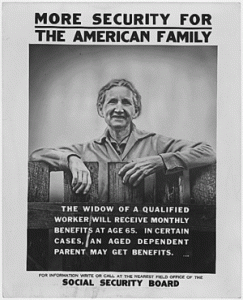


Tue, Dec 16, 4:00 PM PST to Wed, Dec 17, 10:00 AM PST
What
Southwest winds 20 to 30 mph with gusts up to 50 mph expected.
Where
Portions of northwest and west central Washington.
When
From 4 PM Tuesday to 10 AM PST Wednesday.
Impacts
Gusty winds could blow around unsecured objects. Tree limbs could be blown down and a few power outages may result.
Additional Details
Due to saturated grounds from previous heavy rain, expect more widespread impacts with these winds.
Summary
Use extra caution when driving, especially if operating a high profile vehicles. Secure outdoor objects.
Issued By
NWS Seattle WA
 1654 – A meteorological office established in Tuscany began recording daily temperature readings.
1791 – In the U.S., the first ten amendments to the Constitution, known as the Bill of Rights, went into effect following ratification by the state of Virginia.
1815 – Jane Austen’s “Emma” was published.
1840 – Napoleon Bonapart’s remains were interred in Les Invalides in Paris, having been brought from St. Helena, where he died in exile.
1854 – In Philadelphia, the first street cleaning machine was put into use.
1877 – Thomas Edison patented the phonograph.
1890 – American Sioux Indian Chief Sitting Bull and 11 other tribe members were killed in Grand River, SD, during an incident with Indian police working for the U.S. government.
1925 – The third Madison Square Gardens opened.
1938 – U.S. President Franklin D. Roosevelt presided over the ground-breaking ceremonies for the Jefferson Memorial in Washington, DC.
1939 – “Gone With the Wind,” produced by David O. Selznick based on the novel by Margaret Mitchell, premiered at Loew’s Grand Theater in Atlanta. The movie starred Vivien Leigh and Clark Gable.
1941 – U.S. President Franklin D. Roosevelt signed into practice Bill of Rights Day.
1944 – A single-engine plane carrying U.S. Army Major Glenn Miller disappeared in thick fog over the English Channel while en route to Paris.
1944 – American forces invaded Mindoro Island in the Philippines.
1944 – Dr. R. Townley Paton and a small group of doctors laid the groundwork for the Eye-Bank for Sight Restoration.
1961 – Former Nazi official Adolf Eichmann was sentenced to death in Jerusalem by an Israeli court. He had been tried on charges for organizing the deportation of Jews to concentration camps.
1961 – The U.N. General Assembly voted against a Soviet proposal to admit Communist China as a member.
1964 – Canada’s House of Commons approved a newly designed flag thereby dropping the Canadian “Red Ensign” flag.
1965 – Two U.S. manned spacecraft, Gemini 6 and Gemini 7, maneuvered within 10 feet of each other while in orbit around the Earth.
1966 – Walter Elias “Walt” Disney died in Los Angeles at the age of 65.
Disney movies, music and books
1970 – The Soviet probe Venera 7 became the first spacecraft to land softly on the surface of Venus. The probe only survived the extreme heat and pressure for about 23 minutes and transmitted the first data received on Earth from the surface of another planet.
1973 – J. Paul Getty III was found in southern Italy after being held captive for five months, during which his right ear was cut off and sent to a newspaper in Rome.
1978 – U.S. President Carter announced he would grant diplomatic recognition to Communist China on New Year’s Day and sever official relations with Taiwan.
1979 – The former shah of Iran, Muhammad Riza Pahlavi, left the United States for Panama. He had gone to the U.S. for medical treatment on October 22, 1979.
1979 – In a preliminary ruling, the International Court of Justice ordered Iran to release all hostages that had been taken at the U.S. embassy in Tehran on November 4, 1979.
1981 – The U.S. Congress passed $200 billion spending bill. At the time it was the largest in U.S. history.
1982 – Paul “Bear” Bryant announced his retirement as head football coach at the University of Alabama.
1982 – Gibraltar’s frontier with Spain was opened to pedestrian use after 13 years.
1983 – The last 80 U.S. combat soldiers in Grenada withdrew. It was just over seven weeks after the U.S.-led invasion of the Caribbean island.
1989 – An uprising in Romania began as demonstrators gathered to prevent the arrest of the Reverend Laszlo Tokes, a dissident clergyman.
1992 – IBM announced it would eliminate 25-thousand employees in the coming year.
1992 – Bettino Craxi, the leader of Italy’s Socialist Party, was informed that he was under investigation in a burgeoning corruption scandal in the northern city of Milan.
1992 – El Salvador’s government and leftist guerrilla leaders formally declared the end of the country’s 12-year civil war.
1993 – In Geneva, 117 countries completed the Uruguay Round of the General Agreement on Tariffs and Trade (GATT). The countries agreed on a reform package.
1993 – The prime ministers of Britain and the Republic of Ireland (John Major and Albert Reynolds respectively) made the “Downing Street Declaration,” stating the basis for trying to achieve peace in Northern Ireland.
1995 – The U.N. Security Council authorized NATO to take over the peacekeeping operations in Bosnia.
1995 – French rail workers voted to end a three-week-old strike.
1996 – Boeing Co. announced plans to pay $13.3 billion to acquire rival aircraft manufacturer McDonnell Douglas Corp.
1997 – The San Francisco 49ers retired Joe Montana’s number 16 during halftime of a game against the Denver Broncos.
1999 – Syria reopened peace talks with Israel in Washington, DC, with the mediation of U.S. President Clinton.
2000 – The Chernobyl atomic power plant in Kiev, Ukraine, was shut down.
2000 – New York Senator-elect Hillary Rodham Clinton agreed to accept an $8 million book deal with Simon & Schuster. The book was to be about her eight years in the White House. The advance was the highest ever to be paid to a member of the U.S. Congress.
2001 – It was announced that Siena Heights University would begin offering a class called “Animated Philosophy and Religion.” The two-credit class would cover how religion and philosophy are part of popular culture and is based on the television series “The Simpsons.”
2010 – The U.N. Security Council gave a vote of confidence to the government of Iraq when they lifted 19-year-old sanctions on weapons and civilian nuclear power.


 Be a Seed for Change
You must be logged in to post a comment.